Across the rural landscapes of Algeria, where fields stretch beneath dry winds and harvest time determines survival, stories have long been used to explain the balance between community, fairness, and consequence.
Among these stories, one figure appears often, the jackal.
Click here to explore more Central African folktales
Not as a simple animal, but as a trickster.
A survivor.
A creature whose intelligence often exposes the weaknesses of those who think only of themselves.
This is the story of a clever jackal and a farmer who forgot the meaning of sharing.
A Farmer with Full Granaries
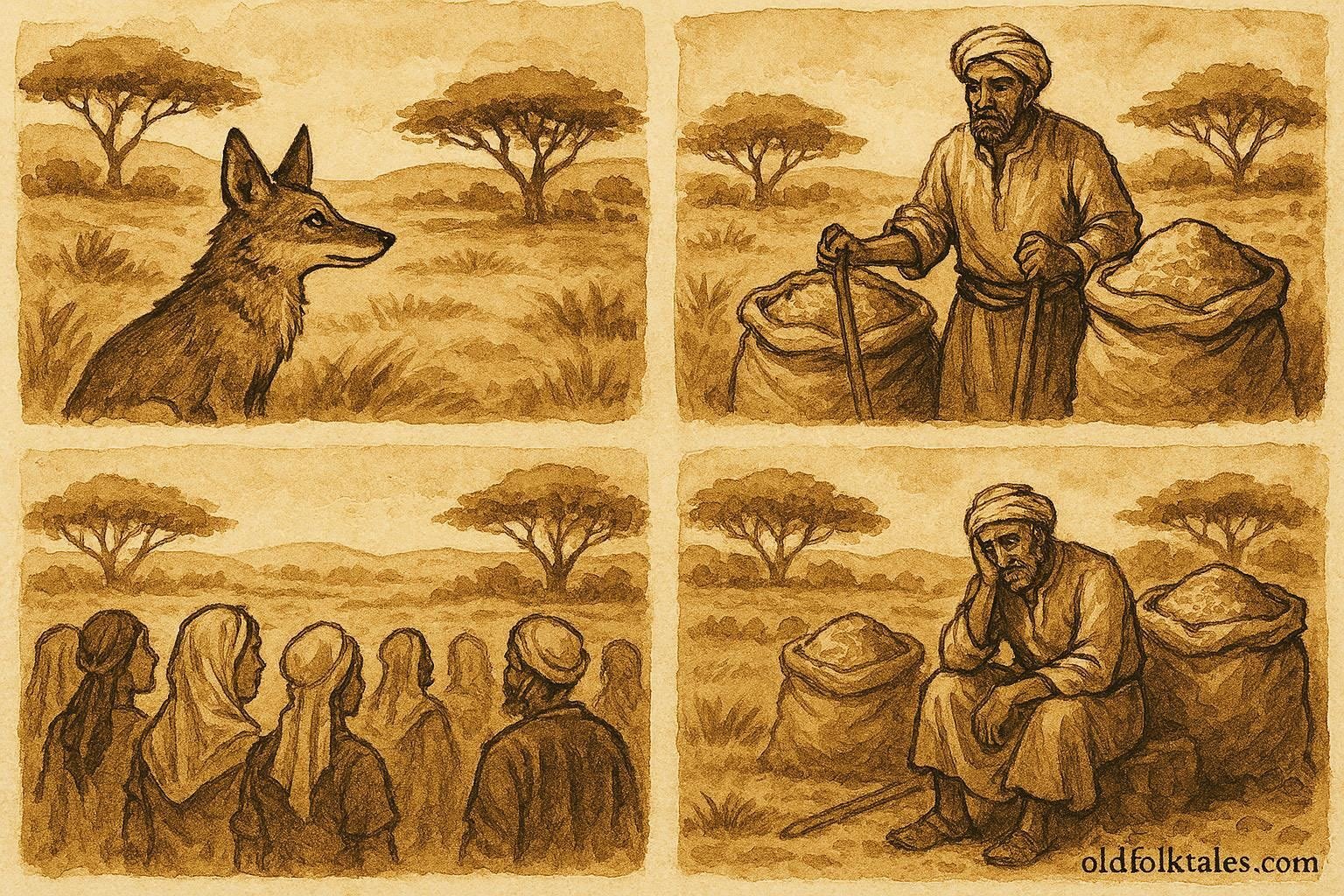
There was once a wealthy farmer who owned large fields filled with grain.
Each harvest season, his stores became fuller, his barns more crowded, and his pride grew alongside his wealth.
But despite his abundance, he was known for one thing above all else:
He did not share.
When neighbors struggled through poor harvests, he kept his doors closed.
When travelers passed hungry through the region, he turned them away.
“I worked for this,” he would say. “Why should others take what I have earned?”
Over time, people stopped asking.
And the farmer grew more convinced that his wealth belonged only to him.
The Hungry Jackal Arrives
In the same land lived a jackal.
Thin from hardship.
Sharp from survival.
He had learned that in a world of scarcity, intelligence mattered more than strength.
One evening, as hunger pressed heavily on him, he came across the farmer’s fields.
He watched the overflowing granaries.
He smelled the stored grain.
And he understood immediately:
There was enough here for many.
But only one man guarded it all.
The jackal sat quietly.
And began to think.
The First Encounter
That night, the jackal approached the farmer’s storage area.
He did not attack.
He did not force his way in.
Instead, he called out from the shadows.
“Honored farmer,” he said.
The farmer stepped outside, annoyed.
“Who speaks?”
“It is only a traveler,” the jackal replied, keeping his voice calm and respectful. “I am lost and hungry. I ask only for a small share of your grain.”
The farmer laughed.
“Leave my land,” he said. “I do not feed strangers.”
The jackal bowed slightly.
“Very well,” he said. “Then I thank you for your answer.”
And he disappeared into the night.
But he had already learned something important.
Not kindness.
But greed.
The First Trick
The next day, the jackal returned.
This time, he did not ask directly.
Instead, he spoke from a distance where the farmer could hear him clearly.
“I heard,” the jackal said loudly, “that this farm is blessed. That it gives more when generosity is shown.”
The farmer paused.
“What do you mean?” he called out.
The jackal replied, “It is said that those who share their harvest never lose it, but those who hoard it eventually find it disappears.”
The farmer scoffed.
“Superstitions,” he muttered.
But that night, he checked his stores twice.
Just in case.
The jackal noticed.
And smiled quietly.
The Second Trick
Days later, the jackal returned again.
This time, he approached in disguise, covering his scent with dust and moving slowly like a weary animal.
“I bring news,” he said.
The farmer narrowed his eyes.
“What news?”
“There are others in the valley,” the jackal said, “who have learned of your grain. They plan to take it while you sleep.”
The farmer became alarmed.
“Who told you this?”
“No one,” the jackal replied. “I only overheard whispers in the wind.”
Fear took root in the farmer’s mind.
That night, he stayed awake guarding his storage.
And while he watched carefully for invisible thieves…
He failed to notice the real one thinking.
The Farmer’s Growing Suspicion
After several nights of anxiety, the farmer became paranoid.
He began checking his grain repeatedly.
He began suspecting neighbors.
He began believing that everyone wanted what he had.
And in doing so, he became more isolated than ever before.
The jackal observed this change carefully.
Greed had not only made the farmer selfish.
It had made him afraid.
The Final Plan
One evening, the jackal returned one last time.
But this time, he did not ask for food.
He did not spread rumors.
He simply stood near the edge of the farm and spoke clearly.
“Farmer,” he called.
The farmer stepped out immediately, alert.
“You again,” he said. “What do you want?”
The jackal tilted his head.
“Only truth,” he said.
The farmer frowned.
“What truth?”
The jackal gestured toward the overflowing storage.
“You have more than you can use,” he said. “Yet you live as though you have nothing.”
The farmer crossed his arms.
“I own what I have earned.”
The jackal nodded.
“And yet,” he said calmly, “you do not own peace.”
The Exposure of Greed
The jackal then did something unexpected.
He began calling out loudly, not lies, not tricks, but observations.
He spoke of how much grain was stored.
He spoke of how little was shared.
He spoke of how neighbors struggled while one man guarded excess.
Soon, others nearby began to hear.
The farmer grew uncomfortable.
“What are you doing?” he demanded.
The jackal replied simply:
“Showing what is already known.”
And for the first time, the farmer realized something unsettling.
His wealth was no longer private.
It was visible.
And so was his greed.
The Change in the Village
Word spread.
People began to question the farmer’s behavior.
Not because the jackal forced them to.
But because the truth had been spoken aloud.
The farmer’s isolation grew, not through punishment, but through awareness.
He had not been robbed.
He had been revealed.
A Lesson Understood
Eventually, the farmer stood alone near his storage.
The jackal sat at a distance, watching quietly.
The farmer spoke, though no one had asked him to.
“I thought keeping everything would make me safe,” he said.
The jackal said nothing.
The farmer continued.
“But I see now… it only made me alone.”
A long silence followed.
Then the jackal replied softly:
“Even grain spoils when it is not shared.”
Aftermath
The farmer did not become generous overnight.
But something changed.
Slowly, he began to open his stores more often.
He began to share during hardship seasons.
And over time, his fear lessened.
The jackal, having achieved what he intended, did not return as often.
Not because he was gone.
But because he was no longer needed in the same way.
Fascinated by this tale? Discover more North African folktales
Moral Lesson
Greed isolates and weakens communities, while fairness and sharing restore balance. Intelligence can expose injustice, but true harmony comes from changing behavior.
Knowledge Check
- What is “The Clever Jackal and the Greedy Farmer” about?
It is an Algerian folktale about a jackal who outwits a greedy farmer who refuses to share his harvest. - Why did the jackal target the farmer?
Because the farmer hoarded food while others suffered from hunger. - How did the jackal trick the farmer?
He used clever words, warnings, and psychological manipulation to expose the farmer’s greed. - What theme does the story highlight?
It emphasizes greed versus wisdom and the importance of sharing in a community. - How was the farmer changed by the jackal’s actions?
He became aware of his greed and began to share his resources more openly. - What lesson does this folktale teach?
It teaches that selfishness leads to isolation, while fairness restores balance in society.
Source: African folktale, Algeria.
Adapted from oral tradition; documented in North African folklore collections compiled during French colonial ethnographic studies (1880s–1920s).
Cultural Origin: Algerian rural folklore (Maghreb oral traditions)