Across the vast Sahara Desert, where sand stretches beyond sight and the horizon shifts like a living thing, survival has always depended on more than strength.
It depends on knowledge.
Continue your journey: Read more East African folktales
It depends on respect.
And, as many desert traditions teach, it depends on understanding that not everything seen is all that exists.
Among the Tuareg and Arab-Berber communities of the Sahara, there are places spoken of in quiet tones, sacred wells believed to be guarded by unseen beings known as djinn.
This is the story of one such well.
And of a traveler who forgot that respect is part of survival.
A Journey Through Endless Sand
There was once a traveler crossing the Sahara alone.
He had traveled far from known routes, relying on his determination and stubborn belief that experience alone could guide him through the desert.
The heat was intense.
The wind carried fine sand that blurred distance and direction.
Days passed with little water and fewer landmarks.
Still, he continued.
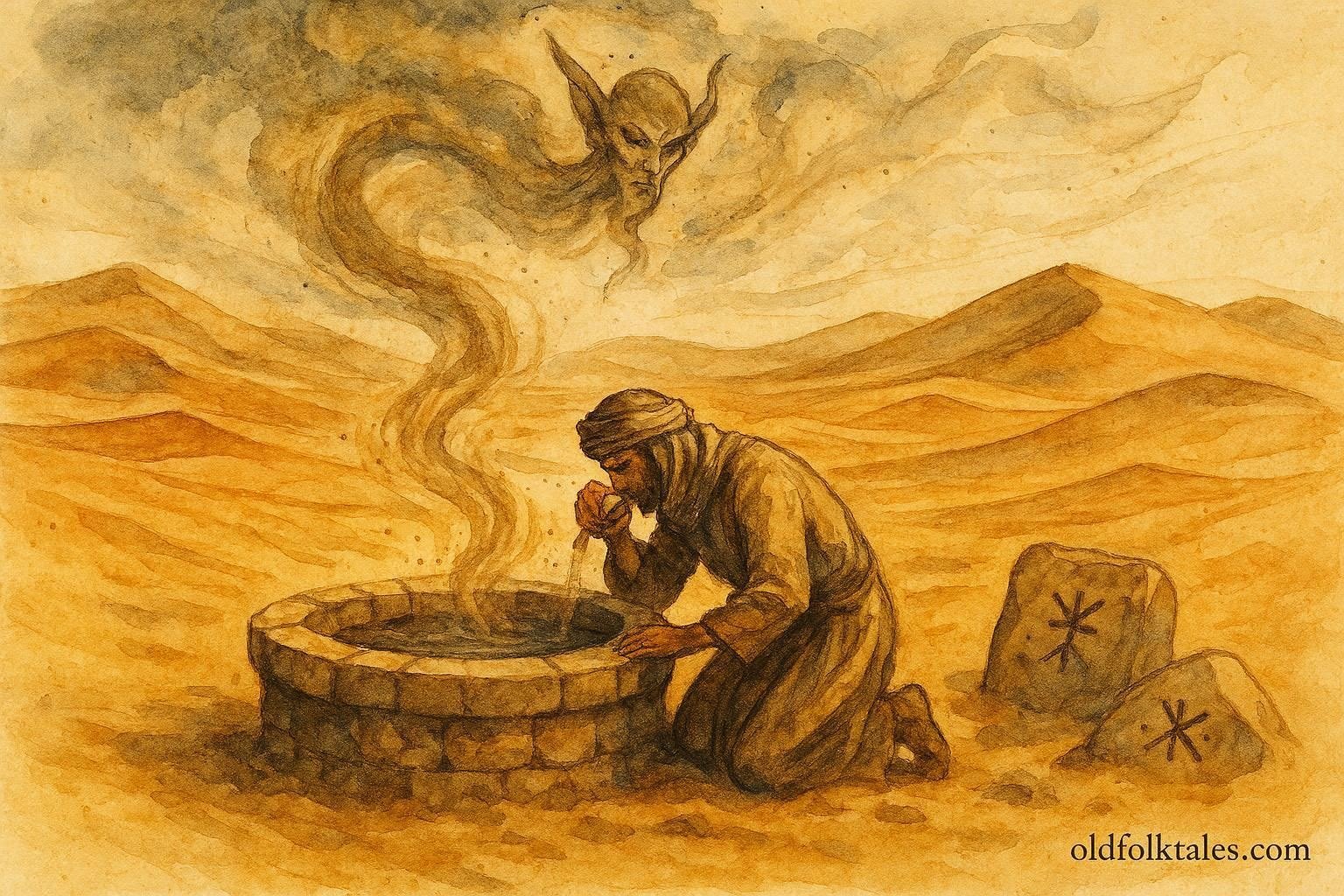
One evening, as exhaustion pressed heavily on him, he came upon a small cluster of rocks surrounding a well.
It was unexpected.
And in the desert, unexpected things are never simple.
Warnings of the Well
Near the well stood markings carved into stone, old symbols and warnings left by those who had passed before.
Local travelers would have understood immediately.
This was no ordinary water source.
It was a sacred place.
A well said to be guarded by a djinn.
Those who approached it with respect were said to find relief.
Those who approached with greed or disregard… did not always return unchanged.
The traveler, however, was too tired to care.
He saw only water.
And in the desert, water is everything.
The First Act of Disrespect
Without offering any greeting or acknowledgment, the traveler approached the well.
He lowered his container and drew water quickly.
He drank without pause.
Then filled his supply again.
There was no gratitude.
No hesitation.
Only relief.
As he finished, the air around him shifted slightly.
A subtle change.
The kind most would feel before they understand it.
But he did not notice.
He simply prepared to leave.
The Voice of the Unseen
As he turned away, the wind slowed.
The air grew still.
Then a voice spoke, not from above, nor from the ground, but from the space between silence and sound.
“You take without asking,” it said.
The traveler froze.
He looked around.
There was no one.
Only the well.
He stepped back cautiously.
“Who speaks?” he demanded.
The voice came again.
“This place is not empty.”
The traveler’s grip tightened.
“I needed water,” he said defensively. “I took only what I required.”
A long pause followed.
Then the voice replied:
“Need is not the same as respect.”
The Djinn Reveals Itself
The sand near the well stirred gently, though no wind had changed.
From the shifting ground and still air, a presence became known, not fully visible, but undeniably there.
The djinn of the well had revealed itself.
Not in anger.
But in awareness.
The traveler stepped back.
“I meant no harm,” he said quickly.
The djinn responded calmly.
“You acted as though nothing watches here.”
The traveler hesitated.
In the silence of the desert, that realization felt heavier than fear.
The Consequence Begins
The traveler attempted to continue his journey.
But as he moved away from the well, the landscape began to change in subtle ways.
Paths that seemed clear became uncertain.
Landmarks that should have guided him faded into shifting sand.
The wind no longer felt familiar.
He tried to retrace his steps.
But the desert did not respond as it once had.
It was as if the land itself had turned away.
Lost in the Desert
Hours became days.
The traveler wandered.
His water grew low.
His confidence weakened.
The well he had found earlier was nowhere to be seen again, no matter how he searched.
He began to understand something he had ignored:
The desert does not simply contain water.
It protects it.
And it does not forget how it is treated.
Realization in the Silence
As thirst deepened and exhaustion set in, the traveler finally stopped resisting.
He sat upon the sand, no longer walking in circles of frustration.
Instead, he reflected.
He remembered the warnings.
He remembered the markings.
He remembered the voice.
And for the first time, he understood that survival in the desert was not only about finding water.
It was about respecting where it came from.
The Act of Repentance
Weak and humbled, the traveler returned in thought to the well.
Not physically, but in intention.
He spoke aloud into the desert air.
“I did not respect what I took,” he said. “I treated the water as if it had no guardian. I understand now that I was wrong.”
The wind shifted gently.
Not violently.
Not dramatically.
But enough to be noticed.
The Return of Guidance
After some time, the traveler found himself once again near familiar terrain.
Or perhaps the desert had simply chosen to reveal the path again.
The well appeared once more in his journey.
He approached slowly this time.
Carefully.
He paused before taking any water.
And then, he spoke.
Not demands.
Not entitlement.
But acknowledgment.
“Peace be upon this place,” he said quietly.
The air remained still.
But no longer heavy.
He drank.
And for the first time since arriving, the desert did not resist him.
Balance Restored
The traveler did not take more than he needed.
He did not rush.
He did not ignore the signs around him.
And as he continued his journey, the desert once again became navigable.
Not because it changed.
But because he did.
The unseen presence did not disappear.
But it no longer stood against him.
It simply observed.
As it always had.
Explore the wisdom and wonder of North African folktales
Moral Lesson
In the natural world, respect is essential, even for what cannot be seen. Disregarding sacred balance leads to loss, while humility and acknowledgment restore harmony and guidance.
Knowledge Check
- What is “The Djinn of the Sahara Well” about?
It is a Saharan folktale about a traveler who disrespects a sacred well and faces consequences from a djinn. - What does the djinn represent in the story?
It represents unseen spiritual forces and the sacred nature of desert resources. - Why did the traveler become lost in the desert?
Because he disrespected the well and ignored warnings about its sacred nature. - How did the traveler find his way again?
Through repentance, humility, and respect for the unseen forces of the desert. - What theme is central to this folktale?
Respect for nature, spiritual balance, and consequences of disrespect. - What lesson does this African folktale teach?
It teaches that survival depends on humility and respect for both seen and unseen forces in nature.
Source: African folktale, Sahara Desert region.
Adapted from oral Bedouin and Tuareg storytelling traditions recorded by early 20th-century ethnographers (c. 1900–1935).
Cultural Origin: Saharan Algerian desert communities (Tuareg and Arab-Berber traditions)