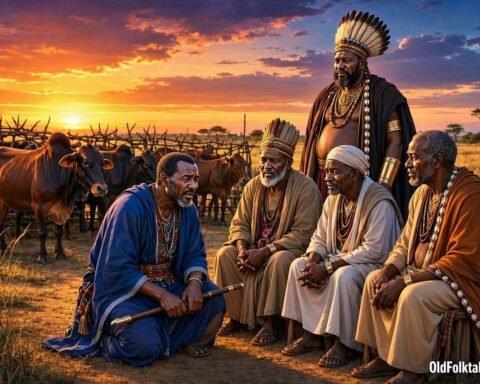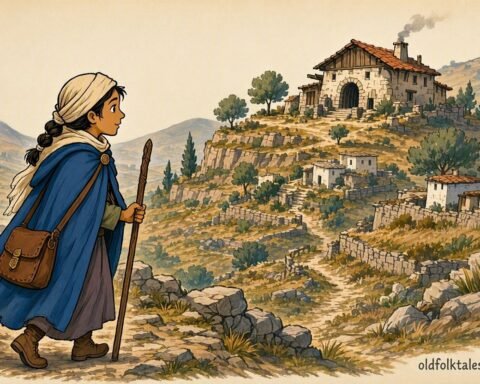
In the high Atlas Mountains of northern Algeria, where steep slopes meet wide skies and shepherds guide their flocks across rocky paths, life has always depended on trust.
Trust in the land.
If you liked this story, see our Central African folktales collection
Trust in the flock.
And most importantly, trust in oneself.
Among Berber and Arab pastoral communities, the mountains are not only geography, they are presence. They are believed to observe those who live within them, quietly testing character through hardship and solitude.
This is the story of a young shepherd, his disappearing sheep, and a truth the mountains would not allow him to ignore.
A Young Shepherd’s Duty
There was once a young shepherd who tended his family’s flock in the Atlas highlands.
Each morning, he guided the sheep from the village into open grazing lands. Each evening, he brought them back.
At first, his work was steady.
Simple.
Predictable.
But over time, something unusual began to happen.
The First Disappearance
One morning, the shepherd noticed that one sheep was missing.
He searched the nearby rocks and valleys.
He called out across the hills.
But there was no answer.
He returned home uneasy.
His family asked questions, but he had no explanation.
He blamed the terrain.
He blamed distance.
He did not yet blame himself.
The Pattern Begins
The following night, he made sure the flock was safe before resting.
But again, by morning, another sheep had disappeared.
Then another.
And another.
The shepherd grew anxious.
He began to feel that something unseen was taking them.
The villagers listened to his concerns but offered no answers.
Some said predators.
Some said coincidence.
But the shepherd felt something deeper.
Something intentional.
The Mountain’s Silence
One evening, as he sat alone watching his flock, he noticed something strange.
The air grew still.
The wind stopped moving.
And the mountains around him felt unusually present, as if watching.
He turned quickly.
There was no one.
But he no longer felt alone.
That night, he did not sleep.
The Hidden Presence
On the fourth night, the shepherd decided to stay awake.
He watched carefully as the sheep rested.
Hours passed in silence.
Then, just before dawn, he saw movement near the edge of the flock.
Not a predator.
Not a thief.
But something he could not fully explain.
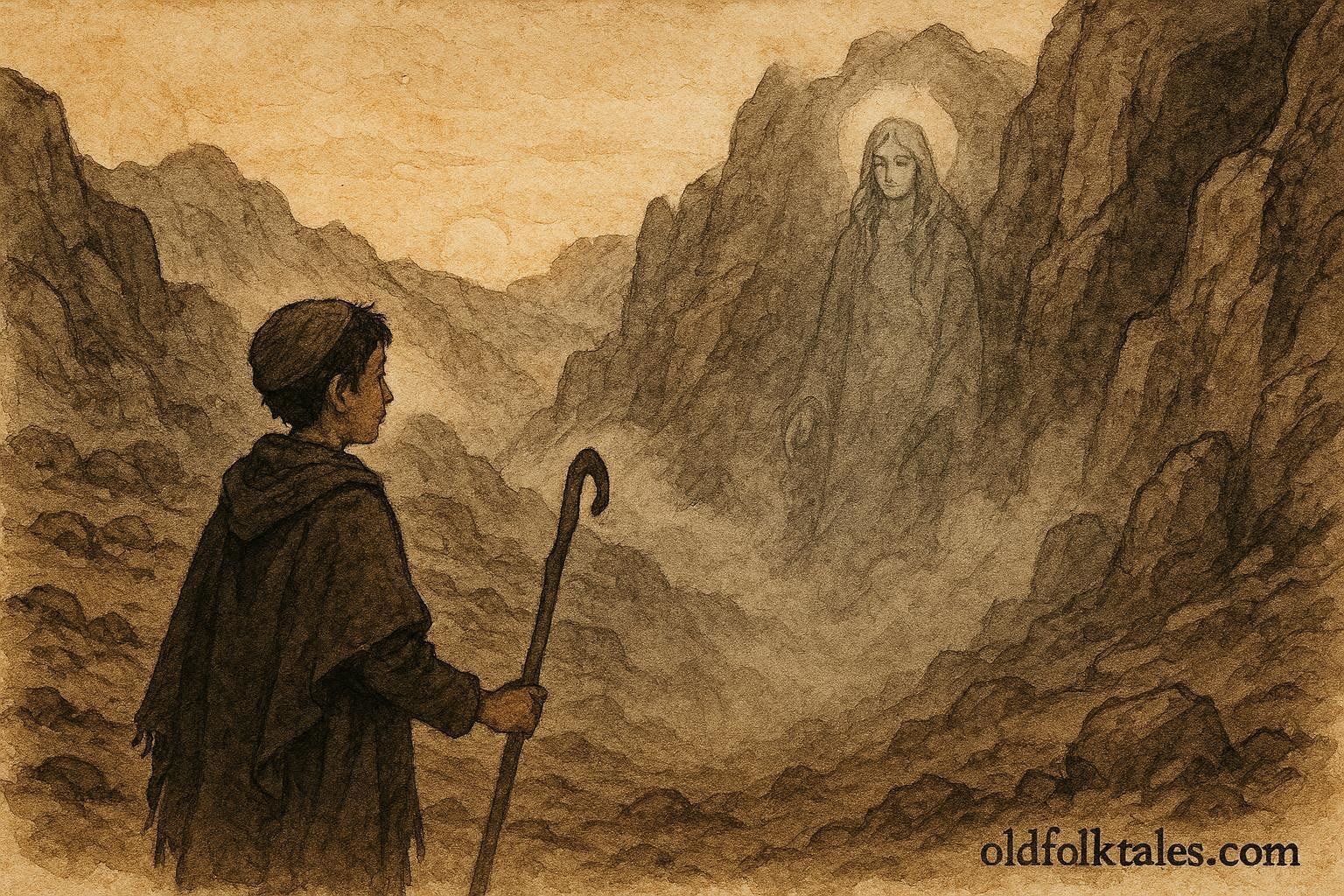
A presence emerged from the rocky slope, shaped by shadow and stone, yet alive in its own way.
The shepherd froze.
The mountain spirit had revealed itself.
The Test Begins
The spirit did not speak immediately.
It simply observed.
Then, in a voice that seemed to come from the earth itself, it said:
“Why do you lose what you are given to protect?”
The shepherd trembled.
“I do not know,” he admitted.
The spirit stepped closer, not physically, but in feeling.
“You do know,” it said. “But you do not speak it.”
The shepherd looked down.
Silence stretched between them.
The Truth He Avoided
Finally, the spirit spoke again.
“The sheep do not vanish without reason,” it said. “They are lost because they are not watched.”
The shepherd felt his chest tighten.
He understood what was being revealed.
He had been careless.
He had rested when he should have stayed alert.
He had neglected his responsibility.
But he had not admitted it, not even to himself.
The Moment of Honesty
The spirit waited.
The mountains waited.
The shepherd finally spoke.
“The fault is mine,” he said quietly. “I was not careful. I did not guard them as I should have.”
As soon as the words left his mouth, something changed in the air.
The tension eased.
Not because he was forgiven immediately.
But because truth had been spoken.
The Restoration
The spirit responded.
“Truth is the first step,” it said. “Responsibility must follow.”
The shepherd nodded.
That night, he stayed fully awake.
He guarded the flock with care.
He paid attention to every sound, every movement, every shadow.
And for the first time in many nights, no sheep disappeared.
The Return of the Flock
Over the following days, the shepherd remained vigilant.
The missing sheep did not return as individuals, but no more were lost.
The flock stabilized.
And slowly, trust returned to the rhythm of his work.
One morning, as he gathered the sheep, he felt the presence of the spirit again.
This time, it was not heavy.
It was quiet.
Observing.
Then it was gone.
A Changed Shepherd
The shepherd returned to his village with a different understanding.
He did not speak of monsters or invisible forces.
Instead, he spoke of responsibility.
Of attention.
Of honesty.
And of how admitting failure had been the beginning of recovery.
The elders listened.
And they nodded.
Because they understood what the mountains had always taught:
That truth is not punishment.
It is correction.
Fascinated by this tale? Discover more North African folktales
Moral Lesson
Responsibility requires honesty. When mistakes are acknowledged, they can be corrected, but denial only deepens loss. Truth restores balance and trust.
Knowledge Check
- What is “The Shepherd and the Disappearing Sheep” about?
It is an Algerian folktale about a shepherd whose sheep disappear and who is tested by a mountain spirit. - What caused the sheep to disappear?
The shepherd’s negligence and lack of attention to his responsibility. - Who was the mountain spirit in the story?
A supernatural presence representing moral testing and the voice of the mountains. - What lesson did the shepherd learn?
He learned to accept responsibility and practice honesty about his mistakes. - What theme is central to this folktale?
Truth, accountability, and respect for responsibility in pastoral life. - What lesson does this African folktale teach?
It teaches that acknowledging mistakes is the first step toward restoring balance and trust.
Source: African folktale, Algeria.
Adapted from oral Berber and Arab pastoral traditions collected in mid-20th-century ethnographic records (1940–1970).
Cultural Origin: Highland and rural Algerian shepherding communities (Atlas Mountain regions)