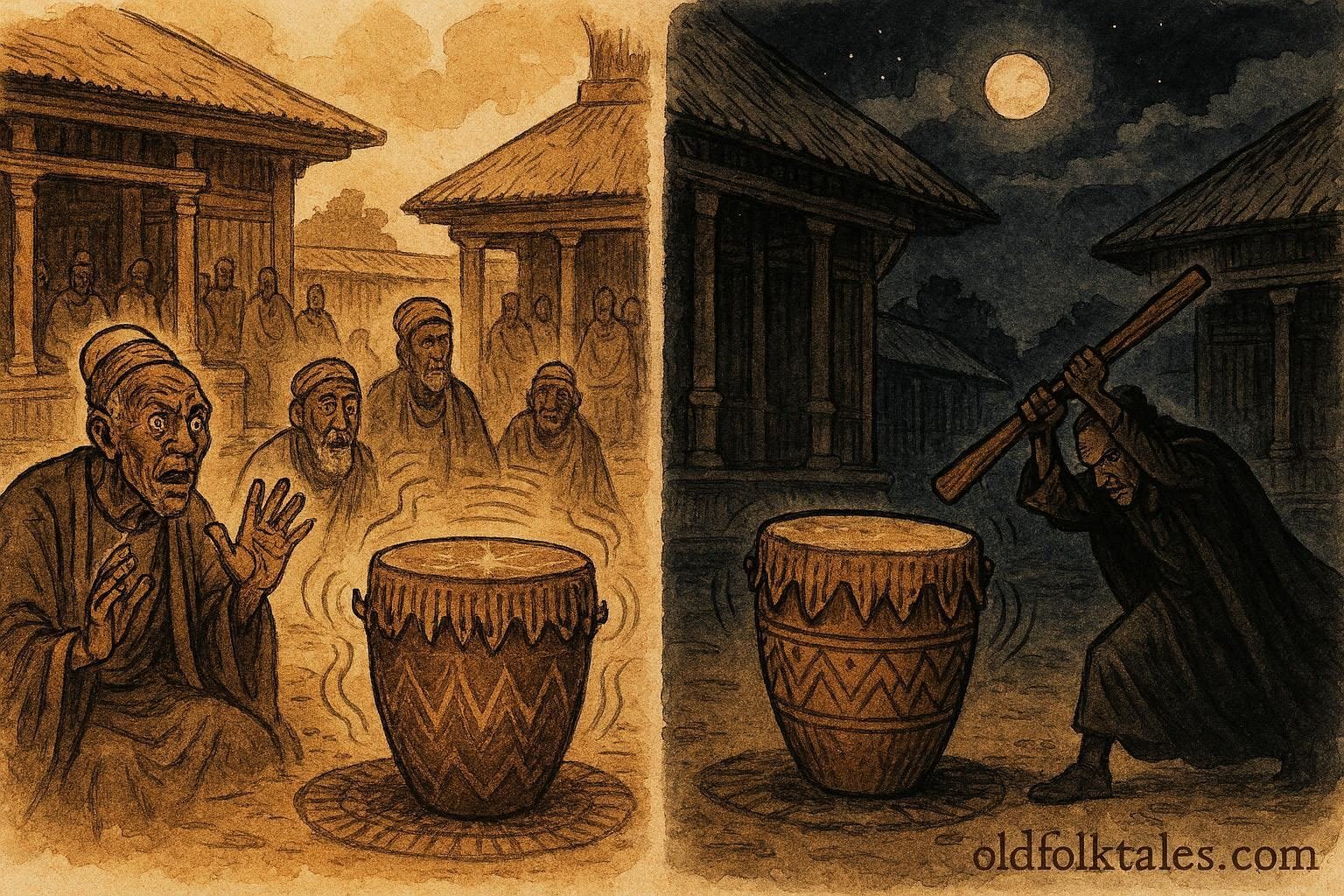
In the heart of the Buganda kingdom in central Uganda, where royal courts once shaped justice and tradition guided leadership, sacred objects were not merely ceremonial.
They were believed to carry authority.
Want more? Read more West African folktales now
Memory.
And sometimes, truth itself.
Among these sacred symbols stood the royal drum, an object treated with deep respect, believed to hold ancestral power tied to honesty and moral order.
This is the story of a drum that did not simply echo sound, but revealed truth.
A Drum of Royal Presence
In the royal court, the sacred drum was placed in a position of honor.
It was not struck lightly.
It was not used for entertainment.
It was reserved for ceremonies, gatherings, and moments of judgment.
The elders believed it carried the spirit of ancestral guidance, listening quietly to everything said in its presence.
And for a long time, it remained silent.
Watching.
Waiting.
The Beginning of Strange Events
One day, during a court gathering, a dispute was brought before the council.
Two men stood before the elders, each presenting conflicting accounts of the same event.
The atmosphere was tense.
The court listened carefully.
But as one man spoke, something unusual happened.
The drum vibrated softly.
Not from being struck.
But as if responding.
A faint sound emerged.
Not rhythm.
Not music.
But a deep, resonant tone that echoed through the courtyard.
The First Revelation
The elders fell silent.
The accused man continued speaking, unaware of what had just occurred.
But the drum had reacted.
And those who understood its symbolism grew uneasy.
When the other man spoke, the drum remained still.
It did not respond.
The elders exchanged glances.
And slowly, a pattern began to form.
The Drum’s Voice Emerges
As more cases were brought before the court, the same phenomenon repeated.
Whenever truth was spoken, the drum remained calm.
But whenever deception entered the discussion, the drum would respond.
A low vibration.
A deep sound.
As if the object itself rejected falsehood.
The court began to change.
People became more careful with their words.
Corruption became harder to hide.
And justice, once uncertain, became clearer.
A Council Member’s Fear
Among those observing the growing influence of the drum was a council member.
He had once used his position to influence decisions quietly.
Not always with honesty.
And as the drum continued to reveal inconsistencies, he became increasingly uneasy.
Because truth, once awakened, does not choose whom it exposes.
It simply responds.
Attempts to Silence the Truth
The council member began to argue that the drum was causing disorder.
He claimed it was superstition.
He suggested that reliance on the drum weakened human judgment.
But privately, he feared something else:
That his own past decisions might be exposed.
So, he proposed something drastic.
“The drum should be removed,” he said.
Some agreed.
Others hesitated.
But the elders refused.
Because they understood what the drum represented:
Not magic.
But accountability.
The Final Court Gathering
During a major court session, a case involving land ownership was presented.
The council member himself spoke during the proceedings, attempting to guide the judgment.
As he spoke, the drum vibrated strongly.
More intensely than before.
The court fell silent.
Again, he tried to justify his position.
Again, the drum responded.
The truth of his inconsistency was becoming visible to everyone present.
And this time, it could not be ignored.
The Attempt to Destroy the Drum
Fearing exposure, the council member made a desperate decision.
Under the cover of night, he attempted to destroy the sacred drum.
But as he approached it, something unusual occurred.
The air around the drum felt heavy.
The courtyard was silent.
And though no one physically stopped him, he hesitated.
It was as if the weight of consequence itself pressed against his actions.
Still, fear pushed him forward.
He struck the drum.
The Consequence of the Act
The next morning, the court gathered.
The drum was damaged.
But something had changed.
Instead of silence, the absence of the drum created discomfort.
Truth no longer had a symbolic voice.
And without it, confusion returned.
Disputes became harder to resolve.
Dishonesty spread quietly again.
And the balance that had been restored began to weaken.
Restoring Order
The elders understood what had been lost.
They did not punish the drum.
Instead, they reflected on what it represented.
They rebuilt it carefully.
With ritual.
Respect.
And renewed understanding.
When it was finally restored, the court gathered once more.
And when truth was spoken again, the drum responded once more.
Not louder.
But clearer.
The Lesson Remembered
The council member was removed from his position.
Not by force.
But by loss of trust.
The people understood that leadership requires accountability.
And that when truth is ignored, systems weaken.
From that time onward, the drum remained a symbol, not of supernatural power, but of moral responsibility.
Looking for more? Explore the magic of East African folktales here
Moral Lesson
Truth strengthens justice, while deception weakens leadership. Societies thrive when accountability is respected and corruption is confronted, not hidden.
Knowledge Check
- What is “The Drum That Spoke the Truth” about?
It is a Buganda folktale about a sacred drum that reveals lies during court proceedings. - What does the drum symbolize?
It symbolizes truth, accountability, and moral justice in leadership. - How did the drum expose corruption?
It vibrated or responded whenever deception was spoken in court. - Why did the council member try to destroy the drum?
Because he feared being exposed for dishonest behavior. - What theme is central to the story?
Truth, justice, and leadership accountability. - What lesson does this African folktale teach?
It teaches that truth strengthens governance and corruption cannot survive accountability.
Source: African folktale, Uganda.
Adapted from Buganda kingdom oral tradition preserved in court history narratives and ethnographic studies of royal symbolism (1920s–1970s; pre-colonial oral preservation).
Cultural Origin: Buganda kingdom oral tradition (Central Uganda)