In the ancient city of Kairouan, where sunbaked walls glowed golden at dusk and the call to prayer drifted softly across narrow streets, there lived a poor man and his daughter. Their home stood at the edge of the city, modest and worn, its clay walls cracked by years of heat and wind. Yet within that humble dwelling lived something far more valuable than wealth, sharp intelligence and quiet dignity.
The man was known for his honesty. He owned little, but he worked diligently, earning just enough to feed himself and his daughter. The girl, though young, possessed a mind that seemed to shine brighter than the desert sun. She listened carefully, observed deeply, and spoke only when her words carried weight. People who encountered her often left surprised, for wisdom seemed to sit naturally upon her, like a crown she never needed to claim.
Click here to discover more legendary tales from West Africa
Despite their peaceful life, hardship came one year when the rains failed and work became scarce. The man struggled to provide, and desperation led him to seek help from the local judge—a man known less for justice and more for his appetite for power and gain.
The judge lived in a large house adorned with carved doors and shaded courtyards, a stark contrast to the simplicity of the poor man’s life. When the man approached him, humbly asking for assistance, the judge saw not a man in need, but an opportunity.
“I will help you,” the judge said slowly, his voice smooth but calculating, “but only if you agree to a condition.”
The man, already burdened by worry, hesitated. “What condition, my lord?”
The judge leaned forward. “If you fail to repay what I give you, your daughter will come to serve in my household.”
The words hung heavy in the air. The man’s heart tightened, but hunger and desperation clouded his judgment. Believing he had no other choice, he agreed.
When he returned home and told his daughter what had transpired, her calm expression did not falter, though her eyes sharpened with understanding.
“You should not have agreed so quickly,” she said gently. “But do not worry. We will not fall into his trap.”
Days passed, and as expected, the man found it impossible to repay the judge. The debt loomed over them like a gathering storm. Soon enough, a summons came, calling them to appear before the judge.
The courtroom was filled with townspeople. Some came out of curiosity, others out of concern, for many had suffered under the judge’s decisions but lacked the courage or means to challenge him.
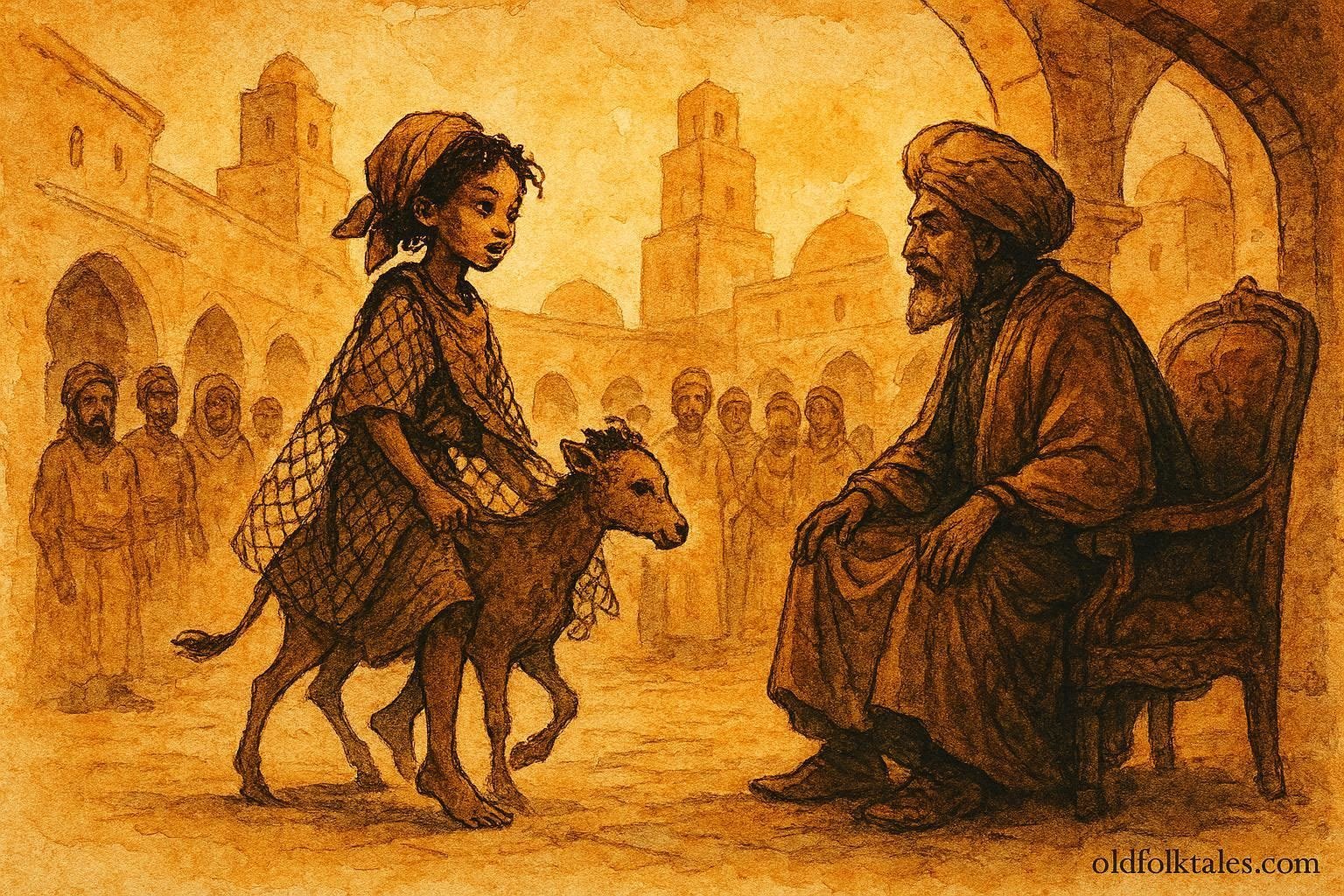
The judge sat high on his seat, his robes flowing, his face arranged in a mask of authority.
“You have failed to repay your debt,” he declared. “Therefore, the agreement must be honored.”
The father bowed his head in silence. But before he could speak, the girl stepped forward.
“My lord,” she said, her voice steady, “may I ask for a fair chance to resolve this matter?”
The judge raised an eyebrow, amused. “And what could a child possibly offer in such a situation?”
“A test,” she replied. “If I succeed, my father’s debt is forgiven. If I fail, I will go with you willingly.”
Murmurs spread through the room. The judge, confident in his position, agreed, believing the outcome certain.
“Very well,” he said. “But the test will be mine to set.”
The girl inclined her head. “As you wish.”
The judge paused, then spoke with deliberate cunning. “You must come to me neither dressed nor undressed, neither walking nor riding, neither by day nor by night. If you succeed, I will forgive the debt. If not, you will serve in my house.”
The crowd fell silent. The challenge seemed impossible, a trap disguised as a game.
But the girl simply nodded. “I accept.”
That evening, she prepared carefully. She thought not of fear, but of the meaning hidden within the judge’s words. Each condition, she realized, was meant to confuse, but within confusion lay opportunity.
At dawn the next day, just as the sky balanced between darkness and light, she set out.
She wrapped herself loosely in a fishing net, so that she was neither fully clothed nor entirely bare. She rode upon a small animal, but one that kept her feet brushing the ground, so she was neither fully riding nor completely walking. And she arrived at that fleeting moment between night and day, when the world itself could not decide what it was.
When she entered the courtyard, the judge’s confident expression faltered.
The crowd, gathered once more, erupted in whispers.
“She has done it,” some said.
“She has answered every condition,” others murmured.
The judge struggled to maintain composure. “This is… clever,” he admitted. “But I am not yet satisfied.”
The girl met his gaze calmly. “Then perhaps, my lord, you will allow me to ask you a question in return.”
The judge hesitated but nodded, determined not to lose face before the crowd.
“Speak.”
She stepped forward, her voice clear and unwavering.
“If a man sets a trap with words meant to deceive, is he a judge of justice or a servant of greed?”
The question struck deeper than any accusation. The courtroom fell silent, every eye fixed upon the judge.
He shifted in his seat. For the first time, uncertainty crept into his expression.
“You dare question me?” he said, though his voice lacked its earlier certainty.
“I do not question your authority,” she replied. “Only your fairness. A judge’s duty is to protect the weak, not to exploit them.”
Her words stirred something among the people. Faces that had once been passive now showed quiet agreement.
The judge looked around and saw that the tide had turned. To persist would not only expose him further but risk his standing entirely.
At last, he raised his hand.
“The debt is forgiven,” he declared.
Relief washed over the father, but the girl remained composed.
“And let it be known,” the judge added, attempting to reclaim dignity, “that justice has been served.”
But everyone present knew the truth, that justice had not come from the seat of power, but from the courage and intelligence of a young girl.
From that day forward, her story spread throughout Kairouan and beyond. She became a symbol of wisdom, a reminder that authority without fairness is hollow, and that even the smallest voice can challenge injustice when guided by truth.
Fascinated by this tale? Discover more North African folktales
Moral Lesson
True justice does not depend on power or position but on fairness, wisdom, and courage. Intelligence and moral strength can overcome even the most oppressive authority.
Knowledge Check
- Who is the main character in The Clever Girl of Kairouan?
The main character is a brilliant young girl who uses her intelligence to protect her father and challenge injustice. - What challenge did the judge give the girl?
The judge asked her to appear neither dressed nor undressed, neither walking nor riding, and neither by day nor night. - How did the girl solve the judge’s riddle?
She cleverly fulfilled all conditions by wearing a net, arriving at dawn, and traveling in a way that was neither fully walking nor riding. - What does the judge represent in the story?
The judge symbolizes corrupt authority and the misuse of power for personal gain. - What themes are highlighted in this Tunisian folktale?
Key themes include justice, cleverness, moral courage, and the empowerment of intelligence over authority. - What is the cultural significance of this story?
It reflects North African values of wisdom, fairness, and respect for intellect, especially within oral storytelling traditions.
Source: African folktale, Tunisia. Adapted from North African oral storytelling traditions documented in regional folklore collections such as Tales of the Maghreb (20th-century compilations, c. 1960s–1980s).
Cultural Origin: Tunisian / Maghrebi Arab-Berber oral tradition