In the height of the Ashanti Kingdom’s power, the city of Kumasi stood at the center of wealth, trade, and royal authority. Traders traveled from distant regions carrying ivory, cloth, kola nuts, leather, salt, and precious metals. The markets overflowed with movement from sunrise until evening, and the roads leading into the city remained busy throughout the seasons.
But above all else, gold shaped the life of Kumasi.
Gold dust was used in trade, royal ceremonies, taxation, and gifts between powerful families. Wealthy merchants carried small leather pouches filled with carefully measured gold dust, while royal officials maintained strict systems to ensure fairness in every major transaction.
To protect the kingdom from dishonesty, the Ashanti court appointed respected officials known as the royal gold weighers.
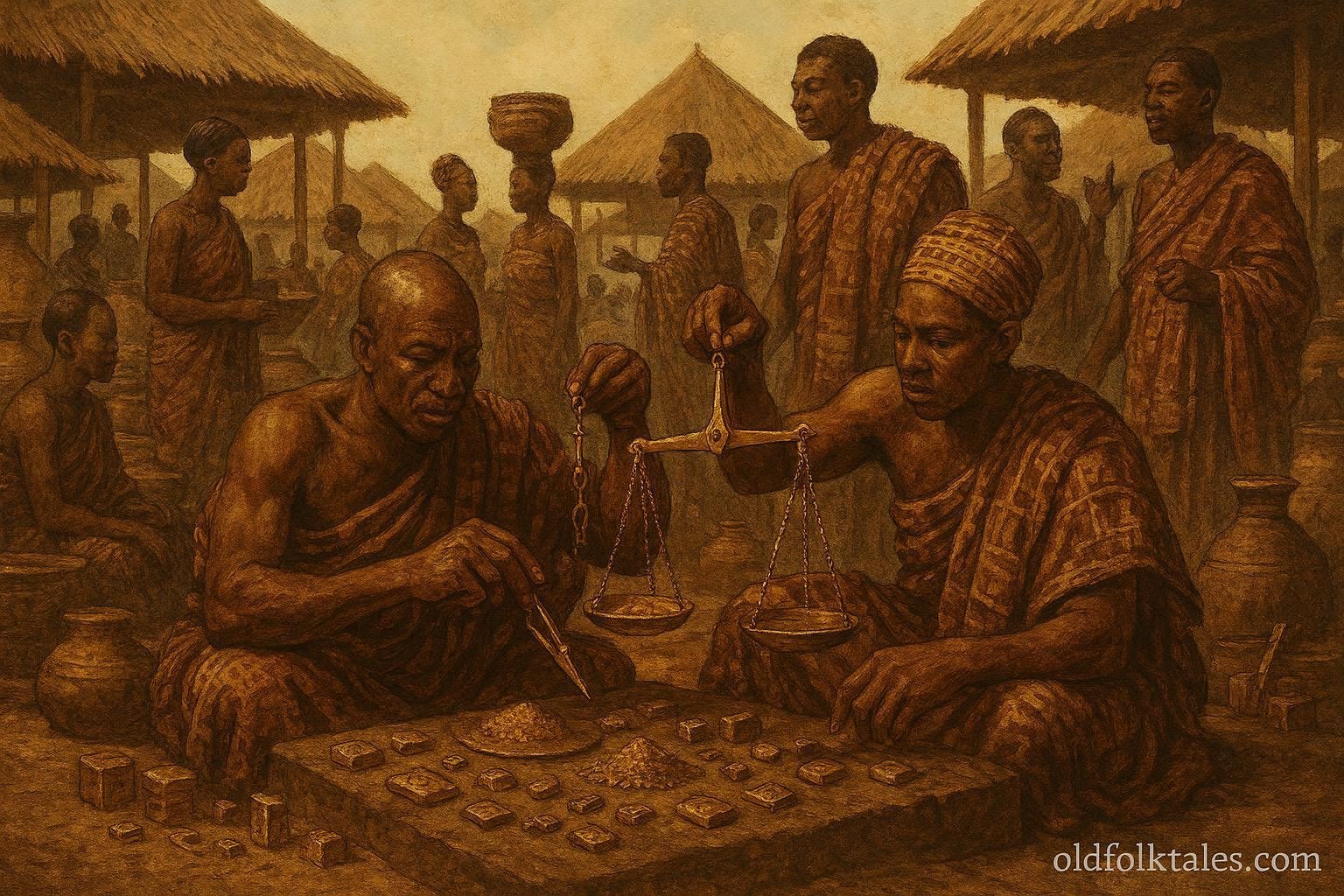
These men carried delicate weighing scales and beautifully crafted brass weights of different sizes. Every weight represented approved standards recognized throughout the kingdom. Merchants trusted the gold weighers because trade depended entirely on accuracy. Even a small imbalance could create conflict between buyers and sellers.
Keep reading: Discover more Central African folktales
Among the royal gold weighers, none was more respected than a man named Kwame Denteh.
Kwame had spent many years serving the royal court. He was known for his patience, discipline, and sharp attention to detail. Younger weighers often trained under him before receiving their own responsibilities in the market.
People admired him because he valued honesty more than wealth.
“Gold loses its value when trust disappears,” he often reminded his apprentices.
For many years, trade in Kumasi flourished peacefully.
Then strange complaints began to spread through the market.
Some merchants claimed they were losing gold during exchanges even when measurements appeared correct. Others accused rival traders of using false weights during private transactions. Arguments increased between buyers and sellers. Suspicion quietly moved through the marketplace like smoke.
At first, many people dismissed the complaints as ordinary trade disputes.
But Kwame paid close attention.
One afternoon, a trader from the northern caravan routes approached the royal weighing house carrying a small pouch of gold dust.
“I have traded across many kingdoms,” the merchant said carefully, “but something is wrong in Kumasi.”
Kwame listened silently as the trader explained how his gold seemed to lose value after several exchanges inside the market. According to him, the measurements used by certain traders produced inconsistencies too small for ordinary people to notice immediately.
Kwame examined the trader’s weights and scales personally.
Everything appeared normal.
Yet the complaints continued growing over the following weeks.
Eventually, the chief’s court ordered Kwame and several trusted weighers to investigate the matter quietly. The court feared public panic could damage confidence in the kingdom’s markets.
Kwame began visiting different sections of Kumasi disguised as an ordinary trader. He observed transactions closely while pretending to purchase goods himself. During these visits, he noticed a troubling pattern.
Some traders insisted on using their own weighing sets instead of official market weights.
At first glance, the differences appeared insignificant.
But Kwame’s trained eyes recognized subtle irregularities.
Certain brass weights had been slightly altered.
Some were hollowed carefully from beneath.
Others carried hidden metal fillings that changed their balance.
The modifications were almost impossible for ordinary traders to detect.
Kwame realized someone had created a secret system of fraudulent weights designed to steal small amounts of gold during every transaction. Individually, the losses seemed minor. But across hundreds of exchanges, enormous wealth was being stolen from merchants throughout Kumasi.
The discovery shocked him deeply.
Trade was the lifeblood of the kingdom. If trust collapsed inside the markets, the reputation of Kumasi itself could suffer.
Kwame reported his findings privately to the royal court.
The chief listened carefully while court officials examined the altered weights placed before them.
“This corruption spreads wider than we imagined,” one elder admitted.
The court ordered the investigation to continue in complete secrecy.
For several weeks, Kwame and his assistants traced the movement of suspicious weights through different trading districts. Slowly, they uncovered a hidden network involving dishonest merchants, metalworkers, and middlemen who profited from manipulated transactions.
Some members of the network had become wealthy very quickly.
Large homes appeared in unexpected places. Expensive cloth and imported goods were displayed openly by people whose businesses once struggled. Yet fear prevented many ordinary traders from speaking publicly against them.
Kwame understood the danger of confronting the network too early.
Instead, he prepared carefully.
The annual market festival approached, bringing traders from many regions into Kumasi. During this period, public weighing ceremonies were held before large crowds to demonstrate fairness and royal authority in commerce.
Kwame believed this would be the perfect moment to expose the corruption.
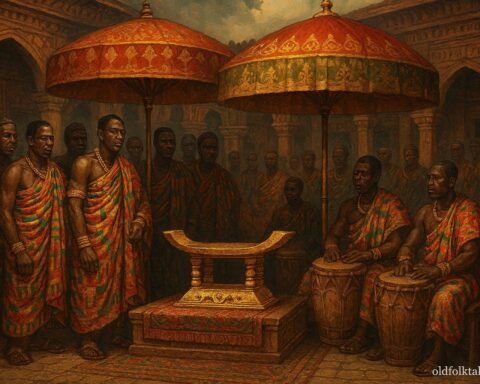
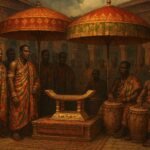
On the morning of the festival, the marketplace overflowed with activity. Drumming echoed through the city while traders arranged goods beneath decorated stalls. Royal guards stood near the weighing grounds as important officials gathered beneath ceremonial umbrellas.
Kwame entered the market carrying a wooden chest.
Inside were both official royal weights and the fraudulent versions discovered during the investigation.
At the chief’s command, several respected merchants stepped forward to participate in a public demonstration.
Kwame began weighing gold dust carefully using the approved royal measures. Then he repeated the same transactions using the altered weights seized from corrupt traders.
The differences quickly became visible.
Gasps spread through the crowd as people realized how easily dishonesty had entered the market system.
Some merchants immediately recognized the fraudulent weights.
Others lowered their heads in shame.
Then royal guards brought forward several traders already identified during the investigation. Fear spread across their faces as the crowd understood the truth.
The chief rose slowly before the gathered market.
“Wealth without honesty destroys a kingdom,” he declared firmly. “Trade survives only where trust survives.”
The corrupt network was dismantled, and strict new protections were introduced throughout the markets of Kumasi. Every official weight in the kingdom was reexamined and certified publicly before witnesses.
As for Kwame Denteh, his reputation grew even stronger after the investigation.
But despite the praise he received, he remained humble.
One evening, an apprentice asked him why he cared so deeply about such small measurements.
Kwame lifted one of the brass weights gently into his hand.
“A kingdom is not destroyed only by war,” he replied. “Sometimes it is destroyed grain by grain, lie by lie, until trust disappears completely.”
The apprentice never forgot those words.
Years later, the story of the gold weighers became part of Ashanti oral tradition, reminding future generations that fairness and accountability protect not only wealth, but the stability of society itself.
And throughout Kumasi, traders continued to respect the careful balance of the scales, knowing that honesty carried value greater than gold.
Want more? Read more West African folktales now
Moral Lesson
A society cannot prosper when dishonesty replaces trust and fairness.
Knowledge Check
- Why were gold weighers important in Kumasi?
They ensured fairness and accuracy during trade transactions. - Who was Kwame Denteh?
He was a respected royal gold weigher in the Ashanti Kingdom. - What problem spread through the markets?
Fraudulent traders used altered weights to steal gold during exchanges. - How did Kwame investigate the corruption?
He secretly observed transactions and examined suspicious weighing sets. - Why was the public demonstration important?
It exposed the corruption before merchants and royal officials. - What lesson did the Ashanti people learn?
Trust and honesty are necessary for trade and social stability.
Source
Ghanaian historical folklore. Adapted from Akan trade traditions documented in Ashanti economic history archives and historical studies.