Long ago among the green hills and river valleys of Madagascar, the Betsileo people told stories about hidden worlds existing beside ordinary human life. Rivers, waterfalls, lakes, and deep pools were believed to carry spiritual presence older than memory itself. Many communities respected the waters carefully, believing unseen beings lived beneath the surface and occasionally crossed into the human world.
Among these beings were the water spirits.
Some were described as protectors of rivers and springs. Others were feared for drawing careless travelers into the depths. Elders taught children never to mock sacred waters or disturb quiet pools without permission from the ancestors.
One of the most famous legends connected to these beliefs was the story of Ranoro.
According to oral tradition, Ranoro was not entirely human.
She belonged partly to the mysterious world beneath the water.
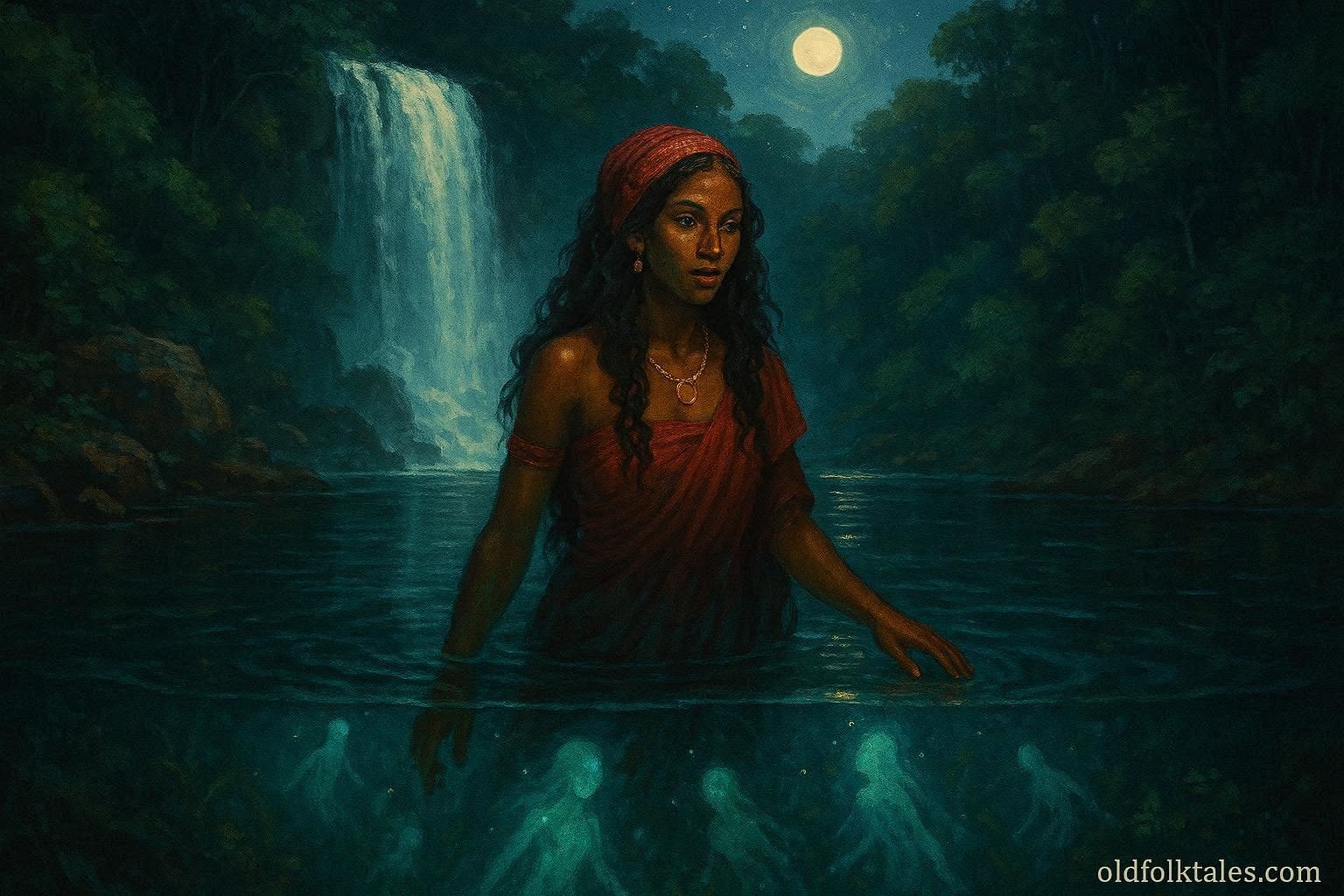
The story began in a quiet Betsileo village surrounded by rice fields and flowing streams. Near the village stood a deep pool fed by a waterfall hidden between large stones and forest trees. The pool remained sacred to the community because unusual events were often connected to it.
Want more? Read more West African folktales now
People claimed the water glowed strangely beneath moonlight.
Others reported hearing songs rising softly from the pool at night.
For generations, villagers approached the place respectfully and avoided swimming there after sunset.
At that time, a young hunter named Andriamanitra lived in the village. He was hardworking, respected, and known for his calm nature. Unlike many young men, he preferred solitude and often wandered alone through forests and rivers searching for game.
One dry season, while tracking animals through the hills, Andriamanitra stopped beside the sacred waterfall to drink water.
There he saw her.
A young woman sat quietly near the edge of the pool combing her long dark hair while sunlight reflected across the water around her. Her beauty seemed almost unnatural, and her calm presence made the forest itself feel silent.
The hunter froze immediately.
The woman looked toward him but showed no fear.
For several moments, neither spoke.
Then she smiled gently.
Her name, she explained, was Ranoro.
Andriamanitra became deeply fascinated by the mysterious stranger. Though cautious at first, he continued returning to the waterfall over many days. Gradually, conversations between them grew longer, and affection slowly developed.
Yet Ranoro always avoided certain questions.
She never explained where she lived or why she appeared only near the water. Whenever Andriamanitra asked about her family, she simply smiled quietly without answering directly.
Still, the hunter’s feelings for her grew stronger.
Eventually, he asked her to marry him.
Ranoro became silent for a long time before responding.
“I can live among your people,” she said softly, “but only if one promise is never broken.”
Andriamanitra agreed immediately.
“You must never allow me to be touched by dry ashes,” Ranoro warned. “If that happens, I cannot remain in the human world.”
Though confused by the strange condition, the hunter promised faithfully.
Soon afterward, Ranoro joined the village as Andriamanitra’s wife.
The people admired her beauty, kindness, and unusual calmness. She worked hard within the household and treated others respectfully. Over time, the couple had children together and built a peaceful family life.
Yet some villagers remained suspicious.
Ranoro behaved differently from ordinary women in subtle ways. She spent long hours near rivers and streams, rarely ate dry food, and often disappeared quietly during heavy rainstorms.
Most unusual of all, she avoided ashes completely.
In Betsileo households, cooking fires produced ash daily, and keeping away from it required constant care. Ranoro cleaned carefully, stayed distant from fireplaces after meals, and reminded her husband repeatedly about the promise he made.
At first, Andriamanitra protected the secret faithfully.
But years passed, and familiarity slowly weakened his caution.
Meanwhile, rumors spread throughout the village about Ranoro’s true origins. Some older women whispered she belonged to the water spirits. Others warned Andriamanitra that hidden powers always carry dangerous conditions.
One afternoon, during a family gathering, tension unexpectedly erupted.
Several relatives criticized Ranoro quietly behind her back, accusing her of secrecy and strange behavior. Though Andriamanitra defended his wife at first, frustration and embarrassment slowly clouded his judgment.
Then, during an argument near the cooking fire, disaster struck.
In a moment of anger and carelessness, Andriamanitra brushed ashes accidentally toward Ranoro while gesturing angrily during the quarrel.
The moment the ashes touched her skin, silence filled the room.
Ranoro stood completely still.
Fear entered her eyes immediately.
Outside, dark clouds gathered suddenly across the sky although moments earlier the weather had remained calm.
The wind changed direction.
Then Ranoro spoke softly.
“The promise is broken.”
Andriamanitra’s anger vanished instantly.
Realizing what had happened, he begged forgiveness desperately. But Ranoro’s expression carried deep sadness rather than anger.
“I warned you,” she whispered.
Without another word, she ran from the house toward the sacred waterfall beyond the village. Her children cried as Andriamanitra followed behind desperately through the forest paths.
When they reached the waterfall, the waters already churned violently beneath darkening skies.
Ranoro turned toward her husband one final time.
“I loved you truly,” she said. “But the worlds of water and humans cannot remain joined once sacred trust is broken.”
Tears filled Andriamanitra’s eyes as he pleaded for her to stay.
But slowly, Ranoro stepped backward into the pool.
The water rose around her gently.
Then she disappeared beneath the surface forever.
For several moments, the waterfall roared loudly through the forest.
Then silence returned.
According to the legend, Andriamanitra returned to the village carrying deep sorrow and regret for the rest of his life. Though he continued raising their children, he never fully recovered from losing Ranoro.
Some nights, villagers claimed they could still hear singing near the waterfall after sunset.
Others believed Ranoro occasionally emerged from the water to watch over her children from a distance.
The story of Ranoro and the Water Spirits spread throughout Madagascar for generations as both a love story and a warning about trust, promises, and the fragile balance between human and spiritual worlds.
And even today, many Malagasy communities still treat sacred rivers and waterfalls with great respect, believing the waters may still hide unseen spirits beneath their surface.
Continue your journey: Read more East African folktales
Moral Lesson
Trust and promises must be protected carefully, because one careless action can destroy what love has built.
Knowledge Check
- Who was Ranoro?
Ranoro was a supernatural woman connected to the world of water spirits. - Where did Andriamanitra first meet Ranoro?
He met her beside a sacred waterfall and deep pool. - What condition did Ranoro give before marriage?
She warned that she must never be touched by dry ashes. - Why did the villagers become suspicious of Ranoro?
Her unusual behavior made people question her true origins. - What happened when the promise was broken?
Ranoro returned permanently to the spirit world beneath the water. - What lesson does the story teach?
Promises and trust should never be broken carelessly.
Source
Madagascan spiritual folklore. Adapted from Malagasy oral traditions collected in 19th and 20th century folklore and mythology studies.