For centuries, the port city of Zeila stood as one of the most important centers of trade along the northern Somali coast. Merchants from distant lands arrived with textiles, spices, tools, and luxury goods, while local traders transported livestock, incense, hides, and precious metals across vast desert routes connecting communities throughout the Horn of Africa. Wealth flowed through the region, and successful caravan leaders earned great respect for their courage and skill.
Among the stories preserved by Somali storytellers, few were discussed more often than the legend of the Golden Caravan of Zeila.
According to tradition, the tale began during a period when trade flourished across the region. Markets were crowded, merchants prospered, and caravans traveled constantly between inland settlements and coastal ports. It was an era of opportunity, but also one in which ambition sometimes grew faster than wisdom.
At the center of the story was a wealthy merchant named Xasan.
Xasan had spent many years building his reputation. Through careful trading and successful journeys, he became one of the most prosperous caravan leaders in the region. His caravans were larger than most, his goods more valuable, and his influence extended far beyond Zeila itself.
Fascinated by this tale? Discover more North African folktales
Success, however, brought a growing desire for even greater wealth.
While many merchants were satisfied with steady profits, Xasan constantly searched for ways to increase his fortune. He believed there was no limit to what he could achieve if he continued taking risks and expanding his trade network.
One year, news reached Zeila of rich gold deposits being exchanged in distant settlements far inland. Traders returning from the region described opportunities unlike anything they had seen before. Gold was abundant, demand was high, and enormous profits seemed possible for those willing to undertake the journey.
The reports quickly attracted Xasan’s attention.
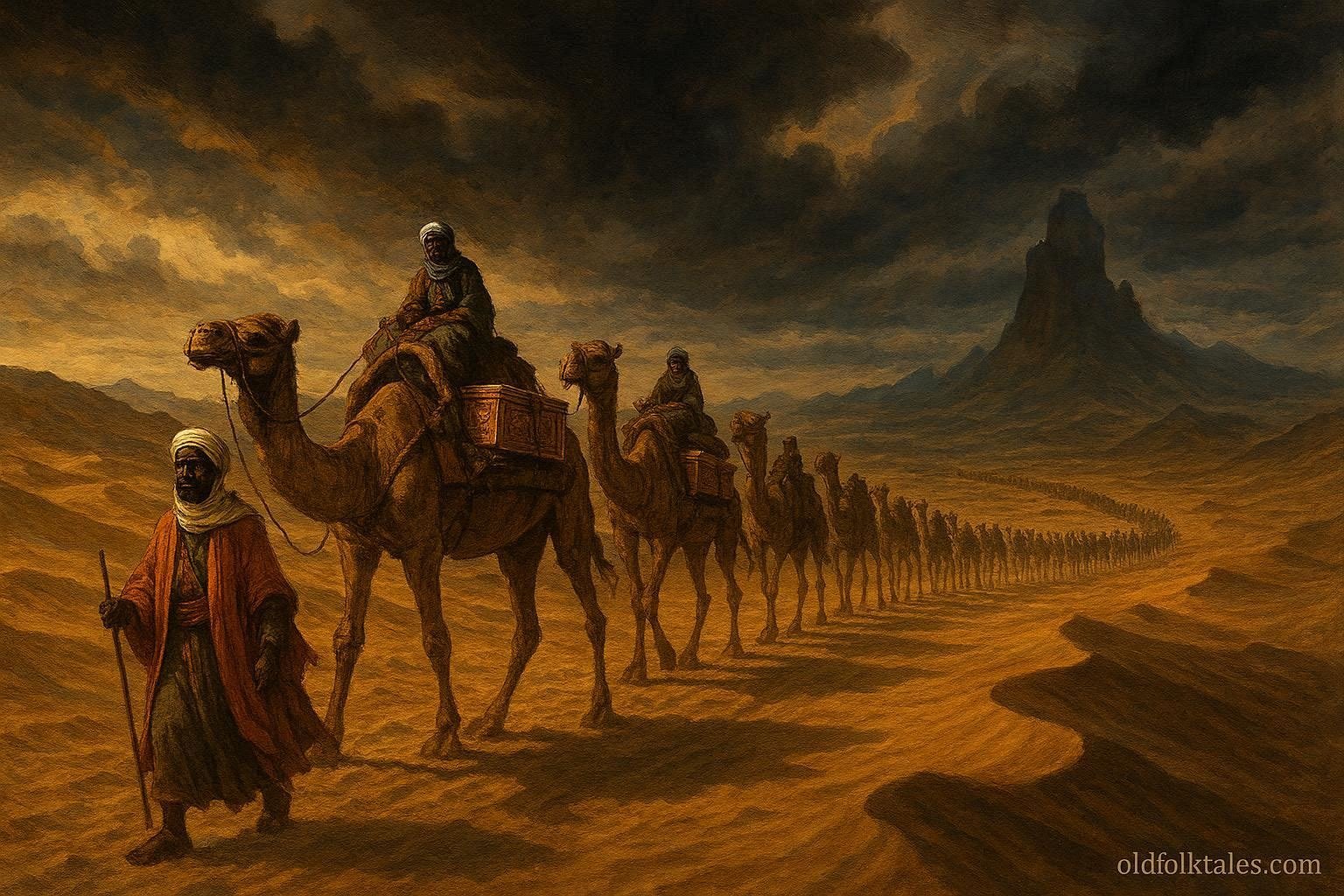
He organized what would become the largest caravan he had ever assembled.
Dozens of camels were prepared.
Supplies were gathered.
Experienced guides were hired.
Guards were recruited to protect the valuable cargo.
When preparations were complete, the caravan stretched across the landscape in an impressive procession. Merchants, laborers, camel handlers, and guards all joined the expedition, eager to share in its anticipated success.
Before departure, an elderly traveler approached Xasan.
The old man had spent much of his life crossing the deserts of the Horn of Africa and was known for his knowledge of forgotten routes and ancient traditions.
He studied the caravan carefully before speaking.
“There are many roads through the desert,” he said, “but not all of them should be traveled.”
Xasan listened politely.
The elder pointed toward the west.
“Beyond the usual trade paths lies a region our ancestors avoided. Travelers call it the Silent Territory. Those who enter it seeking wealth rarely return.”
Several nearby merchants nodded in agreement.
They had heard similar stories throughout their lives.
According to tradition, the area was associated with strange disappearances, unusual storms, and unexplained misfortune. Most caravans deliberately avoided it, even when alternative routes required additional travel.
Xasan thanked the elder for his concern.
Yet privately, he dismissed the warning.
He viewed such stories as superstitions that discouraged exploration.
If others feared the territory, he reasoned, fewer competitors would challenge him there.
After several weeks of successful travel, the caravan reached a point where two possible routes lay ahead.
The first followed the established trade road used by generations of merchants.
The second crossed part of the territory mentioned by the elder.
The shorter route promised significant advantages.
It could save valuable time.
It might increase profits.
And it would allow Xasan to reach the gold markets before rival caravans.
His guides advised caution.
Several experienced travelers recommended staying on the traditional road.
But Xasan focused only on the potential rewards.
Ignoring their concerns, he ordered the caravan to take the shorter path.
Reluctantly, the others obeyed.
At first, the decision appeared successful.
The terrain was manageable.
Progress was swift.
The caravan advanced steadily across the desert, and Xasan felt increasingly confident.
He quietly congratulated himself for rejecting what he considered irrational fears.
Then the landscape began to change.
The familiar signs used by desert travelers became difficult to find.
Rock formations known to experienced guides disappeared.
Animal tracks became scarce.
Even the wind seemed strangely absent.
An unusual stillness settled across the desert.
The silence disturbed many members of the caravan.
Conversations became less frequent.
Several guides reported feeling uneasy.
One evening, as the travelers prepared camp, an older guide approached Xasan.
“We should turn back,” he said.
“Why?” Xasan asked.
“The desert feels wrong.”
The merchant frowned.
“The desert is the desert.”
The guide shook his head.
“No. This place is different.”
Xasan refused to change course.
The journey continued.
Over the following days, strange events multiplied.
Landmarks appeared where none should exist.
Distant shapes resembling settlements vanished when approached.
Some travelers reported hearing voices carried across empty sands.
Others claimed to see figures moving along distant ridges only to disappear moments later.
The growing unease affected everyone.
Even Xasan began noticing unusual occurrences.
Yet he remained determined to continue.
The gold markets were close.
Turning back now would mean abandoning the opportunity he had pursued for so long.
One afternoon, dark clouds appeared unexpectedly along the horizon.
Desert storms were not uncommon, but experienced guides immediately recognized that something unusual was approaching.
The clouds moved with alarming speed.
Within hours, powerful winds swept across the landscape.
Visibility collapsed.
Sand filled the air.
Camels became difficult to control.
Shouts vanished beneath the roar of the storm.
The caravan struggled desperately to stay together.
For hours, chaos consumed the desert.
Travelers clung to ropes connecting animals.
Guards attempted to maintain order.
Guides fought to keep their bearings.
But the storm overwhelmed every effort.
When it finally passed, the landscape looked completely different.
Massive dunes had shifted.
Familiar landmarks were gone.
The caravan was scattered.
Groups became separated from one another.
Supplies were lost.
Worst of all, no one knew exactly where they were.
Fear spread quickly.
The guides admitted they could no longer identify the route.
The desert around them appeared unfamiliar in every direction.
Days passed as the survivors searched for a way out.
Water supplies dwindled.
Food became scarce.
Hope faded.
Some groups attempted to retrace their path.
Others continued forward.
None found success.
One by one, the scattered sections of the caravan disappeared into the vast desert.
Back in Zeila, news of the caravan’s disappearance caused widespread concern.
Weeks became months.
Months became years.
No survivors returned.
Search expeditions followed portions of the route but discovered little evidence explaining what had happened.
The fate of the Golden Caravan remained a mystery.
Over time, stories about the event spread throughout the region.
Some believed the caravan had simply become lost during an unusually powerful storm.
Others insisted that ancestral forces protected the forbidden territory and punished those who entered it driven by greed.
A few storytellers claimed that fragments of gold occasionally appeared among desert sands after severe winds, as though the desert itself continued holding pieces of the lost expedition.
Generations later, travelers still shared accounts of strange sights in remote desert regions.
Some reported seeing a distant caravan moving across the horizon before suddenly vanishing.
Others described hearing camel bells during calm nights despite finding no travelers nearby.
Whether these stories reflected imagination, memory, or something more mysterious remained uncertain.
Yet the lesson endured.
The legend was never simply about a lost caravan.
It was about ambition without caution.
About ignoring wisdom passed down through generations.
And about the dangers of allowing the pursuit of wealth to outweigh respect for experience and tradition.
Today, the story of the Golden Caravan of Zeila continues to be told among those interested in the rich oral traditions of the Horn of Africa.
The gold itself was eventually forgotten.
The missing caravan became a legend.
But the warning remained.
Not every shortcut leads to success.
And some paths are dangerous precisely because they appear too tempting to resist.
If you liked this story, see our Central African folktales collection
Moral Lesson
Greed and overconfidence can lead people to ignore wisdom, placing both themselves and others in danger.
Knowledge Check
- Where is the story set?
It is set along the ancient trade routes connected to Zeila in the Horn of Africa. - Who was Xasan?
He was a wealthy merchant who led the Golden Caravan. - Why did Xasan choose the forbidden route?
He wanted to save time and increase his profits. - What warnings did he receive?
Elders and guides warned him about the dangerous Silent Territory. - What happened to the caravan?
It disappeared after becoming trapped in a powerful desert storm and losing its way. - What lesson does the story teach?
Wisdom and caution should never be sacrificed for greed or ambition.
Source
Somali folklore. Adapted from medieval Somali trade-route oral traditions documented in Horn of Africa trade folklore archives and regional historical folklore studies.