In the heart of Gabon, where thick rainforests stretched across valleys and rivers wound their way through ancient landscapes, Mount Iboundji rose above the surrounding land like a silent guardian. Its slopes were covered with dense vegetation, and clouds often gathered around its peak. To the Tsogo people who lived in nearby communities, the mountain was more than a geographical landmark. It was a place of memory, tradition, and spiritual significance.
For generations, elders taught that Mount Iboundji possessed a unique connection to the ancestors. Stories passed from one generation to another described unusual events associated with the mountain. Hunters spoke of hearing unexplained echoes among its slopes. Travelers told stories about strange lights appearing near the summit during certain seasons. Elders listened to such accounts carefully, for they believed that the mountain sometimes communicated with those willing to pay attention.
Among the many traditions connected to Mount Iboundji, none was more famous than the legend of the hidden drum.
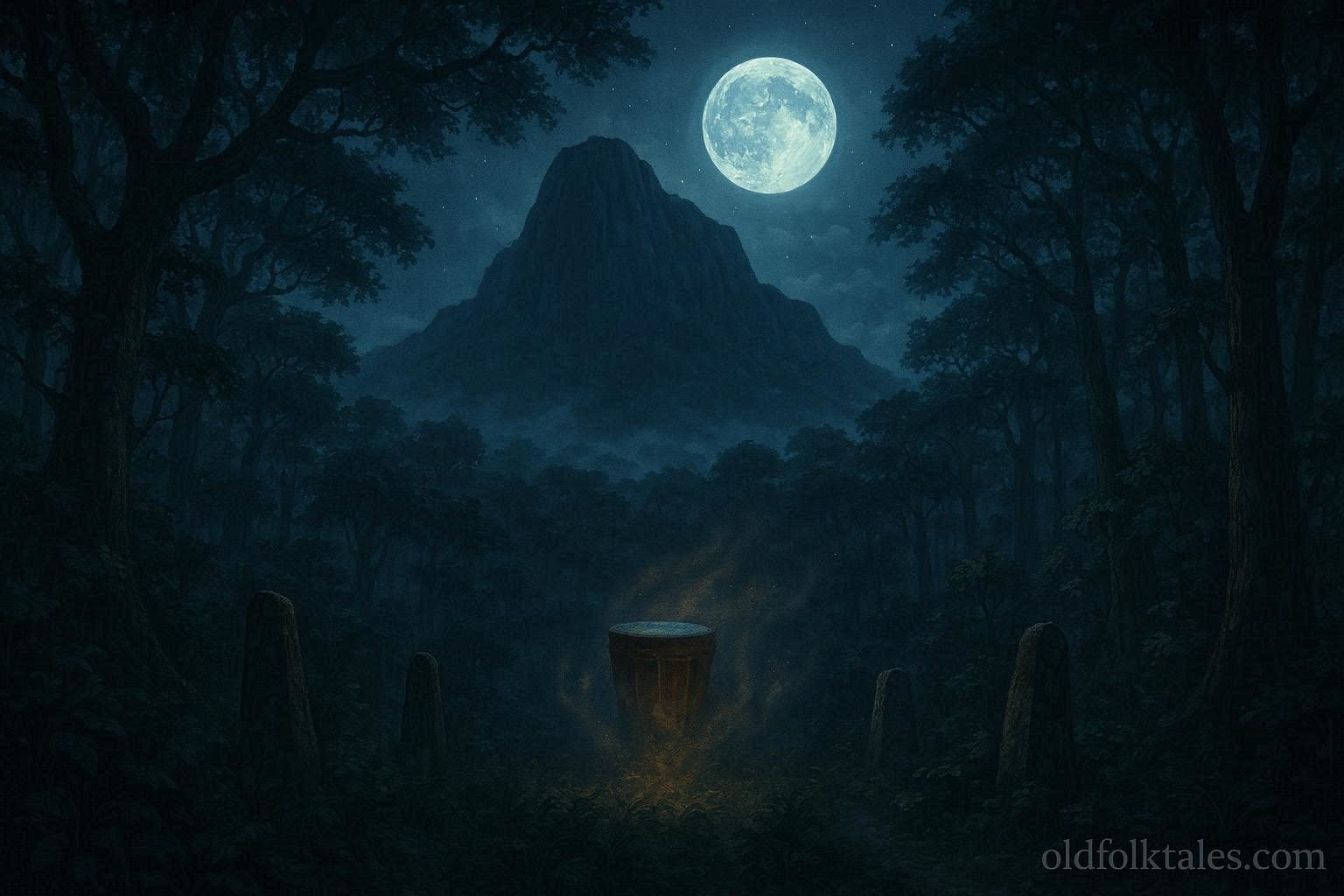
According to old stories, a sacred drum rested somewhere beneath the mountain. No one knew who had placed it there or how it had arrived. Some traditions claimed that the ancestors themselves had hidden it long ago. Others suggested it had existed beneath the mountain since the beginning of time.
Whatever its origin, the drum was said to remain silent for many years at a time.
Yet whenever important changes approached the surrounding communities, mysterious drumming could be heard echoing from deep beneath the earth.
If you enjoyed this story, explore our full West African folktales collection
Many villagers regarded the tale with respect.
Some believed every word.
Others viewed it as a symbolic story meant to encourage attentiveness and wisdom.
Still, everyone knew the legend.
In one village near the mountain lived a young man named Mabiala.
Mabiala was known for his curiosity and his love of exploring the forests surrounding Mount Iboundji. He often accompanied hunters, gathered medicinal plants with elders, and listened eagerly to stories shared during evening gatherings.
Unlike many people his age, he paid close attention whenever older community members discussed ancestral traditions.
One evening, while sitting beside a fire, he listened as an elder named Goma recounted the story of the hidden drum.
“It does not sound often,” Goma explained.
“When it does, wise people listen.”
“What kind of changes does it announce?” Mabiala asked.
The elder smiled.
“That depends upon what the future brings.”
The answer fascinated him.
Weeks later, during the height of the rainy season, something unusual happened.
Late one night, several villagers were awakened by a distant sound.
Boom.
Boom.
Boom.
The rhythm was slow and steady.
At first, many assumed it was thunder.
Yet the sky was clear.
The sound continued.
Boom.
Boom.
Boom.
By morning, stories about the mysterious noise spread throughout the community.
Some people had heard it clearly.
Others claimed it seemed to come from the direction of Mount Iboundji.
When Mabiala heard the reports, he immediately remembered the elder’s story.
That evening, he visited Goma.
The old man appeared thoughtful.
“It has been many years since anyone reported hearing the drum,” he said quietly.
The following night, the sound returned.
This time, even more villagers heard it.
The drumming echoed across valleys and forests, carrying through the darkness before fading shortly before dawn.
Concern and curiosity spread throughout nearby communities.
People debated its meaning.
Some feared disaster.
Others believed it signaled important opportunities.
Village leaders decided to observe events carefully in the weeks ahead.
Mabiala, however, wanted answers.
Determined to learn more, he began speaking with elders from different settlements. Many shared stories passed down through their families.
One elder remembered hearing similar drumming before a major migration that had reshaped several communities.
Another recalled stories connecting the sound to the discovery of new farming lands generations earlier.
A third spoke of a time when the drum was said to have sounded before rival villages united after years of conflict.
The accounts differed in detail but shared one common theme.
The drumming always preceded significant change.
Armed with this knowledge, Mabiala became even more interested in understanding the mystery.
A few days later, he organized a small expedition with several friends.
Their goal was not to find the hidden drum itself, which many believed impossible, but to explore the mountain and learn more about its history.
The group departed before sunrise.
The climb was challenging.
Dense vegetation covered much of the terrain, and narrow trails wound through thick forest. Along the way, they encountered unusual rock formations, ancient trees, and clear streams flowing down the mountainside.
As they traveled higher, Mabiala noticed evidence that previous generations had used certain areas for ceremonies and gatherings.
Weathered carvings appeared on stones.
Old pathways emerged beneath vegetation.
The mountain clearly held a long history.
By late afternoon, the group reached a plateau overlooking the surrounding forests.
There they discovered something unexpected.
Partially hidden beneath vines stood several ancient stone markers arranged in a circle.
Symbols carved into the stones resembled designs occasionally used in traditional Tsogo ceremonies.
The group examined the site carefully.
Although they could not fully interpret its meaning, they recognized its cultural importance.
After returning home, Mabiala shared the discovery with village elders.
The elders visited the location and confirmed that it had once served as an important gathering place for ancestral ceremonies many generations earlier.
The discovery renewed community interest in preserving local history.
Young people began learning more about traditions associated with Mount Iboundji.
Storytelling gatherings became more frequent.
Elders shared knowledge that had rarely been discussed in recent years.
Meanwhile, the mysterious drumming continued.
Sometimes it sounded once a week.
Sometimes several nights passed without any sign of it.
Then, several months after the sounds first appeared, major changes began unfolding throughout the region.
A new trade route connecting several communities was established, creating opportunities for cooperation and economic growth.
Long-standing disagreements between neighboring villages were resolved through successful negotiations.
Farmers introduced techniques learned from distant communities, improving harvests and strengthening food security.
The region experienced a period of transformation unlike any seen in years.
As positive developments accumulated, many people began viewing the drumming differently.
What had initially inspired fear now seemed more like a warning meant to encourage preparation and awareness.
The drum had not announced destruction.
It had announced change.
One evening, as villagers gathered beneath the stars, Mabiala sat beside Goma once again.
“The stories were true,” he said.
The elder nodded.
“In their own way.”
“Do you think there is really a drum beneath the mountain?”
Goma gazed toward Mount Iboundji, visible in the distance beneath the moonlight.
“Perhaps,” he replied.
“Or perhaps the mountain simply reminds us to pay attention.”
Mabiala considered the answer carefully.
Years passed.
The mysterious drumming eventually faded.
Life continued.
New generations were born, and the events associated with the sounds gradually became part of local history.
Yet the story endured.
People remembered how the mountain’s voice had preceded a time of important transformation.
They remembered the lessons learned from listening rather than reacting with fear.
Most importantly, they remembered the value of preparing for change rather than resisting it.
To this day, storytellers among the Tsogo people continue sharing the legend of the Drum Beneath Mount Iboundji.
Some insist that a sacred drum still rests deep within the mountain.
Others believe the drum symbolizes the wisdom of the ancestors speaking through the natural world.
Whatever the truth may be, the lesson remains powerful.
Important changes often announce themselves quietly before they arrive.
Those who listen carefully are better prepared to meet them.
And sometimes, the echoes of the past help guide communities toward the future.
Click here to explore more Central African folktales
Moral Lesson
Wisdom comes from paying attention to signs of change and preparing thoughtfully for the future rather than responding with fear.
Knowledge Check
- Where is the story set?
It is set near Mount Iboundji in Gabon. - What was the hidden drum believed to do?
It was believed to sound whenever important changes were approaching nearby communities. - Who was Mabiala?
He was a curious young man who wanted to understand the mystery of the mountain. - What did Mabiala discover on the mountain?
He discovered an ancient ceremonial site marked by stone carvings. - What happened after the drumming began?
Major social, economic, and community changes occurred throughout the region. - What lesson does the story teach?
People should pay attention to signs of change and prepare wisely for the future.
Source
Gabonese folklore. Adapted from Tsogo oral traditions preserved in Gabon mountain folklore archives and Central African folklore studies.