The great rainforests of Río Muni echoed with the sounds of countless birds. From sunrise until dusk, colorful wings moved through the forest canopy while songs and calls filled the air. Every bird had a role in the life of the forest. Some spread seeds, others warned of danger, and many worked together to find food and protect their young.
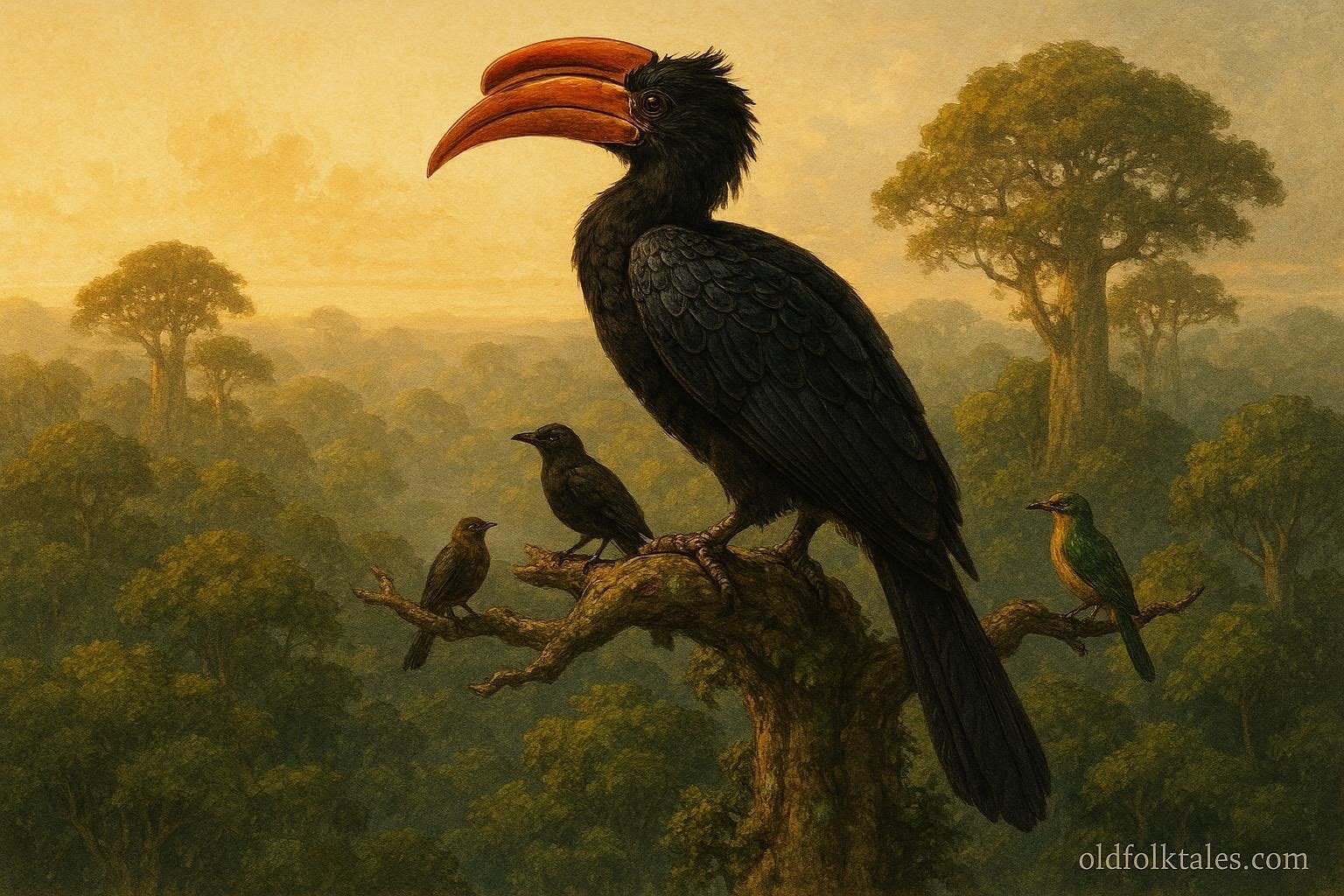
Among these birds lived a magnificent hornbill. Its large curved beak, striking appearance, and powerful wings made it one of the most noticeable creatures in the forest. Whenever it flew above the treetops, other animals looked up in admiration.
Over time, the hornbill began to believe that its beauty and strength made it more important than every other bird.
While parrots traveled together searching for fruit, the hornbill preferred to travel alone. When weaver birds worked together to build nests, the hornbill mocked them for relying on one another. Even when smaller birds shared warnings about approaching predators, the hornbill often ignored them.
“I have strong wings,” the hornbill would boast. “I do not need the help of anyone.”
The other birds were disappointed by the hornbill’s attitude, but they continued their lives without arguing. They understood that pride often teaches its own lessons.
Looking for more? Explore the magic of East African folktales here
One year, the forest experienced an unusual dry season. Many fruit-bearing trees produced smaller harvests than usual. Food became harder to find, and birds that normally fed with ease had to travel farther each day.
To survive the difficult season, many species began cooperating more closely. Groups of birds shared information about fruiting trees and safe feeding areas. When one flock discovered food, they often informed others. This cooperation helped many birds survive despite the scarcity.
The hornbill refused to participate.
It insisted that sharing information was unnecessary.
“I am stronger than all of you,” it declared. “I can find food on my own.”
At first, the hornbill managed reasonably well. Its strong beak allowed it to reach fruit that some birds could not access. This success only increased its pride.
However, as the dry season continued, food became even scarcer. Trees that once held abundant fruit stood nearly empty. Day after day, the hornbill searched longer distances while finding less to eat.
Meanwhile, the birds that cooperated continued to survive. By sharing knowledge, they were able to locate hidden food sources throughout the forest.
The hornbill noticed their success but refused to ask for help.
Instead, it flew farther and farther from familiar territory.
One afternoon, while searching for food, the hornbill entered a remote section of forest it had never visited before. The trees were taller, the undergrowth thicker, and the landscape unfamiliar.
After many hours of searching, the bird finally found a fruit tree covered with ripe fruit. Excited by its discovery, the hornbill rushed toward the branches.
Unfortunately, the tree stood near the territory of a large forest predator.
Several smaller birds spotted the danger immediately.
From nearby branches, they called warnings.
“Be careful!” they cried.
“The predator is below!”
The hornbill heard the warnings but ignored them.
Believing itself too clever and powerful to be threatened, it continued feeding.
Moments later, the predator lunged from its hiding place.
Startled, the hornbill launched itself into the air. Its wings carried it away from immediate danger, but in its panic, it collided with thick branches and lost its sense of direction.
For hours, it flew through unfamiliar forest, unable to find its way home.
As darkness approached, the hornbill became frightened.
It had never spent a night alone in such unfamiliar territory.
The lower branches were crowded with animals searching for shelter, and dangers moved silently through the forest shadows.
Eventually, the hornbill spotted a group of birds gathered high in the tallest trees.
Among them were parrots, starlings, and several species it had often mocked.
The birds recognized the exhausted hornbill.
Despite remembering its arrogance, they invited it to rest among them.
The hornbill accepted reluctantly.
That night, as the birds shared stories and watched for danger together, the hornbill noticed something important.
The tallest trees offered safety.
From those heights, birds could see predators approaching, locate food sources more easily, and communicate across great distances.
More importantly, the birds protected one another.
Whenever one bird noticed danger, all the others benefited from the warning.
Whenever one bird discovered food, the information spread quickly through the group.
The hornbill began to understand what it had failed to see before.
Strength alone was not enough.
Beauty alone was not enough.
Even powerful wings could not replace wisdom and cooperation.
The following morning, the hornbill thanked the birds for their kindness.
Instead of mocking them, it listened to their advice.
Over the next several weeks, it learned to work alongside other birds. It shared information, accepted guidance, and contributed its own observations to the group.
Gradually, its reputation changed.
The hornbill became respected not because of its appearance, but because it had learned humility.
From that time forward, the hornbill chose to make its home high among the tallest trees of the forest.
There it could remain close to other birds, watch over the forest, and remember the lesson it had learned.
According to Fang storytellers, this is why hornbills are often seen living and nesting high in tall trees. Their place among the highest branches serves as a reminder that wisdom grows when pride gives way to cooperation.
Generations of elders shared this story with children to teach an important lesson. They explained that talent and strength are valuable gifts, but they become far more powerful when combined with humility and respect for others.
The tale endured because every community occasionally encounters individuals who believe they can succeed entirely on their own. The story of the hornbill reminds listeners that no one thrives in isolation forever.
Just as birds depend upon one another in the forest, people depend upon family, friends, and community. Cooperation creates opportunities that pride often overlooks.
And so, whenever a hornbill is seen perched high in the tallest trees, Fang elders say it is still remembering the lesson learned during the great dry season, a lesson about wisdom, humility, and the value of working together.
Click here to explore more Central African folktales
Moral Lesson
Pride can lead to isolation, but humility and cooperation help individuals and communities thrive.
Knowledge Check
1. Why did the hornbill think it was superior?
Because of its large beak, strong wings, and striking appearance.
2. What challenge affected the forest birds?
A severe dry season made food difficult to find.
3. Why did the hornbill struggle during the dry season?
It refused to cooperate with other birds or share information.
4. What lesson did the hornbill learn?
That wisdom and cooperation are more valuable than pride.
5. Why did the hornbill choose the tallest trees?
The tall trees offered safety, better visibility, and connection with other birds.
6. What is the main lesson of the story?
Humility and teamwork lead to success, while pride can create unnecessary hardship.
Source
Adapted from Fang animal tales and etiological folklore traditions preserved in Fang folklore collections and Central African oral literature archives.