Every Zande village carries stories that are told openly and others that remain hidden until the right moment. Elders have long believed that silence can protect wisdom, but it can also conceal injustice. They teach that a wrong left unconfessed does not disappear with time. Instead, it waits patiently until truth is finally given the courage to speak. The legend of The Night Nobody Slept has been passed from one generation to another as a reminder that peace cannot rest where honesty has been abandoned.
The village of Gbere rested peacefully between rolling grasslands and the thick forests that stretched across the land.
Its people were known for their kindness.
Travelers were welcomed.
Harvests were shared.
Children grew up believing they lived in the safest village in the region.
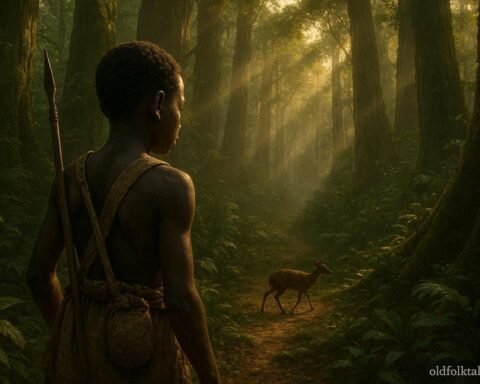
Yet beyond the last row of huts stood a narrow path leading into an old part of the forest that nobody entered.
The trees there were taller.
The air felt cooler.
Even birds seemed reluctant to sing among the branches.
Whenever curious children wandered too close, their parents called them back immediately.
“Leave that place alone.”
“It belongs to yesterday.”
No one explained what those words meant.
Most children eventually stopped asking.
One did not.
His name was Liko.
Unlike the others, Liko loved asking questions that made adults uncomfortable.
“If no one remembers yesterday,” he often asked, “how can we understand today?”
His grandmother smiled whenever she heard him.
“One day,” she said quietly, “the forest will answer you.”
Liko laughed.
He thought she was joking.
One dry season, something unusual disturbed the village.
Fascinated by this tale? Discover more North African folktales
Just after sunset, a faint sound drifted through the trees.
It was soft.
Almost like someone walking across dry leaves.
The next evening the sound returned.
This time it lasted longer.
On the third night everyone heard it.
It no longer resembled footsteps.
Instead, it sounded like distant voices speaking words that nobody could understand.
The strange whispers circled the village.
Sometimes they came from the east.
Moments later they echoed from the west.
No matter where people searched, they found nothing.
The following morning several hunters entered the forbidden forest.
They searched every trail.
Every stream.
Every abandoned shelter.
They discovered no footprints.
No camps.
No strangers.
Only silence.
That evening the whispers returned again.
This time they were louder.
Dogs whimpered beneath their owners’ beds.
Goats refused to leave their pens.
Babies cried without stopping.
No family slept.
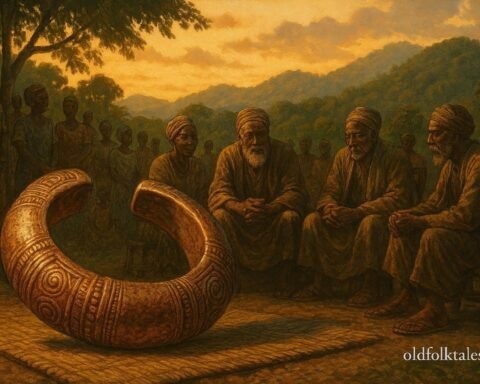
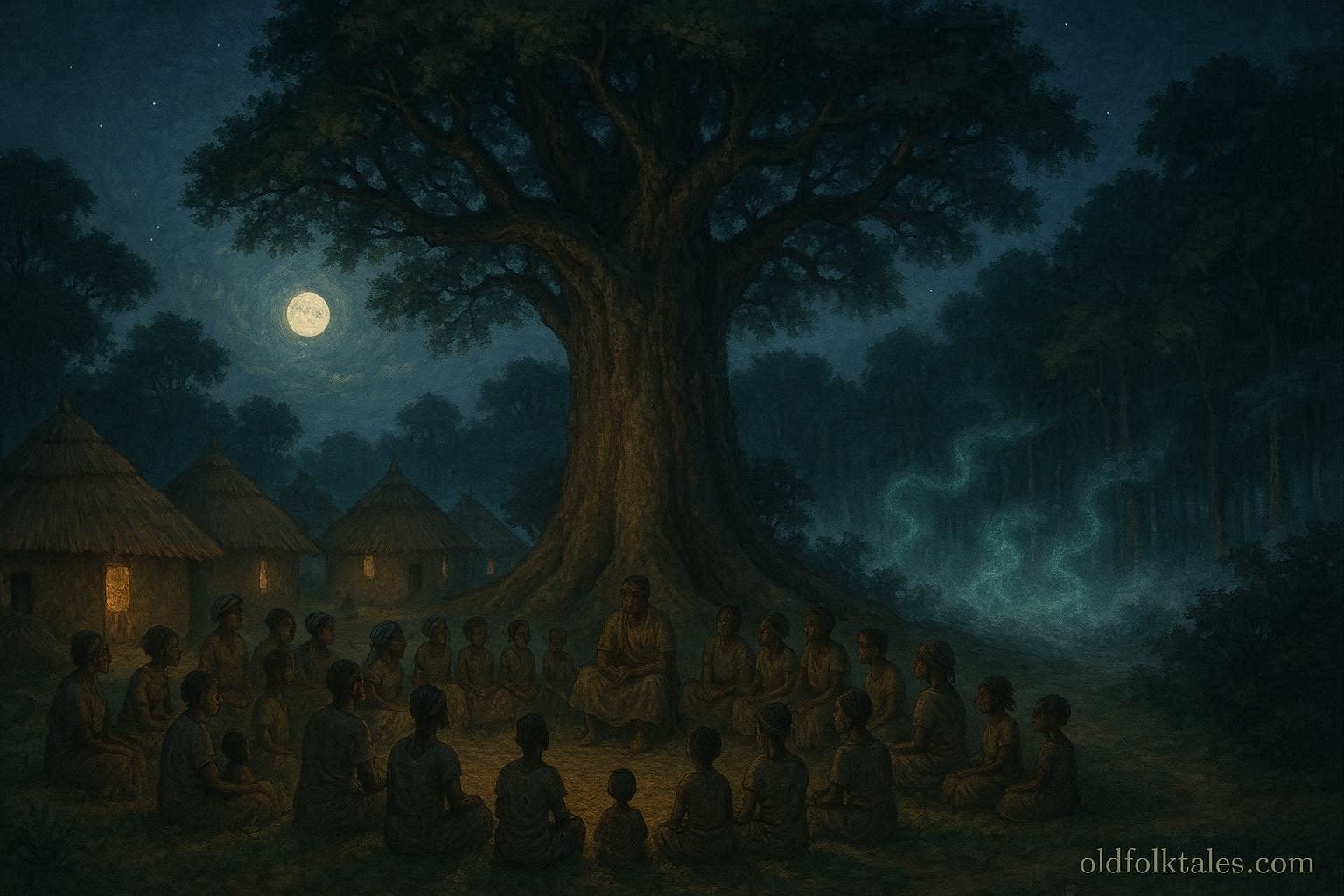
As sunrise finally arrived, the entire village gathered beneath the great meeting tree.
Everyone spoke at once.
“It must be evil spirits.”
“No.”
“It is wandering strangers.”
“Perhaps angry animals.”
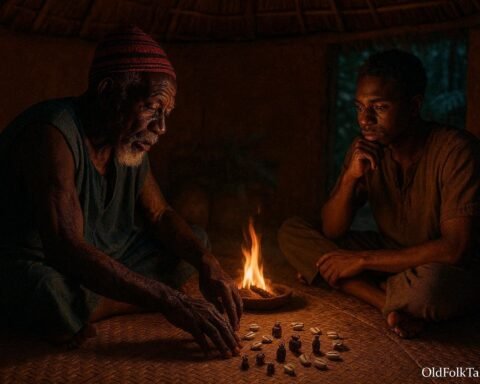
The arguments continued until the oldest woman in the village slowly stood.
Her name was Mama Sira.
She had lived longer than anyone else.
Even the chief respected her wisdom.
She raised one hand.
Immediately the gathering became quiet.
“The forest is not speaking.”
“The past is.”
The chief frowned.
“What do you mean?”
Mama Sira looked toward the forbidden trees.
“My grandfather told me a story that his grandfather told him.”
“For many years I believed silence protected the village.”
“I now know silence has only protected our shame.”
The people listened carefully.
Long ago, before anyone living had been born, Gbere had shared its land peacefully with another nearby Zande settlement.
The two villages hunted together.
Celebrated together.
Helped one another during difficult seasons.
Their friendship lasted for many years.
Then one dry season everything changed.
A valuable hunting ground near the forest became the center of a bitter disagreement.
Both villages believed the land belonged to their ancestors.
Instead of gathering the elders to settle the matter peacefully, several proud young warriors acted without permission.
They accused the neighboring village of stealing game.
Harsh words became threats.
Threats became violence.
During the confusion, an innocent young messenger carrying peace offerings between the villages was killed by mistake.
The moment the truth became known, horror spread through both communities.
The messenger had carried no weapon.
He had come only to stop the fighting.
His death ended the conflict immediately.
Both villages buried him with honor.
Ashamed of what had happened, the elders made peace.
But instead of telling future generations the complete truth, they chose silence.
They marked the forest as forbidden.
They believed forgetting would protect everyone from renewed hatred.
Mama Sira lowered her head.
“But forgotten truth does not disappear.”
“It waits.”
Liko looked around the gathering.
Many elders had tears in their eyes.
The chief spoke quietly.
“If this story is true…”
“Then what do the voices want?”
Mama Sira answered without hesitation.
“They want what we never gave.”
“The truth.”
The villagers fell silent.
No one had imagined that the mysterious whispers were not calling for fear or revenge.
They were calling for remembrance.
As darkness approached once again, no one returned to their homes immediately.
Instead, the chief called every family to gather beneath the great meeting tree.
Torches were lit.
The elders sat together.
The youngest children remained close to their parents.
For the first time in many generations, the entire village heard the complete story.
No names were hidden.
No mistakes were softened.
The people learned how pride had turned friends into enemies.
They learned how one innocent messenger had lost his life while trying to restore peace.
Most importantly, they learned that both villages had chosen silence instead of teaching future generations what had truly happened.
When Mama Sira finished speaking, no one spoke for several moments.
Finally, Liko rose to his feet.
“If our ancestors made peace, why should we continue hiding their mistake?”
The chief nodded slowly.
“You speak wisely.”
“Their greatest error was not the conflict.”
“It was believing that truth should be buried.”
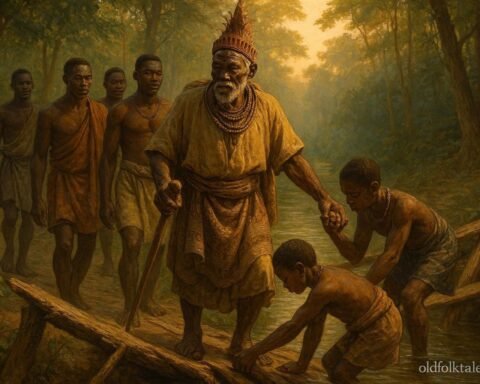
The following morning, messengers traveled to the neighboring village whose ancestors had once shared the forest with Gbere.
Many years had passed.
The people of both villages had lived peacefully beside one another.
Yet neither community knew the full story.
When the visitors arrived, they were welcomed with food and water according to tradition.
That evening, elders from both villages gathered beneath an ancient tree standing between their lands.
Mama Sira repeated the story exactly as she had told it in Gbere.
When she finished, an elderly man from the neighboring village quietly stood.
“My grandmother told me part of this story.”
“She always stopped before the ending.”
“I understand now why.”
He looked toward the forest.
“Our ancestors feared that truth would divide us.”
“They never imagined it could unite us.”
Together the two communities decided to honor the forgotten messenger whose courage had been lost beneath years of silence.
The place where he had fallen was carefully cleared.
Instead of leaving the forest abandoned, they created a small memorial where both villages could gather each year.
No statues were built.
No grand monuments.
Only a simple stone surrounded by flowering plants.
Every year thereafter, children from both villages visited the place together.
The elders told them the complete story.
They explained how pride had caused suffering.
How forgiveness had restored peace.
And how silence had nearly allowed the same mistake to happen again.
That evening, after everyone returned home, darkness settled over the land once more.
Families waited.
The strange whispers had always arrived shortly after sunset.
They listened carefully.
Nothing.
Only the gentle songs of crickets.
The breeze moved softly through the trees.
For the first time in many nights, every child slept peacefully.
The dogs rested quietly beside their owners.
Even the birds greeted the following sunrise with cheerful songs.
The mysterious voices never returned.
Years later, Liko himself became one of the village elders.
Whenever children asked why the two villages celebrated together every year, he would take them to the stone beneath the trees.
“There was once a night when nobody slept.”
“The forest was not trying to frighten us.”
“It was reminding us that truth deserves a voice.”
The children would often ask,
“Could the whispers ever return?”
Liko smiled gently.
“They will never return as long as we remember.”
“Forgotten mistakes grow in silence.”
“Shared truth grows into wisdom.”
Today, stories like The Night Nobody Slept continue to reflect an important lesson found throughout Zande oral tradition: peace is preserved not by hiding painful history, but by remembering it honestly and allowing each generation to learn from it. While the mysterious voices belong to legend, the values of accountability, reconciliation, and forgiveness remain deeply rooted in the storytelling traditions of Central Africa.
Keep reading: Discover more Central African folktales
Moral Lesson
Hiding the truth may bring temporary peace, but lasting harmony is built on honesty, accountability, and forgiveness.
Knowledge Check
1. Why did the villagers fear the old part of the forest?
They believed it was forbidden, but no one knew the true reason because the story had been hidden for generations.
2. What caused the mysterious whispers around Gbere?
According to the legend, they appeared to remind the village of a forgotten injustice their ancestors had concealed.
3. Who revealed the truth about the village’s past?
Mama Sira, the oldest woman in the village, shared the complete story passed down through her family.
4. What mistake had the ancestors made after the conflict ended?
They chose to hide the truth instead of teaching future generations what had happened.
5. How did the two villages finally restore lasting peace?
They openly acknowledged the past, honored the forgotten messenger, and committed to telling the story honestly every year.
6. What is the central message of the story?
True peace comes through truth, accountability, and forgiveness rather than silence.
Source
Inspired by Zande oral traditions and Central African storytelling, with reference to Central African folklore archives, Zande ethnographic studies, and Central African religious anthropology.