Animal origin stories have long been part of Gbaya oral tradition, using the adventures of forest creatures to explain the natural world while teaching important moral lessons. These tales remind listeners that even the smallest animal can display remarkable courage and that kindness is often rewarded in unexpected ways. One beloved legend explains why the gentle pangolin, unlike every other creature of the forest, came to wear its remarkable protective scales.
Long ago, when the forests of Central Africa were still young, every animal wore only skin and fur.
The elephant had no thick hide.
The porcupine carried no quills.
Even the pangolin looked much like every other small forest animal.
Its skin was smooth and soft.
Its body offered little protection from danger.
Although the pangolin was neither strong nor swift, every creature admired its gentle heart.
It never fought over food.
It shared termite mounds with other hungry animals.
Whenever young creatures became separated from their parents, the pangolin patiently helped them find their way home.
Some animals admired its kindness.
Others believed kindness was a sign of weakness.
The leopard often laughed.
“You are too gentle.”
“The forest belongs to the strongest.”
The pangolin simply smiled.
“The forest is large enough for every living creature.”
If you enjoyed this story, explore our full West African folktales collection
One particularly dry season, the rains failed to arrive.
Leaves became brittle.
Streams grew smaller each day.
Even the oldest trees began dropping their branches.
The elders among the animals grew worried.
“This forest has never been so dry.”
Then, one afternoon, lightning struck a dead tree on a distant hillside.
Within moments flames spread across the dry undergrowth.
The wind carried burning leaves through the forest.
Soon smoke covered the sky.
Animals fled in every direction.
The antelope ran toward the river.
Monkeys escaped into the tallest trees.
Birds filled the air with frightened cries.
The leopard raced ahead without looking behind.
Every creature thought only of survival.
Only the pangolin noticed something different.
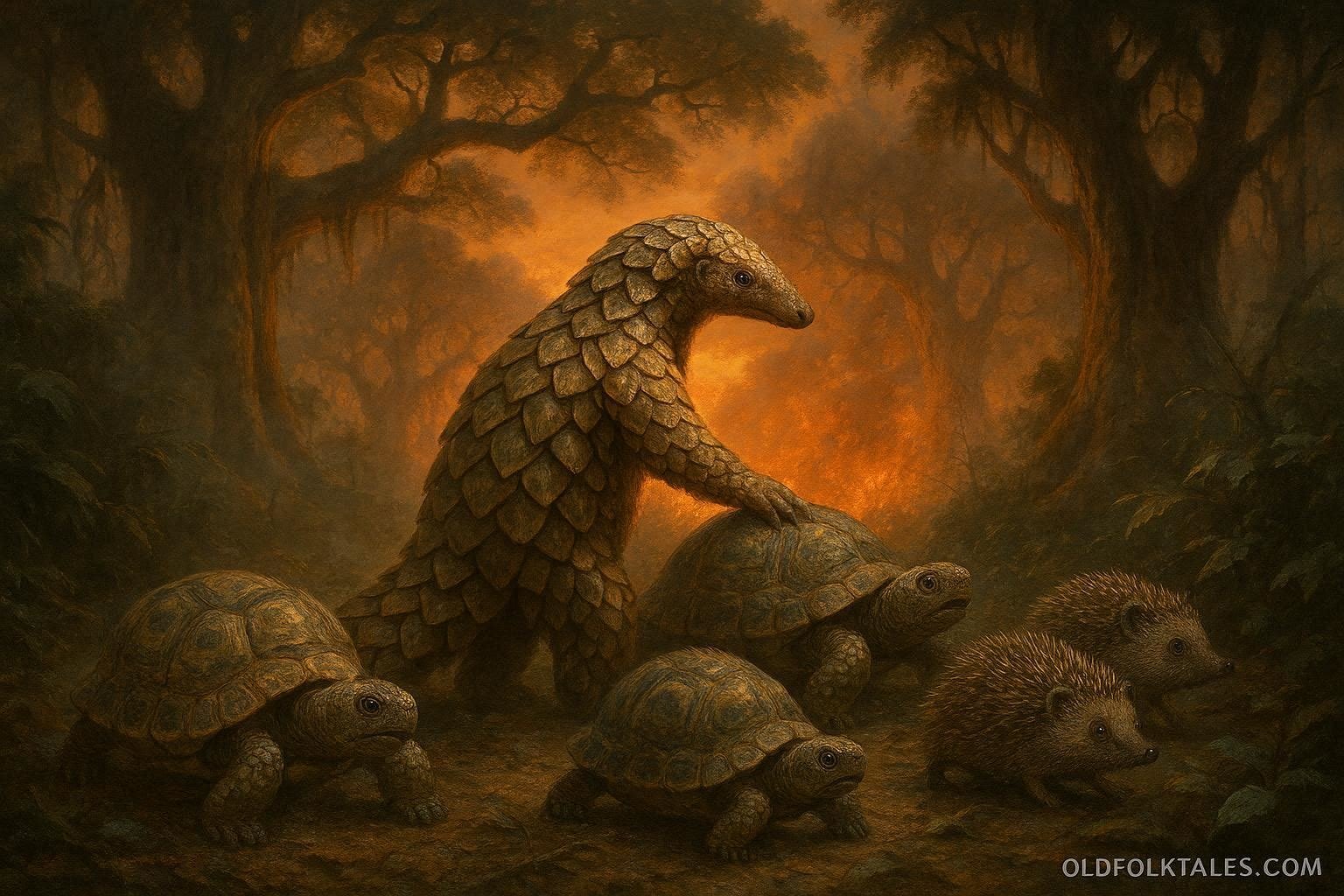
Near an old fallen log, a family of tortoises struggled to move.
Their heavy shells made them painfully slow.
Not far away, young hedgehogs had become trapped beneath thick branches.
Smoke surrounded them.
The pangolin stopped running.
It knew returning meant risking its own life.
Yet it also knew the smaller animals would never escape alone.
Without hesitation, it hurried toward the tortoises.
Using all its strength, it pushed fallen branches away from their path.
Then it guided them toward a narrow stream where the fire had not yet reached.
Next, it rushed back for the frightened hedgehogs.
Again and again, the little pangolin returned through the smoke.
Each journey became more dangerous than the last.
Ash covered its body.
Its soft skin became scratched by burning branches.
Its feet ached from running across hot ground.
Still, it refused to abandon anyone.
At last, the final family reached safety beside the river.
Exhausted, the pangolin collapsed beneath a large rock.
The fire raged through the forest until nightfall.
When heavy rain finally arrived, the flames slowly disappeared.
Morning revealed a changed world.
Many trees had survived.
Others stood blackened by smoke.
Animals cautiously emerged from hiding.
One by one, they discovered how many lives the pangolin had saved.
The tortoises bowed their heads.
The hedgehogs gathered around their rescuer.
Even the proud leopard remained silent.
Ashamed, he admitted,
“I thought strength meant saving only myself.”
“You have shown greater courage than any hunter.”
The oldest elephant stepped forward.
“Kindness protected this forest more than power.”
As the animals spoke, something remarkable began to happen.
The pangolin’s wounded skin felt strangely warm.
Tiny hard plates slowly appeared across its back.
They spread over its sides.
Across its tail.
Layer upon layer formed a strong covering unlike anything the forest had ever seen.
The animals watched in amazement.
The wise hornbill looked closely before speaking.
“The forest has remembered your courage.”
“What was once soft has become strong.”
“But your greatest protection has never been these scales.”
“It has always been your heart.”
From that day onward, the pangolin wore its beautiful overlapping scales wherever it went.
When danger appeared, it curled safely into a tight ball.
The same courage that had protected others now protected it as well.
Generations passed.
Every young pangolin was born wearing the same remarkable armor.
Parents told their children that the scales were more than protection.
They were a reminder that true bravery is measured not by fighting, but by helping others even when it is difficult.
Whenever young animals admired the pangolin’s unusual appearance, the elders smiled.
“They are not scales of pride.”
“They are scales of gratitude.”
Even the leopard never mocked kindness again.
Whenever fires threatened the forest, he was often among the first to help the weakest animals reach safety.
The pangolin’s example had changed more than one life.
It had changed the entire forest.
Today, the pangolin remains one of Africa’s most distinctive mammals, recognized by its protective scales and gentle nature. Although science explains that these scales are made of keratin and evolved over millions of years, Why the Pangolin Wears Scales preserves a timeless Gbaya tradition of using animal stories to celebrate courage, kindness, and gratitude. The legend reminds every generation that the strongest protection often grows from a compassionate heart.
Click here to explore more Central African folktales
Moral Lesson
Kindness shown during difficult times is never wasted. True courage is found in helping others, even when doing so requires personal sacrifice.
Knowledge Check
1. What was the pangolin like before it received its scales?
It had smooth, soft skin and was known throughout the forest for its kindness.
2. What disaster threatened the forest?
A great wildfire spread through the dry forest after lightning struck a tree.
3. Why did the pangolin return to the burning forest?
It chose to rescue trapped animals instead of thinking only about its own safety.
4. How did the other animals react after the fire?
They praised the pangolin’s courage and realized that kindness is greater than selfish strength.
5. What did the pangolin’s new scales symbolize?
They became a symbol of courage, gratitude, and the reward for selfless kindness.
6. What is the central message of the story?
Helping others with courage and compassion brings lasting rewards.
Source
Inspired by Gbaya oral traditions, Central African oral literature, and African animal folklore research.