In the heart of Mbundu country, where broad rivers nourished fertile lands and fishing canoes glided across calm waters each morning, there stood a peaceful village whose people depended on the river for almost everything.
The river provided fish to feed their families.
It watered their crops during the dry season.
It connected neighboring communities through winding channels that had been traveled for generations.
The elders often reminded everyone that the river was more than flowing water.
“It has its own spirit,” they would say. “Treat it with respect, and it will care for you. Treat it with greed, and it will fall silent.”
Most villagers honored this tradition.
Before the first fishing expedition of every season, they offered prayers of gratitude and promised never to take more than they needed.
For many years, the river remained generous.
Then, without warning, everything changed.
The fish disappeared.
Day after day, fishermen returned with empty nets.
The once clear water became strangely still, and even the birds that usually gathered along the riverbanks flew elsewhere.
Continue your journey: Read more East African folktales
Soon the village faced hunger.
Families shared what little food remained, but everyone knew the supplies would not last much longer.
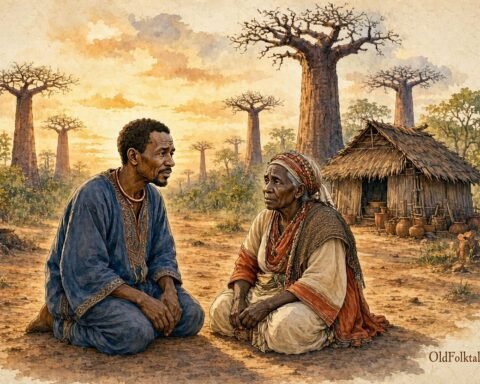
The village elders gathered beneath a great baobab tree to discuss what should be done.
Some believed strangers had frightened away the fish.
Others blamed the unusually dry weather.
Finally, the oldest elder spoke.
“Our ancestors told us that when the river falls silent, its guardian is waiting for someone worthy to seek its counsel.”
A heavy silence settled over the gathering.
No one volunteered.
The stories told of travelers who entered the sacred waters but never returned.
Among those listening was a young fisherman named Kiala.
He was respected for his patience and honesty, though he possessed neither great wealth nor remarkable strength.
After a long moment, Kiala stepped forward.
“If there is even a small chance of saving our people,” he said, “I must try.”
The elders looked at him with concern.
“The journey will test more than your courage,” one warned. “It will test your heart.”
Early the next morning, Kiala climbed into his canoe and paddled upstream toward a place few people dared to visit.
The river grew narrower as towering trees leaned over the water, casting long shadows across its surface.
The air became strangely quiet.
Even the sound of insects faded.
After several hours, Kiala reached a wide pool surrounded by smooth black rocks.
The water was perfectly still.
Not a single ripple disturbed its surface.
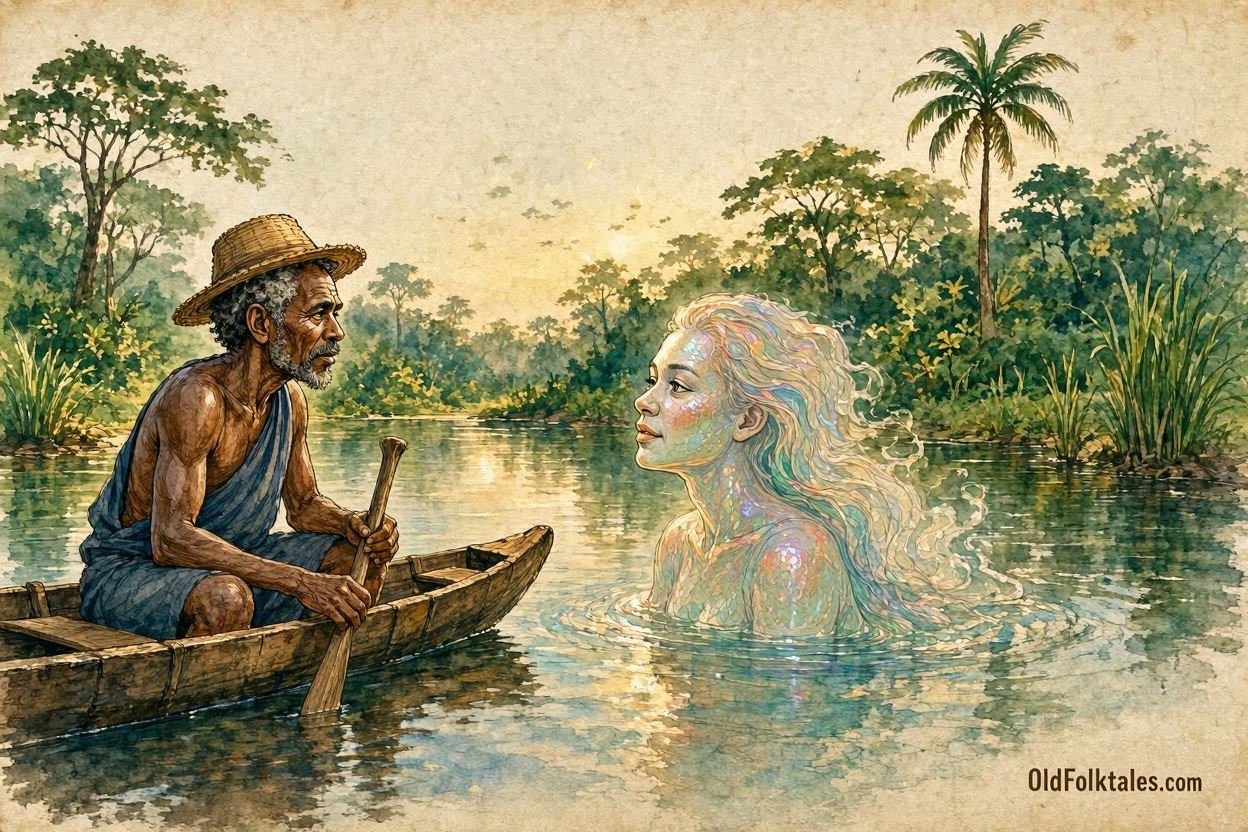
Remembering the teachings of the elders, Kiala laid down his paddle, bowed his head, and thanked the river for sustaining his people through countless generations.
No sooner had he spoken than gentle circles began spreading across the water.
The river slowly shimmered with silver light.
From its depths emerged a graceful figure clothed in flowing garments that sparkled like the river itself.
The spirit’s voice was calm, yet powerful enough to echo through the valley.
“Kiala,” the spirit said, “I have watched your people for many seasons.”
The fisherman lowered his head respectfully.
“Our village is suffering,” he replied. “I have come seeking your guidance.”
The spirit studied him for a moment before speaking again.
“The river has not abandoned your people without reason. Before its gifts can return, you must answer three questions.”
Kiala nodded.
“I will do my best.”
The spirit’s expression remained solemn.
“Many have attempted these questions,” it said. “None have answered all three.”
The water around the spirit glowed brighter.
Then the first question was asked.
“What is the one treasure that grows larger each time it is shared?”
Kiala took a deep breath, knowing that the fate of his entire village now rested upon his answer.
Kiala remained silent for a moment, carefully considering the spirit’s words.
He knew that answering too quickly could lead to failure.
Finally, he looked up.
“The treasure is wisdom,” he replied. “When wisdom is shared, everyone becomes richer without taking anything away from another.”
The river spirit smiled gently.
“The first answer is true.”
At once, the surface of the river shimmered with soft blue light before becoming still once again.
The spirit then asked the second question.
“What becomes lighter the more people carry it together?”
Kiala thought of the countless seasons he had spent fishing alongside his neighbors.
He remembered rebuilding damaged homes after storms, planting crops together, and sharing food during difficult years.
Then he answered.
“A burden.”
“When people help one another, even the heaviest burden becomes easier to bear.”
The spirit inclined its head.
“You have answered wisely.”
The river stirred once more, and a cool breeze swept through the valley.
Only one question remained.
The spirit’s expression grew serious.
“This final question has caused many to fail.”
The water became perfectly calm.
“What kind of leader deserves to be followed?”
Kiala closed his eyes.
He remembered the village elders who always listened before speaking.
He remembered his late father, who never ate before ensuring every child at the table had enough.
He remembered his mother, who quietly cared for the sick without expecting praise.
After a long silence, Kiala opened his eyes.
“A true leader is one who serves others before serving himself,” he said. “Such a person earns respect through compassion, fairness, and good example rather than fear.”
The river spirit looked at him for a long time.
Then a warm smile appeared.
“You have answered all three questions with the wisdom of both your ancestors and your own heart.”
The waters around the spirit sparkled like thousands of stars.
“The river did not become empty because of drought alone,” the spirit continued. “Your people slowly forgot to share its blessings. Some caught more fish than they needed. Others polluted its banks and neglected the customs that once honored the waters.”
Kiala listened with humility.
“Return to your village,” the spirit said. “Tell them that the river gives generously only to those who protect it and share its gifts with gratitude.”
As the spirit raised a hand, the river began flowing swiftly once again.
Schools of fish leaped from the water.
Birds returned to the trees, filling the valley with joyful songs.
The silver light gradually faded as the spirit disappeared beneath the surface.
Kiala paddled home before sunset.
The villagers gathered eagerly along the riverbank as he shared everything he had learned.
From that day forward, the people agreed never to take more fish than their families needed.
They cleaned the riverbanks, protected the surrounding forests, and taught every child to respect the waters that sustained them.
Before every fishing season, they offered prayers of thanksgiving just as their ancestors had done for generations.
In time, the river flourished once again.
Fish became plentiful, crops grew stronger, and neighboring villages admired the harmony that had returned.
Whenever young people asked why the river remained so generous, the elders would smile and repeat the three lessons Kiala had brought home.
“Wisdom grows when it is shared.”
“Burdens become lighter when carried together.”
“And the greatest leader is the one who serves others first.”
Thus, the story of The River Spirit’s Three Questions continued to be told among the Mbundu people, reminding every generation that true leadership begins with wisdom, courage, humility, and respect for both community and nature.
Don’t miss out: Read more Southern African folktales
Moral Lesson
This Angolan folktale teaches that wisdom, cooperation, and selfless leadership are the foundations of a strong community. It also reminds us that caring for nature ensures its blessings endure for future generations.
Knowledge Check
1. Why did Kiala seek the river spirit?
He wanted to save his village after the river stopped providing fish.
2. What was the answer to the first question?
Wisdom, because it grows larger each time it is shared.
3. How did Kiala answer the second question?
He said a burden becomes lighter when people carry it together.
4. What did Kiala say makes a true leader?
A true leader serves others with compassion, fairness, and humility.
5. Why had the river stopped providing for the village?
The people had become careless by taking too much and failing to respect the river and its traditions.
6. What is the central lesson of this Angolan folktale?
The story teaches that wise leadership, unity, and respect for nature bring lasting prosperity.
Source: Adapted from Mbundu oral narratives documented in Óscar Ribas’ Missosso and related ethnographic research on Angolan traditional literature.