In the heart of the ancient Luba Kingdom, where broad rivers nourished fertile plains and towering forests sheltered generations of ancestors, there stood a great stone unlike any other.
It rested upon a small hill overlooking the royal capital.
Smooth with age and darkened by countless seasons of rain and sunshine, the stone was known throughout the kingdom as The Throne of the First King.
The elders believed that the kingdom’s founder had once sat upon it after uniting scattered clans into one peaceful nation.
From that day forward, no ruler was permitted to claim the royal title until the ancestors accepted him at the sacred throne.
Many believed the throne possessed a spirit of its own.
It welcomed only those whose hearts were devoted to justice rather than power.
Prince Ilombo, the youngest son of the aging king, had grown into a kind and intelligent young man.
Fascinated by this tale? Discover more North African folktales
Although he had been taught the arts of hunting, warfare, and government, he often preferred listening to the wisdom of farmers, craftsmen, and village elders.
Some nobles admired his gentle nature.
Others questioned whether such humility belonged in a king.
When the old king announced that the time had come to choose his successor, many expected Ilombo’s older cousins to compete for the throne.
Each proudly displayed his wealth, his warriors, or his victories in battle.
Only Ilombo remained silent.
“The throne is not won by boasting,” his grandmother reminded him. “It is earned by the life you have lived.”
On the morning of the royal selection, chiefs from every corner of the kingdom gathered beneath the sacred trees.
The royal historian carried the ancient symbols of authority.
The high priest lit fragrant herbs as prayers were offered to the ancestors.
At last, the oldest elder rose to address the gathering.
“Before anyone may sit upon the Stone Throne,” he declared, “each candidate must complete the Journey of Four Paths.”
The crowd listened attentively.
“The first path tests compassion.”
“The second tests wisdom.”
“The third tests justice.”
“The fourth reveals the truth hidden within the heart.”
One by one, the royal candidates stepped forward with confidence.
They believed strength alone would guarantee victory.
Prince Ilombo quietly joined them, knowing only that no lesson taught by the ancestors was ever without purpose.
Before sunrise the following day, the candidates departed together, unaware that the sacred journey would challenge them in ways no weapon or royal title ever could.
As dawn broke over the Luba Kingdom, the royal candidates began the Journey of Four Paths.
The first path led them through a quiet farming village that had recently been damaged by heavy rains.
Broken fences lay scattered across the fields, and frightened families struggled to save their harvest before it spoiled.
Most of the candidates hurried past.
“If we stop to help,” one prince said, “we will arrive too late for the next trial.”
Only Ilombo remained behind.
He spent the morning repairing fences, carrying baskets of grain, and helping an elderly widow rebuild the roof of her small home.
When he finally continued his journey, he was far behind the others.
The second path climbed into the hills, where an old storyteller sat beneath a giant fig tree.
He invited each prince to answer a simple question.
“What is the greatest treasure a king can possess?”
One candidate answered, “A powerful army.”
Another replied, “Gold.”
Another said, “Fear.”
The old man simply nodded and allowed them to continue.
When Ilombo arrived, tired from helping the villagers, he listened carefully before answering.
“The greatest treasure is the trust of the people,” he said. “Without it, even the richest king rules alone.”
The old storyteller smiled warmly.
“You have listened not only with your ears but with your heart.”
The third path crossed a narrow bridge where two strangers argued over a basket of precious seeds.
Each claimed it belonged to him.
The princes who arrived first chose sides without asking questions, hoping to finish quickly.
Ilombo examined the basket carefully.
He noticed that one man’s hands were stained with fresh soil while the other’s were clean.
Instead of making an immediate judgment, he invited nearby farmers to speak.
Their testimony revealed that the seeds belonged to the man who had carefully prepared them for planting.
Justice had been found through patience rather than haste.
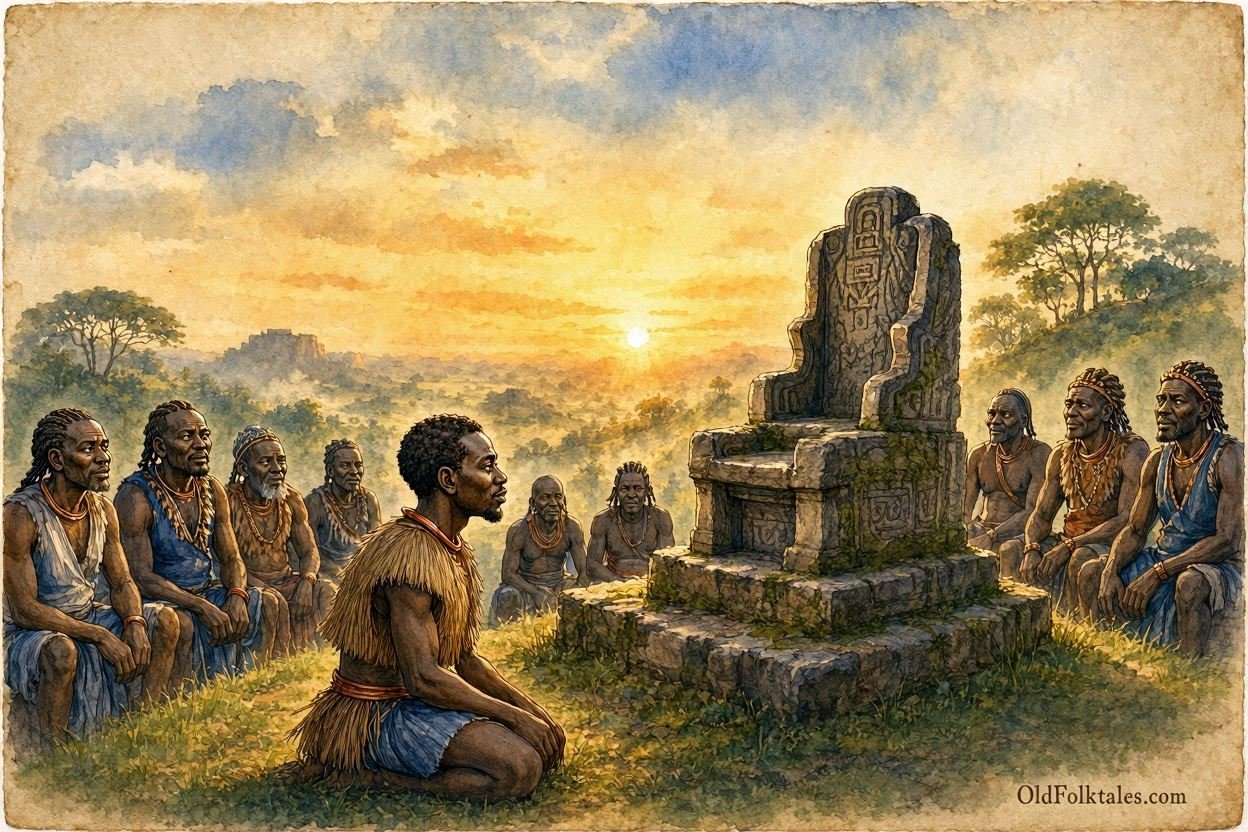
The final path ended at the hill where the Stone Throne stood waiting beneath the open sky.
The candidates gathered around the ancient seat.
The oldest elder addressed them.
“You have completed the four paths. Now each of you may approach the throne.”
The first prince stepped forward confidently.
As he placed his hands upon the stone, he struggled to climb onto it.
No matter how hard he tried, he could not seat himself comfortably.
The second prince laughed and stepped forward.
He too found the throne strangely difficult to climb.
The same happened to every candidate.
At last, Ilombo approached.
Instead of sitting immediately, he knelt beside the stone.
He placed one hand upon it and bowed his head.
“If I am worthy,” he said softly, “let me serve my people with justice. If I am not, may another be chosen.”
A gentle breeze swept across the hill.
The elders looked on in silence.
Ilombo slowly sat upon the throne.
This time, nothing resisted him.
He rested upon the ancient stone with perfect ease.
At that very moment, sunlight broke through the clouds and illuminated the hilltop.
The gathered chiefs smiled.
“The ancestors have spoken,” the oldest elder declared.
The people rejoiced, for they understood that the throne had accepted a ruler whose heart valued service above power.
When Ilombo became king, he never forgot the lessons of the four paths.
He visited villages regularly to hear the concerns of ordinary people.
He listened before making judgments.
He rewarded honesty rather than wealth and reminded his chiefs that leadership was a responsibility, not a privilege.
Under his reign, the Luba Kingdom prospered.
Many years later, parents still told their children about the young prince who won a throne not through strength or ambition but through humility, compassion, wisdom, and justice.
And so, The Stone Throne of the First King became one of the treasured royal legends of the Luba people, reminding every generation that the strongest rulers are those who first learn to serve.
If you liked this story, see our Central African folktales collection
Moral Lesson
This Congolese folktale teaches that true leadership is earned through humility, compassion, wisdom, and justice. A good ruler serves the people before seeking power.
Knowledge Check
1. What was the Stone Throne believed to represent?
It represented the authority of the first Luba king and accepted only rulers worthy of leading the people.
2. What was the first test on the Journey of Four Paths?
The first test measured compassion by seeing whether the candidates would help struggling villagers.
3. How did Ilombo demonstrate wisdom during the second test?
He said that the greatest treasure of a king is the trust of his people.
4. How did Ilombo solve the dispute over the basket of seeds?
He listened patiently, examined the evidence, and sought testimony before making a fair judgment.
5. Why was Ilombo accepted by the Stone Throne?
He approached it with humility and a sincere desire to serve rather than rule for personal glory.
6. What is the central lesson of this folktale?
The story teaches that lasting leadership comes from service, justice, humility, and earning the trust of the people.
Source: Adapted from Luba royal traditions discussed in Jan Vansina’s Kingdoms of the Savanna (1966).