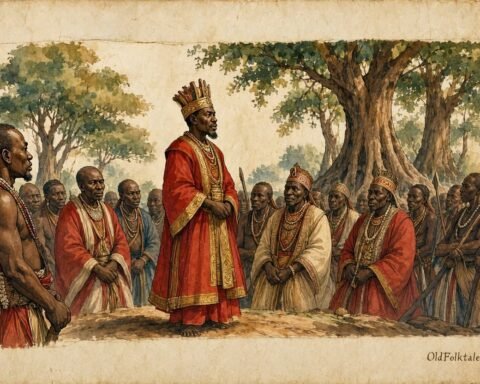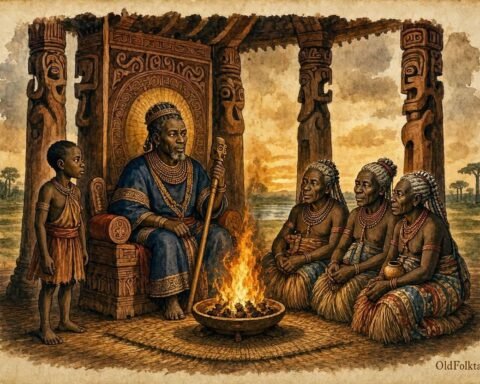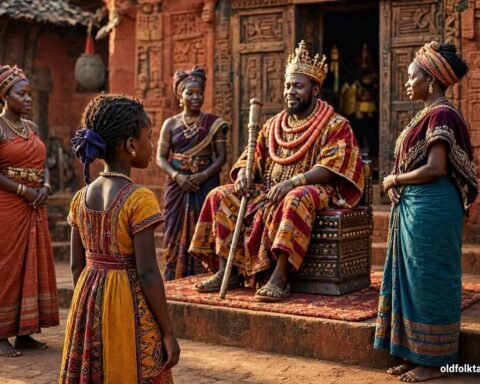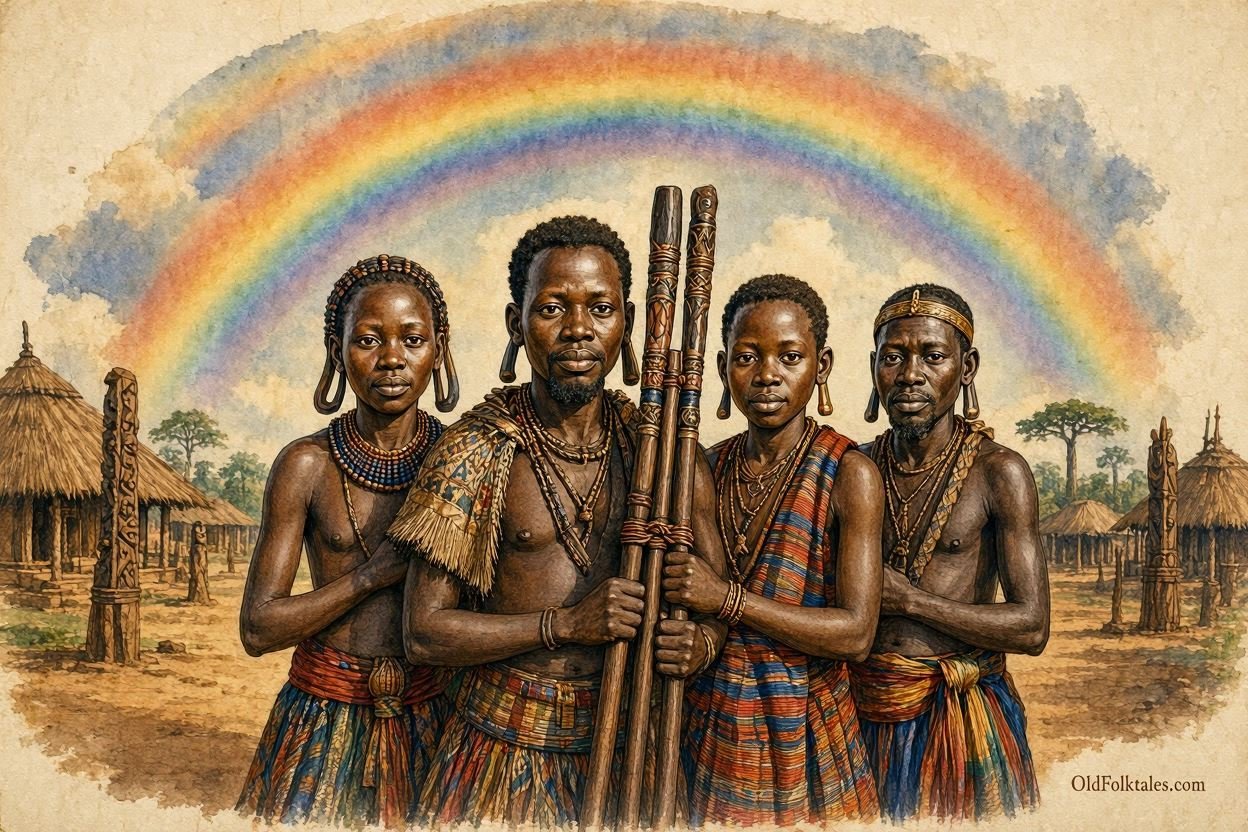
Deep within the rich forests and rolling savannahs of the ancient Luba Kingdom, there lived a ruler whose name was spoken with great reverence long after his lifetime. The elders called him The Rainbow King, for they believed that wherever he traveled, peace followed as surely as a rainbow appears after a storm.
During his reign, villages traded freely with one another, rivers became paths of friendship instead of conflict, and neighboring chiefs gathered beneath the royal tree to settle disagreements without bloodshed.
The Rainbow King had four children.
Each possessed a remarkable gift.
The eldest son, Ilunga, was brave and fearless in battle.
The second son, Kasongo, was wise and patient, preferring thoughtful words to sharp weapons.
Their sister, Bulanda, understood the customs of every clan and often united people who had quarreled.
The youngest, Kabeya, was curious and inventive, always searching for better ways to improve the lives of ordinary people.
The king loved all four equally.
As he grew older, however, he worried about the future.
Looking for more? Explore the magic of East African folktales here
One evening he gathered his children beneath the great mukula tree that stood before the royal court.
“The strength of a kingdom,” he told them, “does not rest in the hands of one ruler. It lives in the hearts of those who choose unity over pride.”
He handed each child a smooth wooden staff carved with symbols of the royal ancestors.
“When the time comes,” he continued, “keep these staffs together. As long as they remain united, our people will remain strong.”
The children promised they would never forget.
Not long afterward, the Rainbow King joined his ancestors.
The entire kingdom mourned.
People traveled from distant villages to honor the ruler who had brought them many years of peace.
For a time, his children ruled together just as he had wished.
Ilunga protected the borders.
Kasongo judged disputes fairly.
Bulanda strengthened friendships among the clans.
Kabeya improved roads, wells, and marketplaces.
The kingdom continued to flourish.
But prosperity sometimes invites jealousy.
Before long, ambitious advisers began whispering into the ears of each royal child.
One told Ilunga that only a great warrior deserved to rule.
Another insisted that wisdom alone should wear the royal crown.
Others claimed that tradition mattered more than courage or that clever ideas should guide the kingdom instead of ancient customs.
Slowly, suspicion replaced trust.
The four siblings stopped seeking one another’s advice.
They began making decisions alone.
One morning, during a heated argument inside the royal court, each sibling carried away their own carved staff.
The bundle their father had once tied together was broken apart.
Outside, dark clouds gathered across the sky.
The elders watched in silence.
One of them whispered sadly, “The Rainbow King’s greatest gift was never the throne. It was the unity of his children.”
None of the four siblings realized that their growing division would soon place the future of the entire kingdom in danger.
As the seasons passed, the effects of the siblings’ division spread throughout the kingdom.
The northern villages obeyed Ilunga because of his strength.
The southern provinces sought Kasongo’s judgments because of his wisdom.
The eastern clans followed Bulanda, whose kindness had earned their trust.
Meanwhile, the western settlements admired Kabeya for the improvements he brought to their daily lives.
Although each leader served faithfully, the kingdom no longer spoke with one voice.
Trade between villages slowed.
Old disagreements returned.
Chiefs who had once cooperated began competing for influence.
The people wondered how a kingdom that had known such peace could become so divided.
One evening, an elderly woman arrived at the royal court carrying a woven basket covered with colorful cloth.
She asked to see the four royal children together.
Curious, they agreed.
Without speaking, the old woman placed four carved staffs on the ground.
Each one looked exactly like the staffs their father had given them years before.
She handed the first staff to Ilunga.
“Break it,” she said.
He snapped it easily.
She gave another to Kasongo.
He also broke it without difficulty.
The same happened with Bulanda and Kabeya.
Then the old woman gathered four new staffs and bound them tightly together with a strip of woven bark.
She handed the bundle to Ilunga.
He pulled with all his strength.
The bundle did not break.
Kasongo tried.
Then Bulanda.
Then Kabeya.
None of them could separate the staffs.
The old woman smiled gently.
“Your father taught this lesson before he left this world,” she said. “You remembered the staffs but forgot their meaning.”
The four siblings lowered their heads.
At that moment, they finally understood.
Their father had never intended one child to rule above the others.
He had wanted each of their different gifts to strengthen the kingdom together.
Ashamed of their pride, the siblings embraced one another before the assembled chiefs.
“We have allowed ambition to divide what our father united,” Kasongo admitted.
“Today we begin again,” Bulanda said.
The following morning, the four rulers traveled together throughout the kingdom.
In every village, they listened to the concerns of the people.
They restored trade between neighboring communities.
They settled old disputes fairly.
They encouraged chiefs to work together instead of competing.
Most importantly, they established a Council of the Four Staffs, where every important decision would be discussed before it became law.
No single voice would govern alone.
Each gift would strengthen the others.
As unity returned, so did prosperity.
Harvests became abundant once more.
Markets filled with merchants from distant lands.
The rivers carried trading canoes instead of war parties.
The people said that the spirit of the Rainbow King smiled upon his children once again.
One evening, after a refreshing rain, a brilliant rainbow stretched across the sky above the royal capital.
The elders looked upward with quiet joy.
“It is a reminder,” they said, “that different colors create one beautiful arc, just as different people build one strong kingdom.”
From that day onward, every new ruler of the Luba Kingdom received four carved staffs bound together before taking the royal seat.
The ceremony reminded each generation that leadership was never about personal glory but about preserving harmony among the people.
And so, The Children of the Rainbow King became one of the cherished legends of the Luba people, teaching that families, communities, and kingdoms remain strongest when wisdom, courage, compassion, and innovation work together in unity.
If you liked this story, see our Central African folktales collection
Moral Lesson
This Luba folktale teaches that unity is stronger than personal ambition. Lasting leadership is built on cooperation, humility, and respect for the different gifts each person brings to the community.
Knowledge Check
1. What gifts did each of the Rainbow King’s children possess?
They possessed courage, wisdom, compassion, and innovation.
2. Why did the kingdom begin to weaken?
The siblings allowed pride and outside influence to divide them.
3. What lesson did the elderly woman teach with the four staffs?
Individual strength can fail, but unity creates lasting strength.
4. What was the Council of the Four Staffs?
It was a council where the four rulers made important decisions together.
5. What did the rainbow symbolize in the story?
It symbolized harmony, unity, and the strength found in diversity.
6. What is the central lesson of this Congolese folktale?
The story teaches that families and nations flourish when people work together and value one another’s unique strengths.
Source: Adapted from Luba royal oral traditions discussed in Thomas Q. Reefe, The Rainbow and the Kings: A History of the Luba Empire (1981).