In the flourishing lands of the ancient Luba Kingdom, where mighty rivers wound through forests and broad grasslands, there lived a young prince named Kalala Ilunga.
He was the son of a noble royal family and was admired for his calm spirit, sharp mind, and remarkable skill with the spear.
From childhood, the elders noticed that Kalala possessed qualities rarely found together.
He was brave without being reckless.
Strong without being cruel.
Wise enough to listen before speaking.
Many believed the ancestors had marked him for greatness.
Not everyone welcomed such praise.
The kingdom was ruled by King Nkongolo, a powerful monarch whose temper had grown harsher with every passing year.
Once respected for his courage, Nkongolo had become suspicious of anyone whose popularity rivaled his own.
If you enjoyed this story, explore our full West African folktales collection
He surrounded himself with advisers who praised every decision he made while punishing those who dared to speak honestly.
Villages that questioned his judgments paid heavy taxes.
Chiefs who disagreed with him lost their authority.
Fear slowly replaced loyalty throughout the kingdom.
As Kalala matured, the people quietly compared the young prince’s kindness with the king’s growing cruelty.
The whispers soon reached Nkongolo’s ears.
“This young man dreams of taking my throne,” the king declared.
His advisers eagerly agreed, although none possessed any evidence.
Rather than seeking the truth, Nkongolo ordered Kalala to leave the kingdom.
“If you value your life,” the king warned, “never return.”
Kalala accepted his exile without anger.
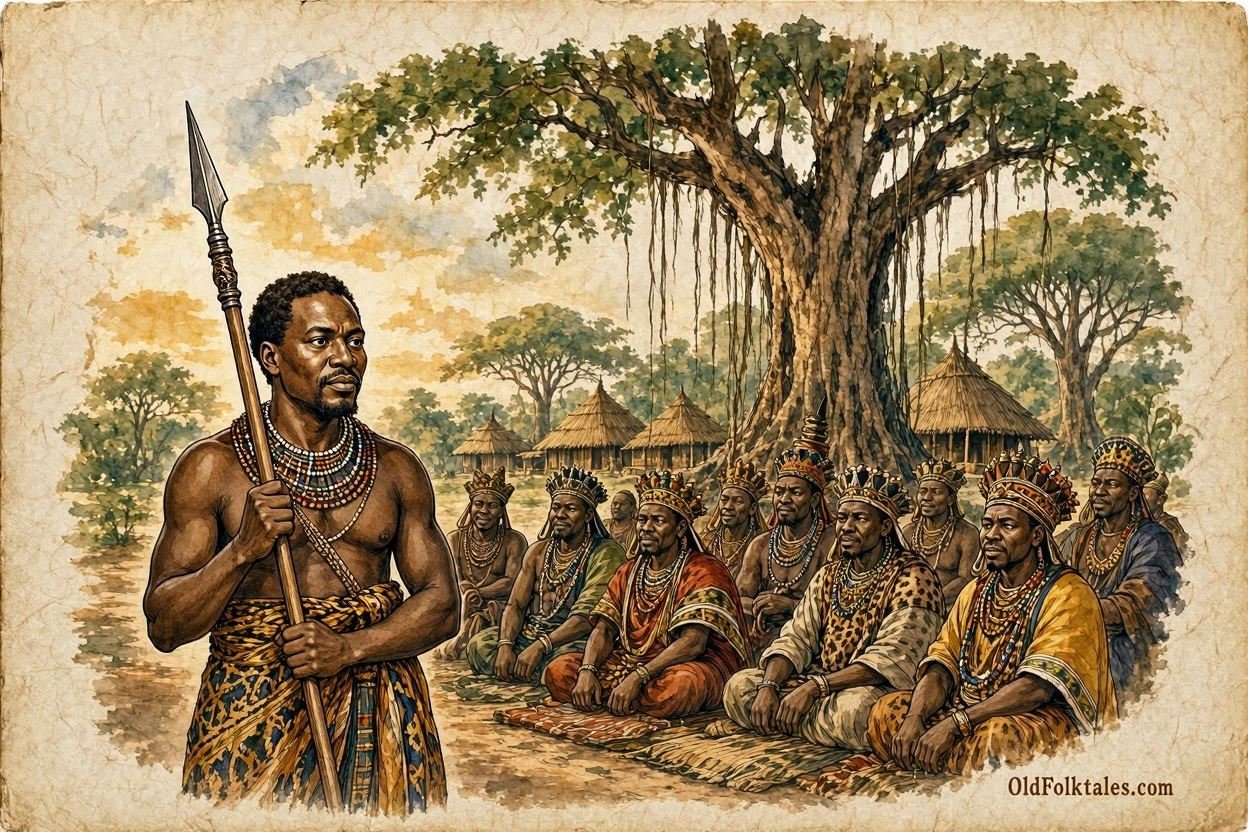
Before departing, his grandmother embraced him and placed an old spear into his hands.
Its polished wooden shaft bore the carved symbols of the royal ancestors.
“This is the Spear of Destiny,” she said softly.
“It has never belonged to the strongest warrior.”
“It belongs to the one who protects the people with wisdom.”
Kalala accepted the sacred weapon with deep respect.
“I will carry it with honor,” he promised.
For many years, he traveled far beyond the borders of the Luba Kingdom.
He lived among distant communities, learning new farming methods, listening to respected elders, and helping villages settle disputes without violence.
Although he mastered the skills of hunting and warfare, he came to believe that the greatest victory was preventing conflict before it began.
Meanwhile, life under King Nkongolo became increasingly difficult.
Harvests declined because farmers feared unfair taxes.
Trade between villages slowed.
Many experienced chiefs abandoned the royal court, unwilling to serve a ruler who valued obedience above justice.
The kingdom that had once prospered began to weaken.
One evening, a group of elderly chiefs secretly crossed the frontier in search of the exiled prince.
After many days, they found Kalala living among a peaceful community where he had earned the respect of everyone through honest work and wise counsel.
The oldest chief stepped forward.
“The Luba people have not forgotten you,” he said.
“Our kingdom cries out for justice.”
“We ask you to return.”
Kalala looked down at the Spear of Destiny resting beside him.
He knew that accepting their request would place him on a path from which there could be no turning back.
Kalala remained silent for a long time.
He looked at the chiefs who had traveled so far to find him.
Then he looked at the Spear of Destiny resting across his knees.
“I do not wish to return to claim power,” he said quietly. “If I return, it must be to restore justice.”
The chiefs nodded.
“That is why we have come,” the oldest replied.
Together they began the journey back to the Luba Kingdom.
As they traveled, people from villages along the way welcomed Kalala with songs and gifts.
News spread quickly that the exiled prince had returned.
Many remembered his kindness before he had been forced to leave.
Others had only heard stories of the young man who settled disputes fairly and treated every person with respect.
When King Nkongolo learned that Kalala was approaching the capital, he became furious.
“He has come to steal my throne,” he shouted.
He ordered his warriors to prepare for battle.
But many of them hesitated.
They had grown weary of fighting to protect fear instead of justice.
Some quietly lowered their weapons.
Others refused to march against the prince.
When Kalala reached the outskirts of the royal capital, he did not attack.
Instead, he sent messengers to the king.
“I have not come to destroy the kingdom,” his message said. “I have come to restore peace. Let the elders and chiefs judge between us.”
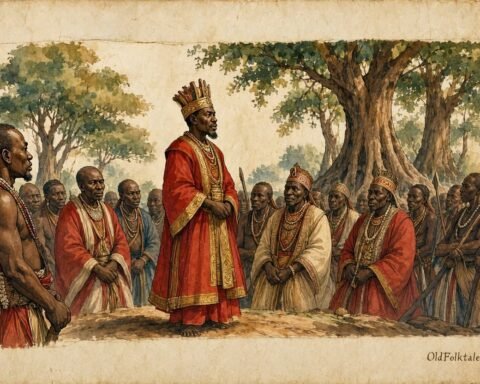
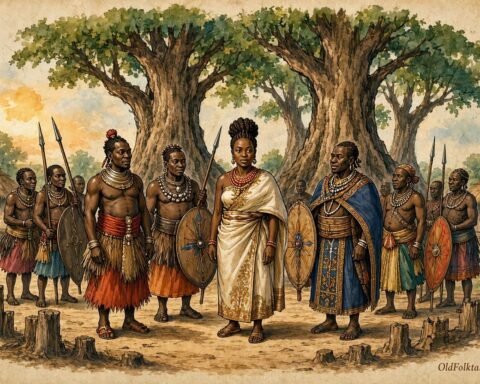
The royal council gathered beneath the great trees where kings had long been chosen and advised.
Chiefs from every province came to witness the meeting.
The oldest elder stood between the two men.
He spoke first to Nkongolo.
“A ruler is judged not by the size of his army but by the well being of his people.”
He then turned to Kalala.
“And a prince is judged not by his ambition but by his willingness to serve.”
One by one, the chiefs spoke of the suffering they had witnessed.
Farmers described empty fields.
Merchants told of abandoned trade routes.
Families spoke of fear replacing trust throughout the kingdom.
At last, the elder asked Kalala a single question.
“If the throne were given to you today, what would you do first?”
Kalala placed the Spear of Destiny upon the ground before him.
“I would not begin by rewarding my friends or punishing my enemies,” he answered.
“I would travel to every province, listen to the people, and rebuild the trust that has been broken. A kingdom cannot stand unless justice reaches every village.”
The gathering fell silent.
Even those who had once supported Nkongolo lowered their heads.
They recognized the difference between a man who desired power and one who accepted responsibility.
The council declared that Nkongolo’s reign had come to an end.
Kalala was chosen to lead the kingdom.
When the royal attendants offered him the crown, he first lifted the Spear of Destiny.
“My ancestors entrusted this spear to protect the people, not to rule over them,” he said.
“As long as I carry it, I will remember that leadership is a duty before it is an honor.”
During the years that followed, Kalala visited villages throughout the kingdom.
He reduced unfair taxes, restored peaceful trade, and encouraged chiefs to settle disagreements through dialogue before turning to conflict.
Slowly, prosperity returned to the Luba Kingdom.
Harvests became plentiful once again.
Markets filled with traders from distant lands.
Children grew up hearing stories not only of Kalala’s courage but also of his fairness and humility.
Whenever young princes prepared to become leaders, the elders would place a spear in their hands and remind them of Kalala’s example.
“A weapon carried for pride brings suffering,” they would say. “A weapon carried for justice protects the people.”
And so, Kalala Ilunga and the Spear of Destiny became one of the enduring royal legends of the Luba people, reminding every generation that true strength is found not in conquering others but in serving them with wisdom, justice, and courage.
If you liked this story, see our Central African folktales collection
Moral Lesson
This Luba folktale teaches that true leadership is earned through justice, humility, and service. Courage is most powerful when it is used to protect people rather than to seek personal power.
Knowledge Check
1. Why was Prince Kalala Ilunga forced into exile?
King Nkongolo feared Kalala’s growing popularity and saw him as a threat to his rule.
2. What was the significance of the Spear of Destiny?
It symbolized the responsibility to protect the people with wisdom and justice rather than rule through force.
3. Why did the chiefs ask Kalala to return?
They believed only he could restore justice and peace to the troubled kingdom.
4. How did Kalala respond when he reached the capital?
He called for the elders and chiefs to judge fairly instead of attacking the kingdom.
5. What promise did Kalala make after becoming king?
He promised to lead with justice, rebuild trust, and remember that leadership is a duty before it is an honor.
6. What is the central lesson of this folktale?
The story teaches that lasting leadership is built on wisdom, justice, humility, and service to the people.
Source: Adapted from Luba royal traditions recorded in Thomas Q. Reefe, The Rainbow and the Kings: A History of the Luba Empire (1981).