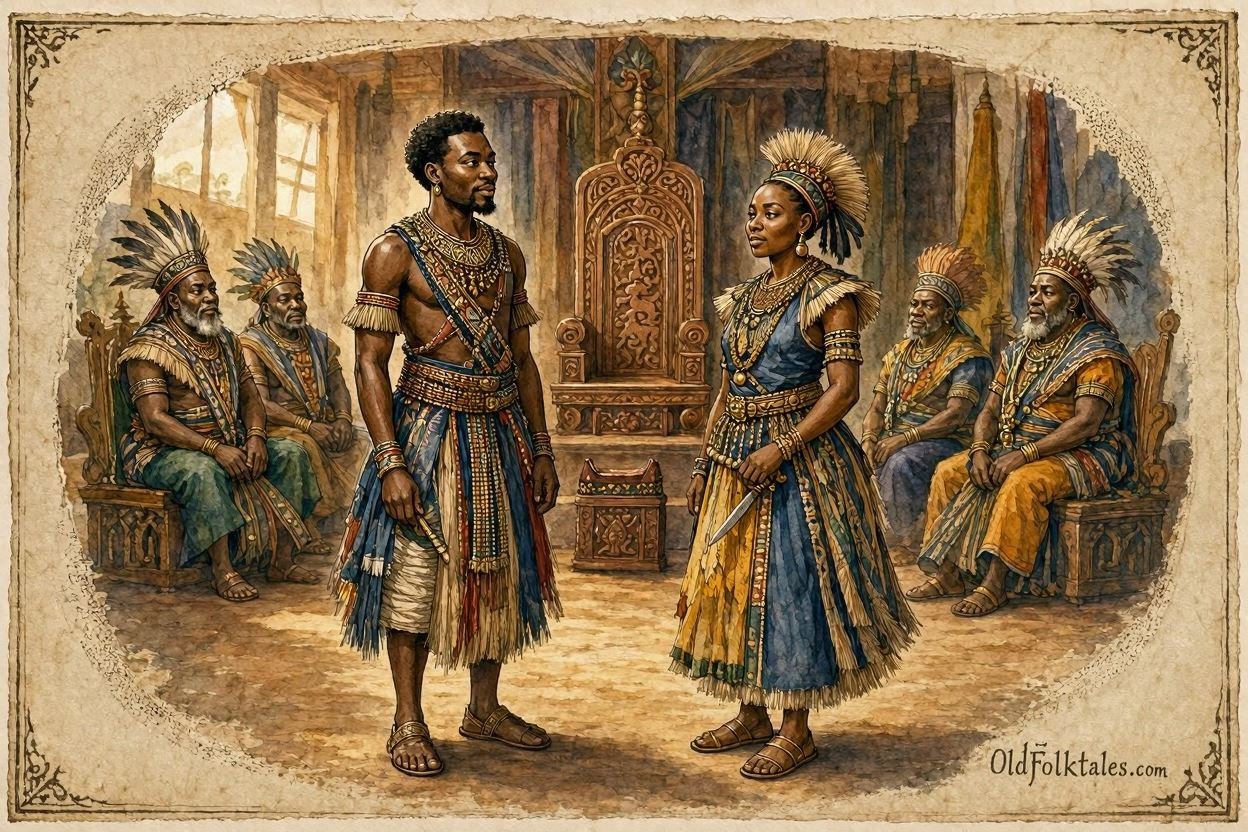
Across the vast woodlands and grassy plains of Central Africa, stories were told of a young prince whose journey would forever change the destiny of two great peoples.
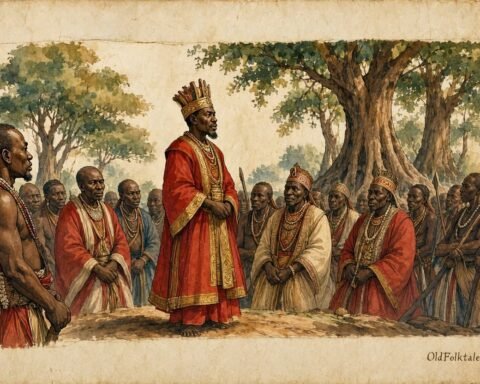
His name was Chibinda Ilunga, a prince of the Luba Kingdom, celebrated not only for his skill with the bow and spear but also for his wisdom, humility, and respect for every person he met.
Although he was born into royalty, Chibinda never believed that noble blood alone made someone worthy of leadership.
He often left the royal court to hunt alongside ordinary villagers, listened to the counsel of elders, and learned the customs of distant clans.
Many admired the young prince.
Others whispered that he was meant for a destiny greater than the kingdom of his birth.
One season, after a time of unrest among neighboring chiefdoms, Chibinda decided to travel beyond the familiar borders of the Luba Kingdom.
He wished to learn how other communities lived and to build friendships where conflict had once existed.
Don’t stop yet! See our complete East African folktales collection
The elders blessed his journey.
Before his departure, the oldest among them placed a finely carved bow in his hands.
“This bow has protected our people for generations,” the elder said. “Carry it with wisdom, for its greatest strength is not in battle but in the peace that follows restraint.”
With a small group of trusted companions, Chibinda began his long journey.
They crossed broad rivers whose waters shimmered beneath the morning sun.
They walked through forests alive with birdsong and passed villages where strangers were welcomed with songs, shared meals, and stories around evening fires.
Everywhere he traveled, Chibinda treated people with kindness.
He helped hunters repair broken traps.
He settled disagreements between travelers without drawing a weapon.
He accepted local customs with respect instead of demanding that others follow his own traditions.
News of the wandering prince spread from village to village.
People spoke of a leader who listened before speaking and who earned respect without demanding it.
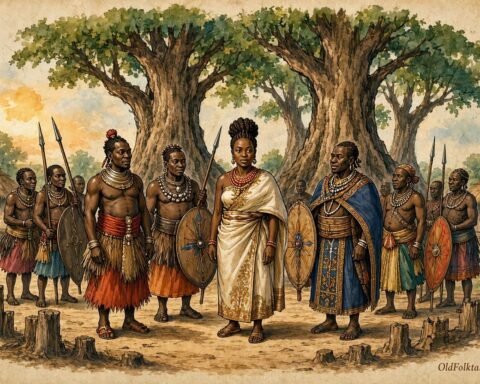
Far to the south, within the flourishing lands of the Lunda people, these stories eventually reached the ears of Princess Lueji, a wise and capable ruler who had inherited responsibility for her father’s kingdom.
Her advisers told her about the remarkable stranger.
“He is a prince,” one elder explained, “but he walks among ordinary people as though they were his equals.”
Lueji became curious.
“A ruler who seeks wisdom beyond his own homeland,” she said thoughtfully, “may carry a future greater than any of us can yet see.”
Not long afterward, fate brought Chibinda Ilunga into the lands of the Lunda Kingdom.
Neither he nor Princess Lueji realized that their meeting would unite two royal traditions and shape the future of Central Africa for generations to come.
When Chibinda Ilunga arrived in the Lunda Kingdom, he expected nothing more than a place to rest before continuing his journey.
Instead, he found a kingdom preparing for an important gathering of chiefs.
Princess Lueji had invited leaders from every corner of her realm to discuss growing disputes over hunting lands and trade routes.
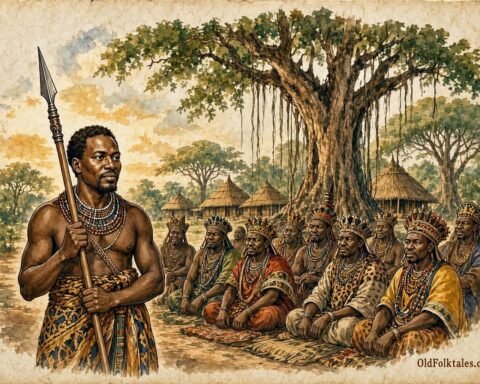
As a respected visitor, Chibinda was welcomed to observe the meeting.
He sat quietly among the elders, speaking only when invited.
The discussions soon became heated.
Several chiefs insisted that only force could settle the disagreements.
Others demanded that neighboring clans surrender valuable lands.
Princess Lueji listened patiently but saw that no agreement could be reached.
She then turned toward the visiting prince.
“You have traveled among many peoples,” she said. “If you were responsible for this kingdom, how would you bring peace?”
The gathering fell silent.
Chibinda stood respectfully before the assembly.
“A kingdom becomes strong,” he replied, “not when one chief defeats another, but when every community believes that justice belongs to all.”
He suggested that respected elders from each clan form a council to hear disputes before violence was allowed.
He also proposed shared hunting grounds during difficult seasons so that no family would suffer from hunger.
The chiefs discussed his ideas long into the evening.
Gradually, one after another, they agreed.
For the first time in many months, the gathering ended in peace rather than anger.
Princess Lueji admired not only Chibinda’s wisdom but also his humility.
He had offered advice without seeking praise.
He had spoken with confidence without insulting anyone.
During the months that followed, Chibinda remained in the Lunda Kingdom as an honored guest.
He taught improved methods of hunting, encouraged cooperation between neighboring villages, and learned the customs and traditions of the Lunda people with genuine respect.
In time, a deep friendship grew between Chibinda and Princess Lueji.
Their shared commitment to justice and good leadership united them, and they were married in a ceremony attended by chiefs, elders, and families from many different clans.
Their marriage became more than the union of two people.
It symbolized the friendship between the Luba and Lunda peoples.
Together, they strengthened trade, encouraged peaceful cooperation, and established customs that promoted fairness throughout the kingdom.
Chibinda never tried to replace the traditions of the Lunda.
Instead, he honored them while sharing the knowledge he had carried from his homeland.
Because of this mutual respect, the kingdom prospered.
Harvests became plentiful.
Trade routes expanded across Central Africa.
Travelers spoke of a land where strangers were welcomed and justice guided those in authority.
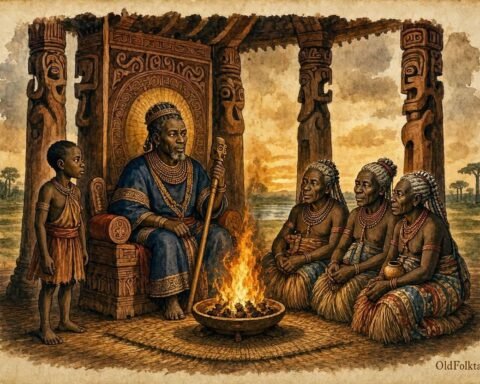
Before growing old, Chibinda gathered the young princes and princesses of the royal family.
He held up the carved bow that had been entrusted to him when he left the Luba Kingdom.
“My greatest journey,” he told them, “was not measured by the rivers I crossed or the forests I explored. It was measured by the friendships I built and the peace we created together.”
The children remembered his words.
For generations afterward, the story of Chibinda Ilunga was told whenever young leaders prepared to accept responsibility.
The elders reminded them that a true ruler does not become great by conquering new lands but by earning the trust of the people through wisdom, humility, and honorable leadership.
And so, Chibinda Ilunga, the Stranger Prince became one of the most treasured royal legends of the Luba and Lunda peoples, celebrating the power of unity, diplomacy, and leadership rooted in mutual respect.
Click here to explore more Central African folktales
Moral Lesson
This Congolese folktale teaches that true leadership is built on wisdom, humility, respect for others, and the ability to unite people rather than divide them.
Knowledge Check
1. Why did Chibinda Ilunga leave the Luba Kingdom?
He traveled to learn from other communities and build peaceful relationships.
2. Who welcomed Chibinda into the Lunda Kingdom?
Princess Lueji welcomed him as an honored guest.
3. How did Chibinda help settle the disputes among the chiefs?
He proposed a council of elders and shared hunting grounds to ensure fairness and peace.
4. Why did Princess Lueji admire Chibinda?
She admired his wisdom, humility, and ability to lead without seeking personal glory.
5. How did the marriage of Chibinda and Lueji benefit their kingdoms?
It strengthened unity, trade, peaceful cooperation, and mutual respect between the Luba and Lunda peoples.
6. What is the central lesson of this folktale?
The story teaches that lasting greatness comes from wise leadership, diplomacy, and respecting the traditions of others.
Source: Adapted from Luba and Lunda royal traditions discussed in Jan Vansina’s Kingdoms of the Savanna (1966) and Thomas Q. Reefe’s The Rainbow and the Kings: A History of the Luba Empire (1981).