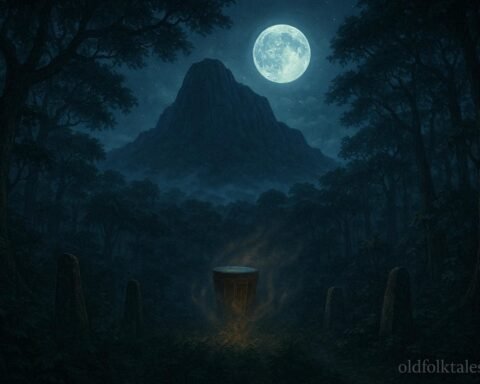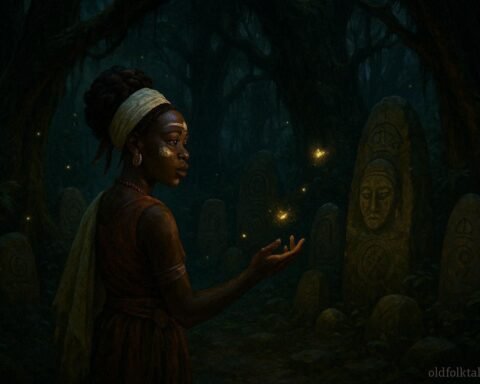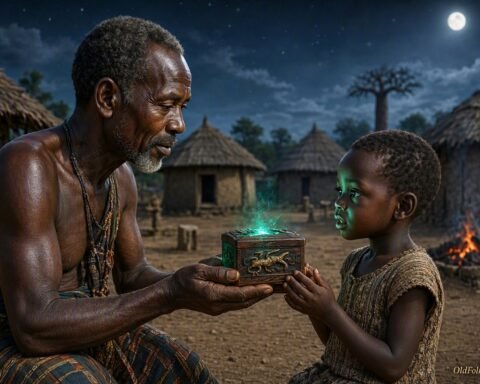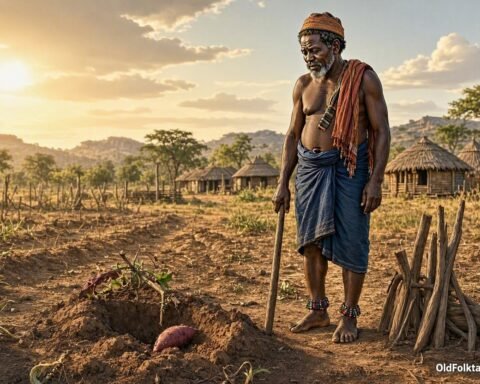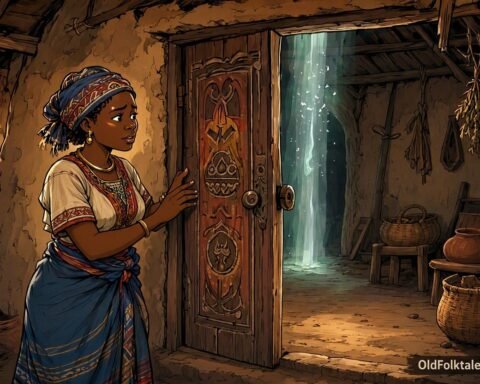
Long ago, in the vast rainforests of Gabon, where towering trees formed a green canopy above winding rivers and hidden pathways, forest communities lived in close harmony with nature. Among the Pygmy peoples who called these forests home, every part of the environment possessed meaning. Trees were not merely wood, rivers were not merely water, and animals were not simply creatures of the wild. Everything belonged to a living world connected through memory, spirit, and balance.
The elders taught that the forest was older than any village and wiser than any single person. It remembered the footsteps of ancestors, the songs of hunters, and the journeys of generations who had traveled beneath its shade. Those who listened carefully could learn valuable lessons from the sounds of birds, the movement of rivers, and even the silence between the trees.
Among the many stories passed from one generation to another, none was more respected than the legend of the Bridge of Whispering Vines.
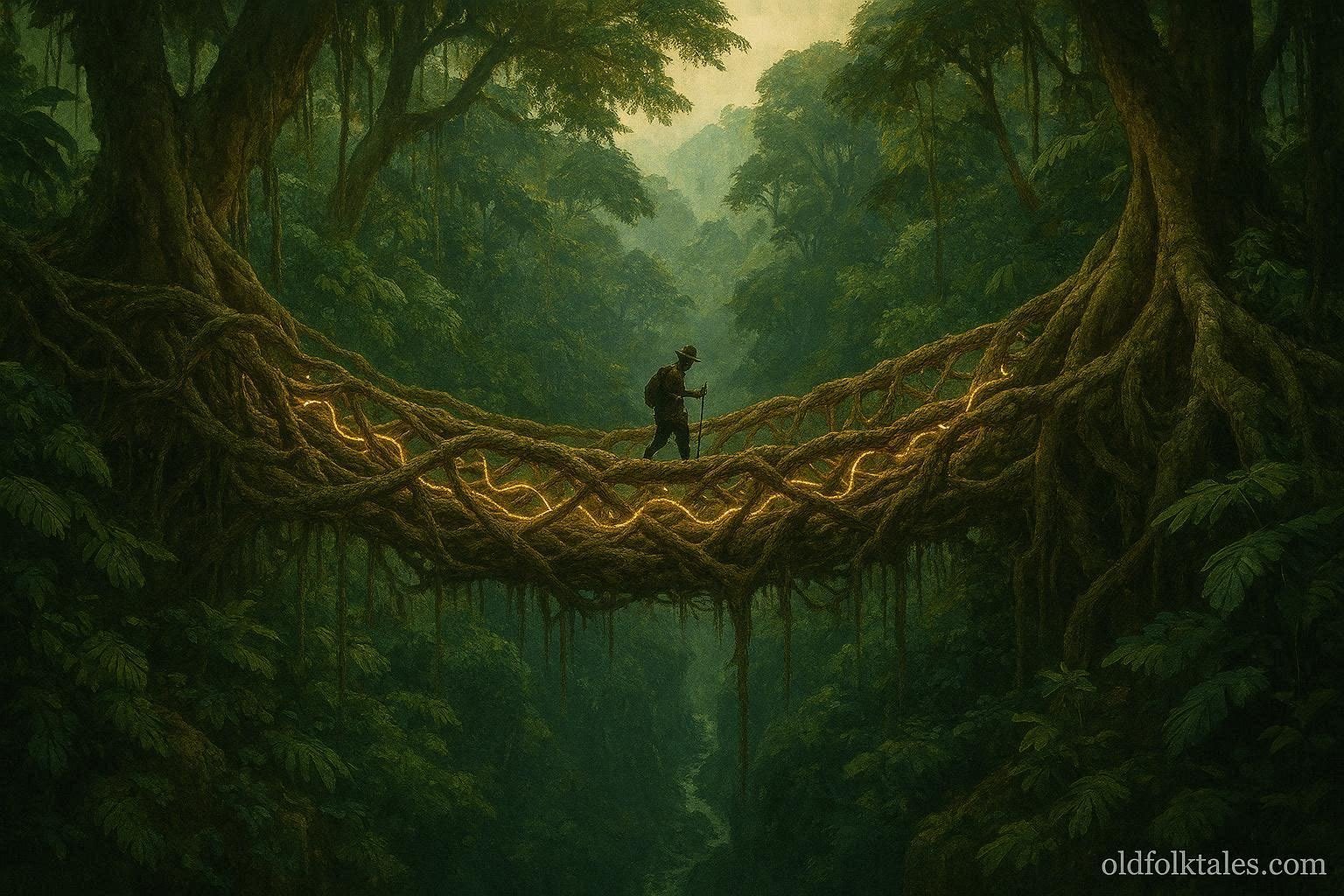
The bridge was said to exist deep within a remote section of rainforest rarely visited by outsiders. According to tradition, it stretched across a wide river gorge where swift waters rushed far below. Unlike ordinary bridges built by human hands, this bridge was alive. Thick forest vines intertwined with enormous tree roots, creating a natural pathway that connected both sides of the gorge.
Looking for more? Explore the magic of East African folktales here
What made the bridge extraordinary was not its appearance but its voice.
Those who approached it respectfully claimed to hear whispers emerging from the vines. These whispers were said to contain stories, lessons, warnings, and memories preserved by the forest itself. The bridge never spoke loudly. Instead, its words came softly, carried by the wind moving through leaves and twisting vines.
The elders taught that the bridge only revealed its wisdom to people who crossed with humility. Those motivated by greed, arrogance, or disrespect would hear nothing at all.
For generations, the story remained part of local tradition.
Some believed it completely.
Others viewed it as a symbolic lesson encouraging respect for nature.
Yet many insisted that the bridge truly existed.
One of the most famous accounts connected to the legend took place during the youth of a hunter named Komba.
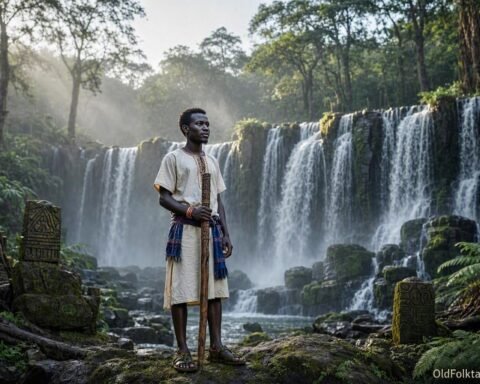
Komba lived in a small forest settlement known for its skilled trackers and gatherers. From an early age, he demonstrated exceptional talent as a hunter. He could identify animal tracks hidden beneath leaves, predict weather changes from subtle signs, and navigate dense forest paths with remarkable confidence.
As his reputation grew, so did his pride.
Komba began believing that no one understood the forest better than he did. Although he respected the elders publicly, he often dismissed their stories in private conversations with his friends.
One evening, while villagers gathered around a fire listening to an elder recount the legend of the Bridge of Whispering Vines, Komba quietly laughed.
“How can a bridge tell stories?” he asked.
The elder smiled calmly.
“The forest speaks in many ways.”
“But have you ever heard it yourself?” Komba challenged.
The old man nodded.
“I have heard enough to know that wisdom often speaks softly.”
Komba remained unconvinced.
Determined to prove the story false, he decided to search for the bridge himself.
Several days later, he set out alone before sunrise. Carrying his spear, hunting knife, and a small bag of provisions, he followed little-used forest paths leading toward regions rarely visited by his community.
The journey proved more difficult than expected.
The deeper Komba traveled, the denser the forest became. Massive trees blocked sunlight from reaching the ground. Strange bird calls echoed through the canopy while unfamiliar insects filled the air with sound. Yet he continued forward, driven by curiosity and confidence.
After two days of travel, he reached a part of the forest unlike any he had seen before.
Ancient trees towered above him like pillars supporting the sky. Their roots twisted across the ground in enormous patterns, creating natural walls and pathways. The air felt cooler and strangely still.
As Komba moved carefully through the area, he heard the sound of rushing water ahead.
Following the noise, he emerged at the edge of a deep gorge.
There, spanning the distance between both sides, stood the bridge.
At first glance, it appeared exactly as the elders described.
Hundreds of thick vines intertwined with roots and branches to form a natural crossing above the river below. Moss covered parts of the structure, and small plants grew from its surface. Despite appearing ancient, the bridge looked remarkably strong.
Komba smiled.
It was impressive.
But it was still only a bridge.
Without hesitation, he stepped onto it.
The vines shifted slightly beneath his feet.
Wind moved through the gorge.
Yet no whispers came.
No stories emerged.
Only ordinary sounds filled the air.
Satisfied that the legend had been exaggerated, Komba crossed to the opposite side and spent the remainder of the day exploring nearby forest areas.
As evening approached, however, dark clouds suddenly gathered overhead.
Within minutes, heavy rain began falling.
The forest transformed rapidly.
Paths disappeared beneath water.
Visibility decreased.
Strong winds shook the trees.
Komba attempted to retrace his route home but quickly became disoriented.
For the first time in many years, he realized he was completely lost.
Night arrived faster than expected.
Unable to find shelter, he spent hours wandering through unfamiliar terrain while rain continued pouring from the sky.
Fear slowly replaced confidence.
The next morning, exhausted and hungry, Komba admitted what he had previously refused to consider.
He needed help.
Remembering the bridge, he decided to return to the gorge and attempt to find his bearings from there.
After many hours of searching, he finally reached it.
This time, however, he approached differently.
He no longer carried the certainty that had accompanied him before.
Standing before the bridge, he lowered his head.
He thanked the forest for protecting him during the storm.
He apologized for his arrogance.
And he asked respectfully for guidance.
Then he stepped onto the bridge.
Almost immediately, something changed.
A gentle breeze moved through the vines.
Soft sounds emerged around him.
At first, they resembled distant voices.
Then the sounds became clearer.
Not loud enough to fully understand every word, but distinct enough to recognize as whispers.
Komba stopped walking.
The whispers seemed to come from every direction at once.
Fragments of stories drifted through the air.
Tales of hunters who shared food with strangers.
Accounts of families helping one another during difficult times.
Lessons about patience, humility, and cooperation.
The voices spoke not to impress him but to teach him.
As he continued crossing, the whispers guided his thoughts toward mistakes he had made and lessons he had ignored.
When he reached the opposite side, a final whisper reached his ears.
“The forest gives knowledge to those willing to listen.”
The breeze faded.
The voices disappeared.
Silence returned.
Yet Komba felt profoundly changed.
Following instincts shaped by what he had heard, he soon discovered a path leading back toward his village.
Several days later, he returned home safely.
The villagers celebrated his return, having feared he had disappeared forever.
When the elders asked about his journey, Komba told them everything.
He described the bridge.
The storm.
The whispers.
And the lessons he had learned.
From that day forward, he became known not only as a skilled hunter but also as a patient listener. Younger members of the community often sought his advice, and he always encouraged them to respect both nature and traditional wisdom.
Years later, Komba became an elder himself.
Whenever children asked whether the Bridge of Whispering Vines truly existed, he smiled before answering.
“The bridge is real,” he would say.
“But its greatest stories are heard only by those who cross it with respect.”
Even today, among some forest communities of Gabon, stories continue to circulate about travelers who hear whispers while crossing hidden vine bridges deep within the rainforest.
Whether these accounts describe a real place or a symbol of ancestral wisdom remains uncertain.
Yet the lesson endures.
Knowledge often surrounds us.
But only those who approach the world with humility are able to hear it.
Keep reading: Discover more Central African folktales
Moral Lesson
Wisdom comes to those who listen with humility, respect, and an open heart.
Knowledge Check
- Where is the story set?
It is set in the rainforests of Gabon. - What was special about the Bridge of Whispering Vines?
It was believed to share ancient stories and wisdom through whispers carried by the wind. - Who was Komba?
He was a talented young hunter who doubted the legend of the bridge. - Why did Komba become lost?
A powerful storm struck while he was exploring unfamiliar parts of the forest. - When did the bridge begin whispering to him?
It began speaking after he approached it with humility and respect. - What lesson did Komba learn?
He learned that wisdom comes from listening and respecting both nature and tradition.
Source
Gabonese folklore. Adapted from Pygmy forest storytelling traditions preserved in Gabon rainforest oral tradition archives and Central African ethnographic folklore studies.