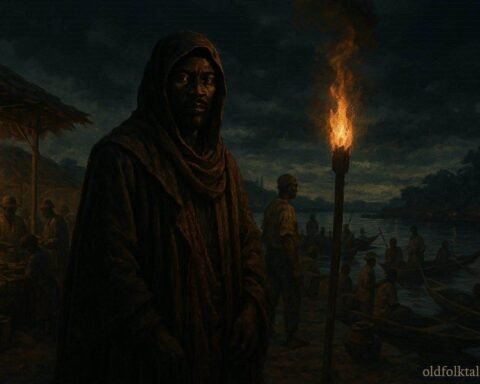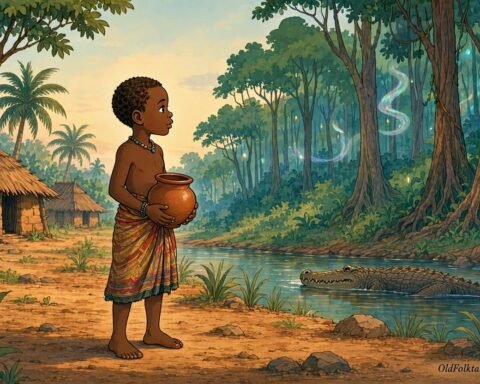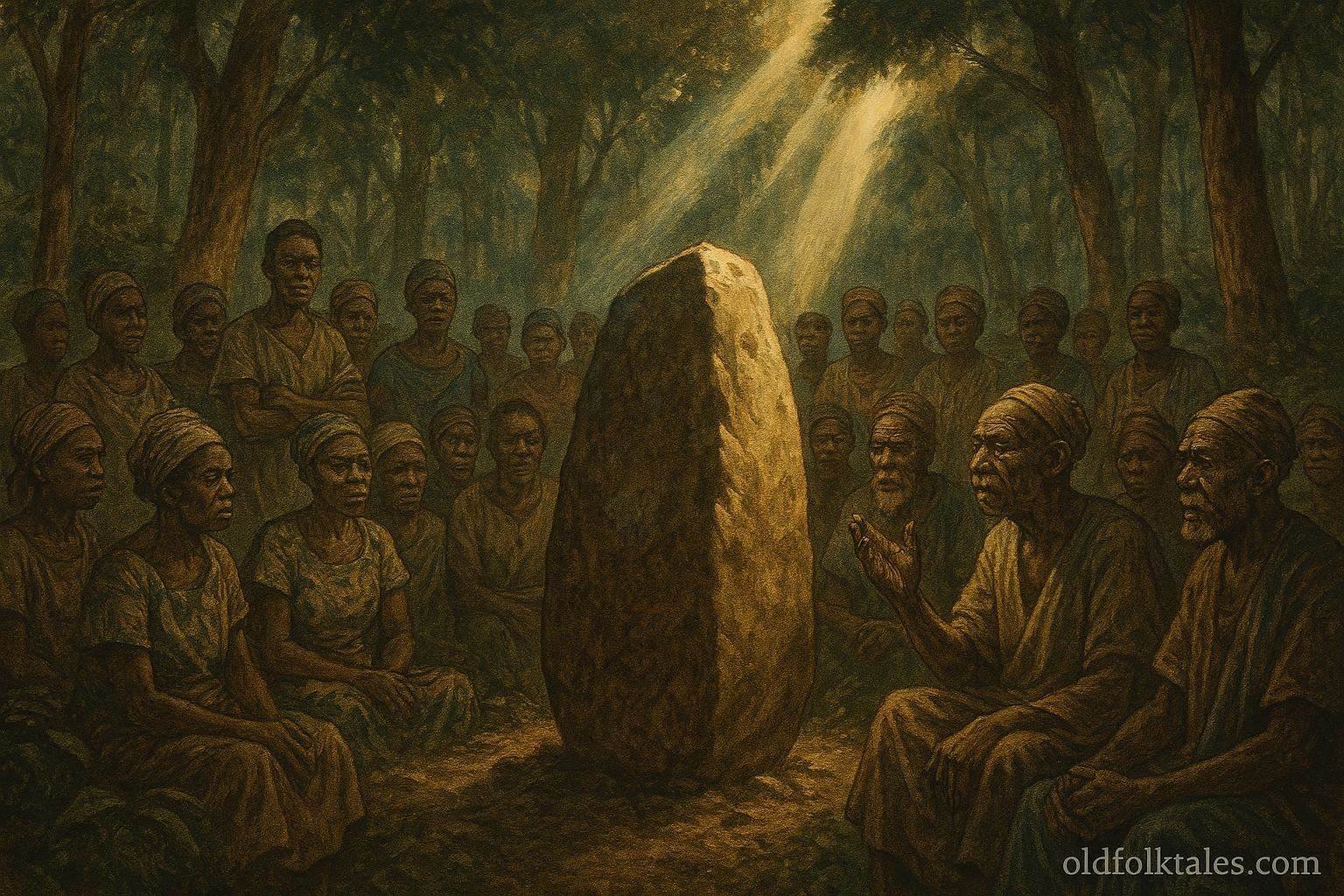
In the deep forests and river valleys of eastern Democratic Republic of Congo, within the region known as Maniema, the Bembe people lived closely connected to the land, the spirits of their ancestors, and the moral codes that governed everyday life. Their society was shaped not only by farming, fishing, and trade, but also by strong traditions of justice that ensured peace within and between communities. Among the most respected of these traditions was the story of the Judgment Stone, a sacred object believed to reveal truth when human words alone could no longer be trusted.
Long ago, in a cluster of villages surrounded by thick forest and winding rivers, life was peaceful most of the time. Families worked their farms, children played along riverbanks, and elders gathered under large trees to tell stories that preserved the wisdom of the past. However, like all communities, disagreements were inevitable. Sometimes disputes arose over farmland boundaries after floods shifted the river paths. At other times, arguments broke out over inheritance when a family head passed away. There were also moments when accusations of theft or dishonesty created tension between neighbors who had once lived in harmony.
At first, these conflicts were handled through ordinary discussions led by elders. The elders would listen carefully, ask questions, and encourage reconciliation. Most of the time, this system worked well because the Bembe people valued peace and respected their leaders. But there came a period when disputes became more frequent and more difficult to resolve. People began to distrust each other more deeply, and even when elders tried to settle matters, arguments often continued after the gatherings ended. The unity of the villages began to weaken.
Explore the wisdom and wonder of North African folktales
It was during this period of growing tension that the story of the Judgment Stone became central to the community’s way of seeking truth. According to oral tradition, the stone had always existed in a sacred place deep within the forest, though few knew exactly when it first appeared. Some said it was placed there by the ancestors at the beginning of time, while others believed it was formed by natural forces guided by spiritual will. Whatever its origin, the stone was regarded as more than just a physical object. It was believed to carry the presence of ancestral truth.
The stone was smooth, dark, and unusually heavy for its size. It was said that no one could move it without permission from the elders, and that anyone who attempted to misuse it would face misfortune or confusion. Because of these beliefs, it was treated with great respect and only brought into use when a dispute could not be resolved through ordinary means.
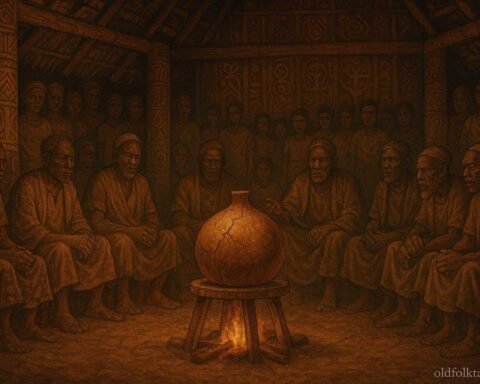
When conflicts reached a serious level, messengers were sent to call the elders together. The community would gather in an open clearing where the Judgment Stone was placed. Before any case began, rituals were performed to honor the ancestors. Elders would pour water or palm wine onto the ground as an offering, speak prayers in traditional language, and ask for clarity and truth to guide the process. The atmosphere during these gatherings was always solemn, as everyone understood the importance of what was about to take place.
When both parties in a dispute stood before the stone, they were required to speak their truth openly. The elders would first allow each side to explain their version of events without interruption. After this, questions would be asked to test consistency and clarity. Throughout the process, the stone remained at the center, silent but deeply symbolic. Many believed that its presence affected those who lied, making them uneasy or uncertain in their speech.
There was a well known case that became part of the oral tradition surrounding the stone. It involved two families who lived near each other and shared a long history of cooperation. One rainy season, a valuable hunting trap disappeared from the boundary between their lands. Both families accused each other of taking it, and the disagreement quickly escalated. What began as a small misunderstanding turned into a serious conflict that divided the entire village.
Despite repeated attempts by elders to mediate, neither side was willing to accept responsibility or compromise. The tension grew so strong that trade between the families stopped completely, and even social visits were avoided. Seeing that the situation threatened the unity of the entire community, the elders decided to bring the matter before the Judgment Stone.
On the day of the gathering, the entire village assembled in silence. The forest seemed unusually still, as if nature itself was observing the event. The stone was placed at the center of the clearing, and rituals were performed to prepare the space. Both families stood on opposite sides, their faces filled with a mixture of anger, fear, and hope.
The first family spoke, denying any involvement in the disappearance of the trap. They swore that they had seen no one from their household near the boundary at the time it went missing. The second family responded with equal certainty, insisting that the other side had been seen near the area shortly before the trap vanished. As each side spoke, the elders observed carefully, noting inconsistencies and emotional reactions.
As the questioning continued, something unusual began to happen. One of the accused individuals became visibly restless. His voice faltered, and he struggled to maintain his account. The elders pressed further, asking detailed questions about his movements during the time of the incident. Under the weight of scrutiny and the symbolic presence of the stone, he eventually admitted that he had taken the trap in a moment of temptation, believing no one would notice.
His confession changed everything. The tension that had built up between the two families slowly began to dissolve. While there was disappointment, there was also relief that the truth had finally been revealed. The elders guided both families toward reconciliation, encouraging forgiveness and restoration of peace. Compensation was arranged according to tradition, and steps were taken to rebuild trust between them.
After this event, the reputation of the Judgment Stone grew even stronger. People began to believe that it did not simply expose lies, but also reminded individuals of their own conscience. It was said that standing before the stone forced people to confront the truth within themselves, even when no physical force was applied.
Over time, the stone became a powerful symbol of justice in Maniema. It was not used frequently, but its presence influenced behavior throughout the region. People became more cautious in their actions, knowing that dishonesty could eventually be revealed. The tradition reinforced the importance of truth, responsibility, and accountability in maintaining social harmony.
Even in later generations, when formal disputes were resolved without the stone being physically present, its symbolic meaning remained deeply rooted in the culture. Elders would refer to it when reminding younger people about the importance of honesty. Parents used its story to teach children about integrity, and storytellers kept its memory alive through oral tradition.
Today, the Judgment Stone of Maniema remains part of the cultural imagination of eastern Congo. Whether understood as a spiritual object or a powerful symbol of justice, it continues to represent the belief that truth is essential for peace, and that a community cannot survive without fairness and trust.
Keep reading: Discover more Central African folktales
Moral Lesson
Truth and justice are the foundation of peace and unity in any society.
Knowledge Check
- Where is the story set?
It is set in Maniema in the Democratic Republic of Congo. - What is the Judgment Stone?
It is a sacred stone believed to reveal truth during disputes. - How was it used?
It was placed at a gathering where elders resolved serious conflicts. - What happened during disputes?
Both sides spoke while elders observed and sought the truth. - What role did elders play?
They guided judgment and maintained fairness in the process. - What is the lesson of the story?
Honesty and justice are necessary for peace and harmony.
Source
Central African folklore. Adapted from Maniema oral justice traditions documented in eastern Democratic Republic of Congo ethnographic studies.