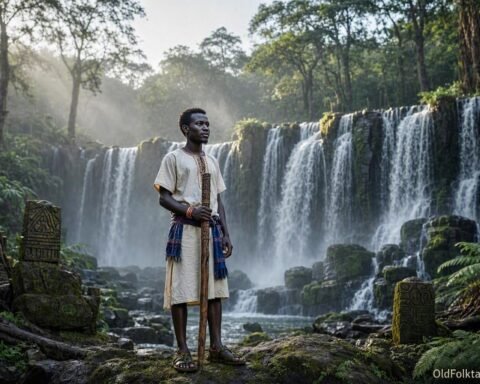
Generations ago, in the Nyanga region of present-day Gabon, the Vili people lived among fertile valleys, winding rivers, and thick forests rich with wildlife. Farming, fishing, and trade sustained their communities, and the success of each season’s harvest determined whether families would enjoy abundance or face hardship. Elders taught that prosperity depended not only on hard work but also on generosity, cooperation, and respect for the balance that connected people to the land.
Among the Vili, sharing was considered a sacred responsibility. When one family harvested more food than it needed, the surplus was often distributed among neighbors. Fishermen shared part of their catch with elders and widows. Hunters provided meat for community gatherings. The well-being of the village depended upon everyone supporting one another, especially during difficult times.
For centuries, elders told a curious story about a hidden orchard somewhere deep within the forests of Nyanga. According to the legend, the orchard appeared only when communities faced extraordinary hardship. Its trees produced fruit unlike any found elsewhere in the region. The fruit was said to be abundant, nourishing, and capable of sustaining entire villages through times of scarcity.
Some believed the orchard was real.
Want more? Read more West African folktales now
Others considered it a symbolic lesson about generosity and communal responsibility.
Regardless of their beliefs, the story remained one of the most respected traditions passed from one generation to the next.
Then came a year that tested the people like never before.
The rainy season arrived late.
When rain finally came, it lasted only a short time before disappearing again.
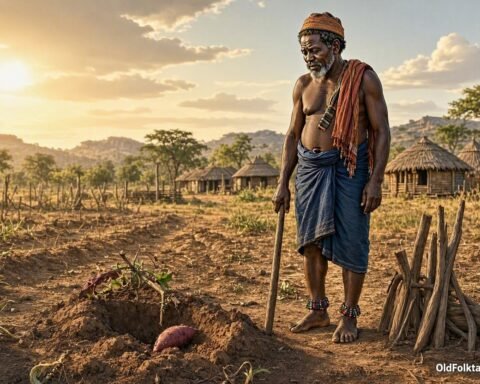
The rivers that normally nourished fields began to shrink. Crops struggled to grow beneath the relentless heat. Farmers watched helplessly as their cassava and plantains withered in the fields. Fishing also became difficult as water levels dropped and fish moved elsewhere.
At first, the villagers relied upon food they had stored from previous harvests.
But as the months passed, those supplies steadily diminished.
Families began eating smaller meals.
Parents worried about their children.
The elderly grew weak.
Concern spread throughout every household.
Village leaders gathered repeatedly beneath the large meeting tree at the center of the settlement. They discussed possible solutions and organized hunting expeditions into distant forests. Yet each effort produced only limited success. Food remained scarce, and the drought showed no signs of ending.
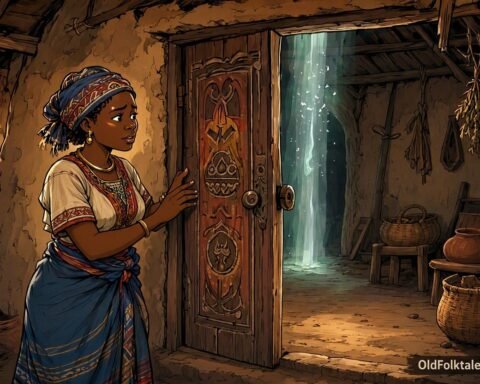
During one such gathering, an elderly woman named Mbanza rose to speak.
Her voice was soft, but everyone listened.
“Our ancestors told us of a hidden orchard,” she said. “Perhaps the time has come to search for it.”
A few villagers exchanged doubtful glances.
Many had heard the story all their lives but never expected to find the orchard itself.
Still, desperation often encourages people to consider possibilities they might otherwise dismiss.
After much discussion, a group of volunteers agreed to explore the surrounding forests.
Among them was a young hunter named Kivula.
Kivula was respected for his courage and knowledge of the wilderness. He knew countless forest trails and had traveled farther than most members of the community. Although he was skeptical of legends, he believed the search might uncover food sources unknown to the village.
The search party departed before sunrise the following morning.
For several days, they explored valleys, crossed streams, and followed old animal paths through dense forest. They discovered edible plants and gathered small amounts of food, but nothing sufficient to solve the community’s growing crisis.
On the fifth day, while investigating a remote area alone, Kivula noticed something unusual.
A sweet fragrance drifted through the air.
The scent was unlike anything he had encountered before.
Curious, he followed it deeper into the forest.
The aroma grew stronger with each step.
Eventually, the trees opened into a large clearing.
Kivula stopped in amazement.
Before him stretched an orchard unlike any he had ever seen.
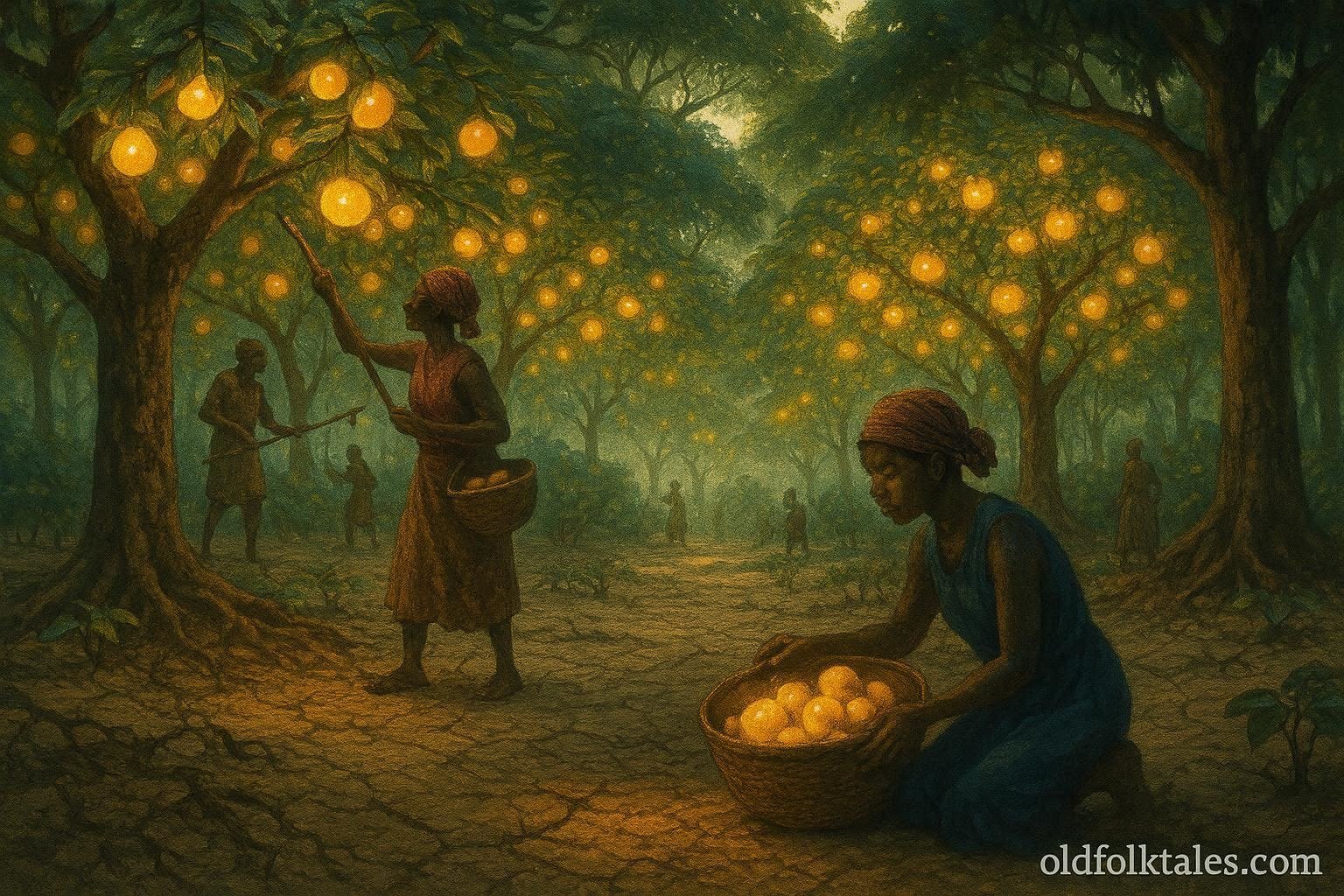
Rows of fruit trees filled the clearing. Their branches bent beneath the weight of ripe fruit in brilliant shades of gold, red, and orange. Birds sang among the leaves. A clear stream flowed through the center of the orchard, providing fresh water despite the drought affecting the surrounding region.
For several moments, Kivula wondered whether he was dreaming.
Then he approached one of the trees and carefully picked a fruit.
It was sweet, refreshing, and unlike anything he had tasted before.
Realizing the importance of his discovery, he hurried back to find the rest of the search party.
When they returned together and witnessed the orchard for themselves, their astonishment matched his own.
The group gathered baskets of fruit and carried them back to the village.
The reaction was immediate.
People who had gone hungry for weeks finally enjoyed a proper meal.
Children laughed again.
The elderly regained strength.
Hope returned to the community.
The following day, village leaders visited the orchard and organized a system to ensure that everyone benefited fairly from its abundance. Families were given equal access to the fruit, and special care was taken to provide for the elderly, the sick, and those unable to travel.
The arrangement worked well.
Each day, small groups visited the orchard, collected what they needed, and returned home. No one took more than necessary. The community treated the orchard with gratitude and respect.
As the weeks passed, the orchard continued producing fruit.
No matter how much was harvested, the trees remained full.
Many villagers became convinced that the orchard truly was the blessing described in ancient stories.
One evening, Mbanza addressed the community.
“The orchard provides for us because we remain united,” she reminded them. “Its gift belongs to everyone.”
Most people agreed.
Yet not everyone viewed the orchard in the same way.
A trader named Sefu began seeing an opportunity where others saw a blessing.
He realized that the fruit could be exchanged with travelers and merchants from neighboring regions. Since the drought affected many communities, the fruit would command a high value.
At first, Sefu simply considered the possibility.
Then he began acting upon it.
Without informing anyone, he started visiting the orchard at night.
He collected far more fruit than he needed and stored it secretly near his home. Later, he traded it for goods and valuables brought by passing merchants.
The profits were considerable.
Encouraged by his success, Sefu became increasingly ambitious.
Soon he persuaded a few others to join him.
Together they harvested large quantities of fruit beyond what community rules permitted.
For a while, their activities remained unnoticed.
The orchard still appeared abundant.
The trees remained heavy with fruit.
But gradually, subtle changes emerged.
The stream flowing through the orchard became smaller.
Birds visited less frequently.
Some branches no longer produced fruit as before.
Kivula noticed these changes during his regular visits.
Concerned, he informed the village elders.
After discussing the matter, they decided to investigate.
The truth soon came to light.
Evidence revealed that Sefu and his companions had been secretly exploiting the orchard for personal gain.
When confronted, Sefu attempted to justify his actions.
“The fruit was plentiful,” he argued. “I simply used an opportunity that was available.”
Mbanza looked at him sadly.
“You forgot why the orchard appeared,” she replied.
“It came to help a community in need, not to enrich individuals.”
Many villagers shared her disappointment.
The issue was not merely that Sefu had taken extra fruit.
It was that he had placed personal wealth above collective well-being.
The elders instructed him to stop immediately and return whatever resources he could.
Sefu reluctantly agreed.
Yet the damage had already been done.
The following morning, villagers traveled to the orchard as usual.
When they arrived, they stood frozen in disbelief.
The orchard had vanished.
The fruit trees were gone.
The stream had disappeared.
Even the birds were absent.
Only an empty clearing remained.
Word spread quickly throughout the village.
For days, search parties explored nearby forests hoping to locate the orchard again.
They found nothing.
It was as though the miraculous place had never existed.
The loss saddened the entire community.
Yet it also reinforced a lesson many would never forget.
The orchard’s gift had depended upon balance, gratitude, and shared responsibility.
When greed entered the community, that balance was broken.
Fortunately, not long afterward, the rains finally returned.
Fields recovered.
Rivers filled once again.
The people planted new crops and gradually rebuilt their food supplies.
Life slowly returned to normal.
Years later, the story of the Sacred Orchard of Nyanga remained one of the most treasured lessons among the Vili people. Elders continued telling it to younger generations, reminding them that abundance carries responsibility and that blessings thrive only where generosity exists.
Some travelers occasionally claimed to have discovered unusual fruit trees hidden deep within the forests of Nyanga.
Others insisted they had seen a mysterious orchard appear during times of hardship.
Whether these stories were true remained uncertain.
What endured beyond all doubt was the lesson.
A community prospers when its members care for one another.
Generosity strengthens blessings.
Greed destroys them.
And somewhere beyond the familiar paths of the forest, many still believe the Sacred Orchard waits for the next generation that remembers how to share.
Click here to explore more Central African folktales
Moral Lesson
True prosperity comes from generosity, cooperation, and caring for the needs of the entire community.
Knowledge Check
- Where is the story set?
It is set in the Nyanga region of Gabon. - Why did the Sacred Orchard appear?
It appeared during a severe drought when the community was suffering from food shortages. - Who discovered the orchard?
A young hunter named Kivula discovered it deep within the forest. - How did the orchard help the villagers?
It provided abundant fruit that sustained the community through hardship. - Why did the orchard disappear?
It vanished after greed and selfish harvesting entered the community. - What lesson does the story teach?
Generosity and cooperation strengthen communities, while greed can destroy valuable blessings.
Source
Gabonese folklore. Adapted from Vili oral traditions preserved in Nyanga folklore archives and regional Central African folklore studies.