In the southern reaches of Mauritius, where the land rises and falls in soft, ancient curves, there exists a place unlike any other. Chamarel.
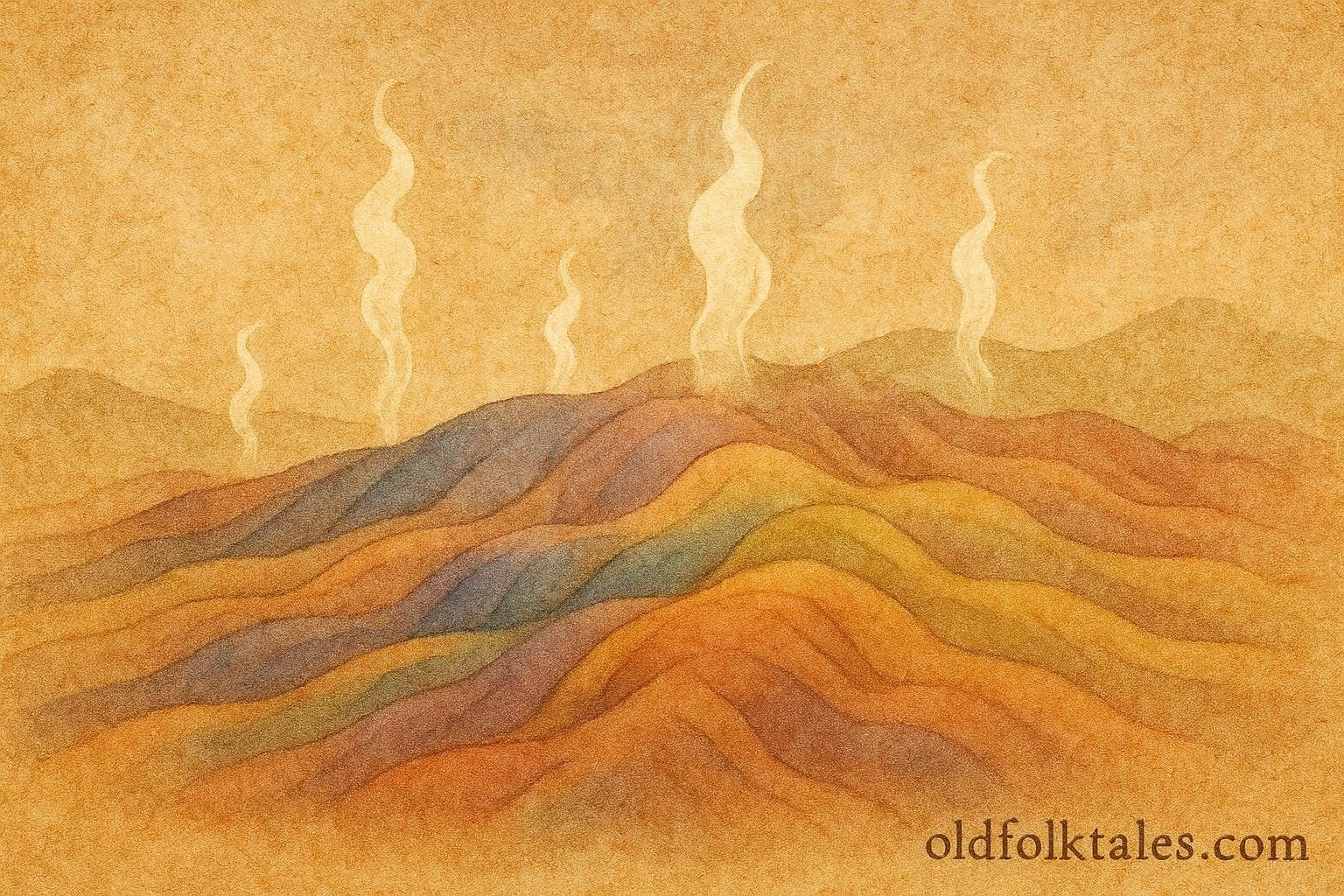
To the eye, it is a striking landscape, rolling dunes of earth layered in bands of red, brown, violet, blue, green, yellow, and ochre. The colors do not blend, nor do they wash away easily with rain or wind. They remain distinct, as though carefully placed by hands far older than memory.
Explore the wisdom and wonder of North African folktales
But in Creole oral tradition, this land is not explained only through soil or science.
It is remembered through spirit.
The elders tell that long ago, before the land was settled and named, Chamarel was a sacred space where earth spirits were deeply connected to the balance of the natural world. These spirits were not separate from the land, they were part of it, shaping its moods, its energy, and its hidden rhythms.
Each spirit carried an emotional force.
Not as human emotion, but as elemental expression.
There was the spirit of anger, fierce and restless, stirring the ground with intensity. The spirit of peace, steady and calm, softening what was harsh. The spirit of sorrow, heavy and deep, settling into the soil like memory that could not be lifted. And the spirit of joy, bright and expansive, lifting the land with quiet warmth.
Together, they formed balance.
Not perfect harmony, but living balance, where each force had its place.
The land was whole because its emotions were in motion.
But sacred balance is fragile when disturbed.
It is said that one day, during a ritual held to honor the earth and its unseen forces, something disrupted that harmony. The details of the event are not always agreed upon in oral retellings, but the outcome remains consistent across generations.
The spirits were disturbed.
Not angered in a simple sense, but unsettled, pulled out of alignment with one another. The ritual, instead of strengthening connection, created imbalance among the elemental forces they embodied.
And when spirits lose balance, the land responds.
What followed was not destruction in the way humans understand it.
It was transformation.
The emotions of the spirits, anger, peace, sorrow, joy, and others unnamed in some versions of the tale, did not disappear. Instead, they settled into the earth itself, each one imprinting its presence into the ground in a visible form.
The land absorbed them.
And in doing so, it became what we now know as the Seven Coloured Earths of Chamarel.
Each color is not just mineral or soil.
It is memory.
It is emotional energy made visible.
The red speaks of intensity, of anger that once surged through the land. The blue and violet carry the quiet depth of sorrow and reflection. The green holds the softness of renewal and peace. The yellow and ochre reflect warmth, movement, and joy. And together, they exist side by side without blending, as if refusing to erase one another.
This separation is not accidental.
In the folklore, it is intentional.
Because the spirits, once disturbed, did not return to unity. Instead, they chose to remain distinct, each emotion preserved in its own form, refusing to collapse into silence or uniformity.
The land, therefore, became a living reminder of what happens when sacred balance is disrupted.
But also, what happens when emotions are allowed to exist without destruction.
The people who later came to live near Chamarel did not interpret the land as empty or decorative. They understood it as charged with presence. A place where the earth itself had once experienced imbalance and chose to preserve its memory rather than erase it.
In Malagasy and Indian-influenced Creole spiritual understanding, land is never inert. It is alive with energy, shaped by unseen forces, and capable of holding meaning beyond physical form. Chamarel fits within this worldview not as a geological curiosity alone, but as a sacred reminder of connection between emotion and earth.
The seven colours became more than landscape.
They became teaching.
A visual language of balance.
A warning against disturbance of sacred order.
And a reminder that emotions, like elements, cannot simply be erased, they settle, they transform, and they remain part of the world long after the moment that created them.
Over time, the site became known beyond oral tradition, attracting attention in modern documentation and cultural studies. Yet even as it is studied and photographed, the older interpretation persists in storytelling circles.
That the land remembers.
That the spirits are still present, not as visible beings, but as the colors themselves.
And that standing before Chamarel is not only an act of observation, but of witnessing something that once carried spiritual weight.
The earth, in this telling, is not silent.
It speaks in color.
And each layer is a reminder that balance is not the absence of emotion, but the respectful coexistence of all that the world carries.
Continue your journey: Read more East African folktales
Moral Lesson
Nature is not separate from emotion or spirit in traditional belief systems. When sacred balance is disturbed, consequences are preserved in the world around us. Respect for land and spiritual harmony ensures that all forces, like emotions, can exist without destruction.
Knowledge Check
- What are the Seven Coloured Earths of Chamarel in folklore?
They are believed to be the result of earth spirits whose emotional energies were absorbed into the land after a sacred disturbance. - What do the different colors represent?
They represent elemental emotions such as anger, peace, sorrow, and joy preserved in the earth. - Why did the spirits of Chamarel become part of the land?
A sacred ritual disturbed their balance, causing their energies to settle into the soil. - What cultural beliefs influence this legend?
It reflects Mauritian Creole spirituality influenced by Malagasy and Indian traditions that see land as spiritually alive. - What does Chamarel symbolize in the folktale?
It symbolizes emotional balance, sacred geography, and the memory of nature itself. - What is the main lesson of the story?
That disturbing sacred balance leads to lasting consequences, and all emotions must be respected as part of natural harmony.
Source: Oral traditions of southern Mauritius documented in tourism-era folklore records and anthropological studies of Mauritian sacred landscapes (mid–20th century onward)
Cultural Origin: Mauritian Creole folklore with Malagasy and Indian spiritual influences
Approx. Documentation Period: Oral origin likely pre-colonial/early colonial; widely documented from 1950s–1980s