In a small village nestled between the rugged mountains and fertile valleys of southern Morocco, there lived a widow named Amina. Her humble home stood at the edge of the village, where the last stone houses gave way to fields of barley and almond trees. Although the house was old and the roof leaked whenever the winter rains arrived, Amina never complained. She believed that gratitude was a treasure greater than gold.
Life had not been easy since her husband passed away many years earlier. She worked from sunrise until dusk weaving woolen blankets, gathering herbs from the hills, and tending a small vegetable garden beside her home. Every coin she earned went toward feeding her two young children, Hassan and Laila.
There were days when the family had only a loaf of coarse bread, a handful of olives, and warm mint tea to share. Yet before every meal, Amina thanked God for providing enough to keep them alive.
Her neighbors admired her quiet strength, but many wondered how she continued smiling despite her hardships.
Love this story? Discover our full Southern African folktales collection
One autumn morning, as the first cool winds swept across the valley, Amina prepared a simple meal. She baked seven small barley cakes using the last of her flour and placed them carefully inside a woven basket.
“I will sell these in the market,” she told her children. “With God’s help, we can buy enough flour for another week.”
Hassan nodded hopefully while Laila helped wrap the warm cakes in a clean cloth.
The journey to the market followed a narrow path through olive groves and rocky hillsides. Birds sang among the branches as Amina walked steadily beneath the bright morning sky.
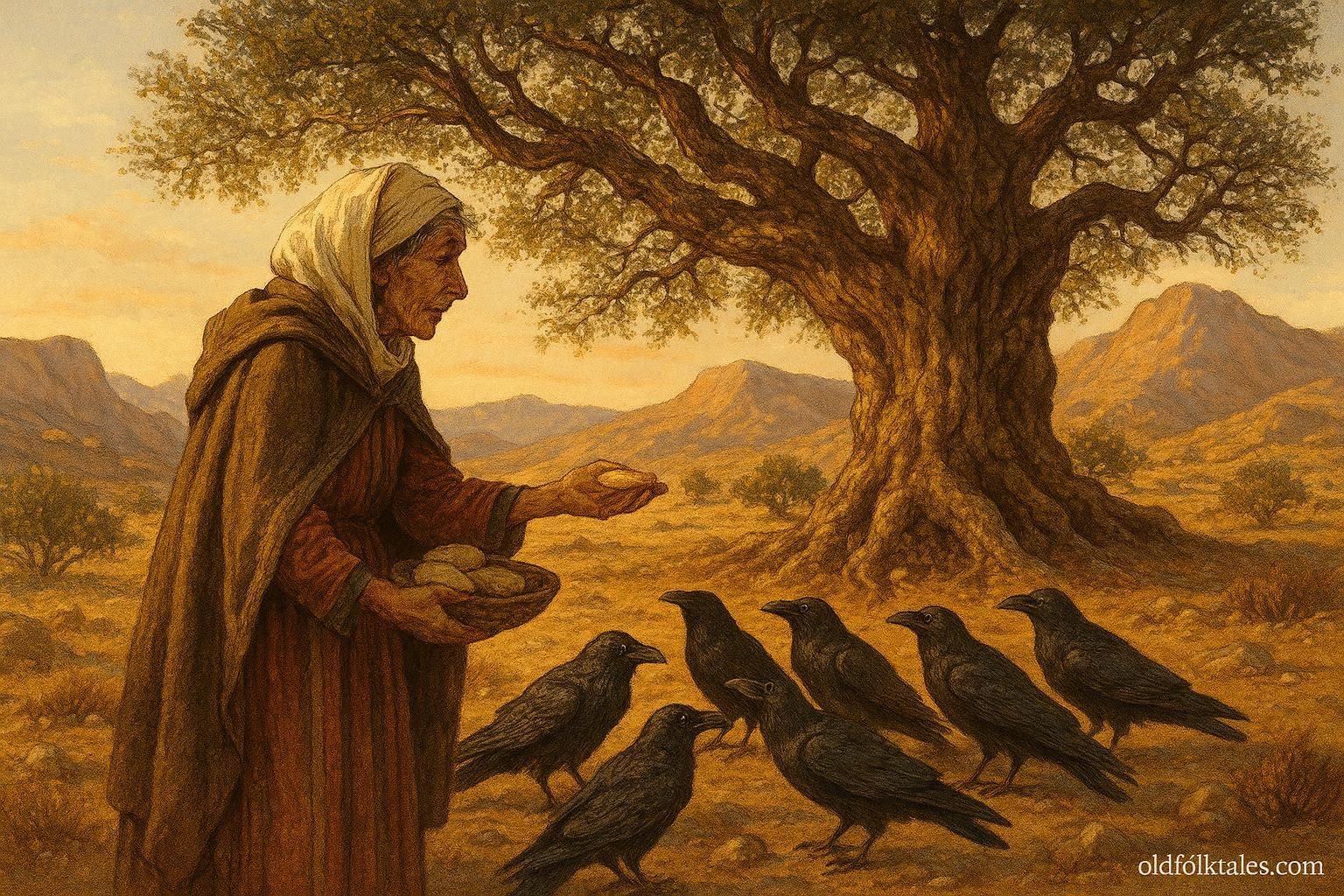
Before reaching the village square, she came upon a large ancient argan tree. Its twisted branches spread wide across the hillside, offering shade to weary travelers.
As Amina rested beneath the tree, she heard a soft rustling overhead.
Seven ravens landed upon the branches.
They were unlike any birds she had ever seen.
Their feathers shimmered with deep shades of black and blue whenever sunlight touched them. Their bright eyes watched her with unusual calm, almost as though they understood every thought in her heart.
The first raven gave a gentle cry.
The second tilted its head.
Soon all seven birds looked toward the basket resting beside her.
Amina smiled sadly.
“You must be hungry,” she whispered.
She opened the basket and broke one barley cake into several pieces, placing them upon a flat stone.
The ravens fluttered down one by one and quietly ate the bread.
When they had finished, they did not fly away.
Instead, they remained beside her, watching silently.
Amina laughed softly.
“You still look hungry.”
Without hesitation, she broke another cake into pieces.
Then another.
And another.
By the time the birds had eaten their fill, every one of the seven barley cakes was gone.
Only the empty basket remained.
For a brief moment, Amina looked toward the distant market.
She knew there would be nothing left to sell.
Her children would have no flour that evening.
Still, she felt no regret.
“If God placed hungry creatures in my path,” she said quietly, “then He also knows what my family needs.”
The ravens circled above her three times before disappearing beyond the mountains.
Amina lifted her empty basket and began the long walk home.
When she arrived, Hassan immediately noticed the empty basket.
“Mother,” he asked gently, “did you sell all the cakes?”
Amina sat beside her children and told them everything that had happened beneath the argan tree.
Laila listened carefully before smiling.
“Then perhaps the birds needed them more than we did.”
Amina embraced both children.
“Kindness is never wasted,” she said. “Even when we cannot see its reward.”
That evening, the family shared the last handful of dried figs stored inside a clay jar. They drank water from the village spring and thanked God before going to sleep.
During the night, a strong wind swept through the valley.
The branches of the old argan tree swayed beneath the moonlight.
Far above the sleeping village, seven dark shapes glided silently across the sky.
Before dawn, the ravens returned.
Each bird carried something in its beak.
One dropped almond seeds into Amina’s garden.
Another released rich dates gathered from distant oases.
A third scattered olive pits from the finest groves.
The remaining birds carried herbs, wild fig seeds, grape vines, pomegranate seeds, and tiny acorns.
Before sunrise, they vanished once again.
The next morning, Amina stepped outside and stopped in amazement.
Her small garden had become covered with fresh green shoots unlike anything she had planted before.
Over the following weeks, every seed began to grow.
The herbs flourished with remarkable fragrance.
The grape vines climbed higher than the garden wall.
The pomegranate trees produced fruit sweeter than any sold in the market.
Even during the dry season, the plants remained healthy and green.
Soon travelers passing through the village noticed the extraordinary garden.
They came to buy herbs, fruit, and young seedlings.
Gardeners asked Amina for advice.
Merchants purchased baskets filled with fresh produce.
Before long, her once empty home overflowed with food, wool, grain, and enough money to provide a comfortable life for her children.
Yet prosperity never changed her heart.
Whenever a hungry traveler knocked at her door, Amina welcomed them inside with bread, olives, and tea.
If a widow needed help, Amina shared her harvest.
If an orphan lacked warm clothing, she wove blankets without asking for payment.
People often wondered how one small garden could continue providing so much year after year.
Only Amina knew about the seven mysterious ravens.
She never searched for them.
She never expected them to return.
She simply continued living with the same generosity she had shown before receiving any blessing.
One spring morning, many years later, Amina walked once again to the ancient argan tree. She wished to thank God for all that had changed since that memorable day.
As she rested beneath its branches, seven ravens appeared once more.
They circled gently overhead before settling upon the tree.
This time, they did not ask for food.
Instead, they sang together in voices so soft that they sounded like the whisper of the wind through the leaves.
Amina smiled with tears in her eyes.
“I understand,” she whispered. “The greatest reward was never the harvest. It was learning that generosity grows wherever faith is planted.”
The ravens spread their wings and disappeared into the bright southern sky.
From that day onward, parents throughout the villages of southern Morocco told the story of the widow and the seven ravens to their children. They reminded them that true generosity does not depend on abundance. It begins with a willing heart that chooses kindness even in times of hardship.
For those who give with sincerity often discover that the richest blessings arrive in ways no one could ever imagine.
Fascinated by this tale? Discover more North African folktales
Moral Lesson
The story of The Widow and the Seven Ravens teaches that true generosity comes from the heart, not from abundance. Amina shared what little she had without expecting anything in return, trusting that every act of kindness had value. Her compassion toward the seven mysterious ravens reflected her faith in God’s provision and her willingness to help others even during difficult times. The tale reminds us that sincere generosity often brings unexpected blessings, while faith and gratitude give people the strength to remain kind despite hardship. When we give selflessly, we plant seeds of hope that can grow into blessings for ourselves and those around us.
Knowledge Check
1. Why did the widow give her barley cakes to the seven ravens?
The widow gave her barley cakes to the ravens because she believed that every hungry creature deserved compassion. She chose kindness over her own immediate needs, trusting that God would provide for her family.
2. What happened after the ravens visited the widow’s garden?
The ravens scattered seeds that grew into a remarkable garden filled with fruit trees, herbs, grapevines, and other plants, providing the widow with a lasting source of food and income.
3. What do the seven ravens symbolize in this Moroccan folktale?
The seven ravens symbolize divine blessing, hope, and the unexpected ways that goodness can be rewarded. They remind readers that acts of compassion are often noticed even when no one else is watching.
4. How did the widow respond after becoming prosperous?
Although she became comfortable, the widow remained humble and generous. She continued feeding travelers, helping widows, and caring for those in need without expecting payment.
5. What is the main lesson about faith in the story?
The story teaches that faith encourages people to do what is right even when the future is uncertain. Trusting in God allowed the widow to remain generous despite her poverty.
6. What is the central message of The Widow and the Seven Ravens ?
The central message is that generosity, faith, and gratitude bring lasting rewards. Kindness offered with a sincere heart often returns in ways greater than anyone expects.
Source
Source: Adapted from traditional Southern Moroccan oral traditions documented in Contes et légendes du Maroc.
Cultural Origin: Southern Morocco.