In the northern regions of Uganda, among the Acholi and Lango communities, storytelling has long been a way to explain not only human behavior, but also the origins of the natural world.
Animals in these stories are not random creatures.
Click here to discover more legendary tales from West Africa
They are symbols of character, choice, and consequence.
This is the tale of the leopard, once plain in appearance, whose desire to become something else changed him forever.
A Time Before Spots
Long ago, the leopard did not look as he does today.
His coat was smooth and plain, without the distinctive patterns we now associate with him.
In the animal world, appearance often carried meaning.
Some animals were admired for their beauty.
Others for their strength.
And some for their closeness to humans.
The leopard, however, was neither especially admired nor feared.
He wanted to change that.
The Desire to Be Admired
The leopard watched other animals closely.
He saw how humans admired certain creatures during rituals and gatherings.
Some animals were painted.
Some were decorated.
Some were even praised and given symbolic importance.
The leopard believed that if he could be more like those animals, he would be respected too.
So, he began to imitate them.
He copied their movements.
He observed their behaviors.
He tried to adjust himself to gain human approval.
But imitation, without understanding, often leads to misunderstanding.
The Human Ritual
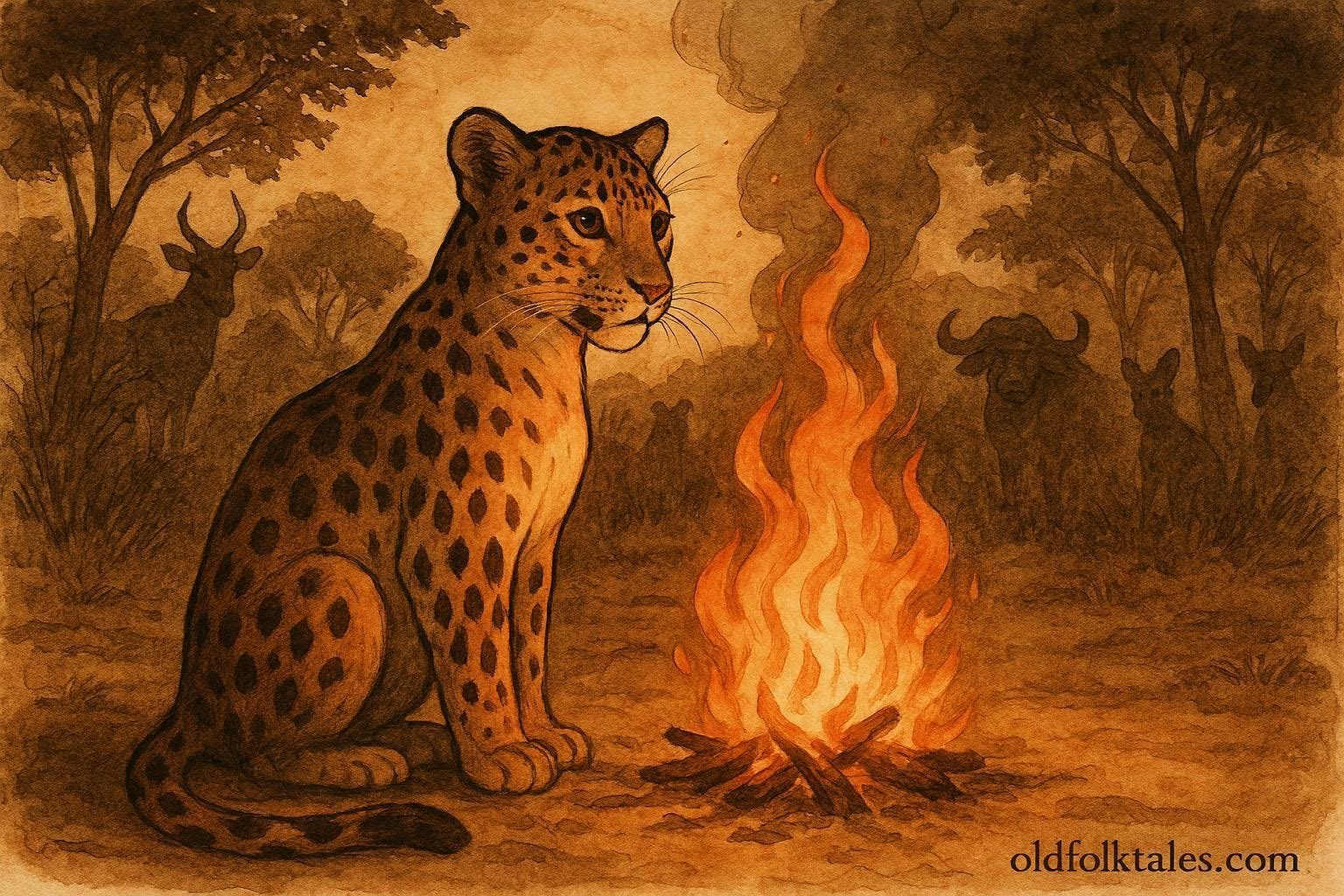
One day, a group of humans gathered in a clearing for a ritual.
They built a large fire at the center.
The flames were meant to symbolize cleansing and transformation.
Animals were present in symbolic roles, each placed according to tradition.
The leopard, seeing an opportunity to be noticed, approached carefully.
He believed that if he participated, he might be accepted.
But he did not understand the meaning of the ritual.
He only saw recognition.
Not caution.
The Trap of Misjudgment
During the gathering, the leopard was instructed, mistakenly or through confusion, to sit near the fire, as some animals were placed according to symbolic positions.
He complied, thinking it would increase his importance.
But the fire was not meant for him in that way.
It was hot.
Closer than he realized.
As he sat there, the flames reflected against his fur.
He tried to move.
But in the confusion of the ritual and the crowd’s focus elsewhere, no one noticed quickly enough.
The Change Begins
The heat touched his coat.
At first, it seemed temporary.
But as time passed, something permanent occurred.
Dark marks formed where the firelight had been strongest.
Small at first.
Then spreading.
Until his once plain coat became permanently marked with spots.
When the ritual ended, the leopard stepped away changed.
Not only in appearance.
But in identity.
Realization After the Fire
The leopard looked at his reflection in a water pool.
What he saw surprised him.
He was no longer plain.
He was patterned.
Distinct.
Different.
At first, he felt shame.
He believed he had lost something.
But over time, he began to understand that the change could not be undone.
It had become part of him.
The Lesson of Identity
In the days that followed, other animals noticed the change.
Some laughed.
Some were curious.
Some were cautious.
But none could reverse what had happened.
The leopard realized something important:
In trying to become something else, he had forgotten what he already was.
And now, nature had made that decision permanent.
Acceptance of Transformation
Over time, the leopard stopped trying to imitate others.
He moved differently.
He lived more carefully.
And his spotted coat, once seen as a mistake, became part of his identity.
It helped him blend into forests.
It became useful.
What had begun as consequence slowly became adaptation.
But the story of how it happened was never forgotten.
What the Elders Say
Among Acholi and Lango elders, this story is often told not simply as a tale of animals, but as a reflection of human behavior.
It is said that those who abandon their identity in pursuit of approval may lose control over what they become.
And sometimes, what is lost cannot be fully regained.
Don’t stop yet! See our complete East African folktales collection
Moral Lesson
Imitating others without understanding one’s own identity can lead to irreversible consequences. True strength comes from self-awareness, not imitation.
Knowledge Check
- What is “Why the Leopard Has Spots” about?
It is an Acholi and Lango folktale explaining how the leopard got its spotted coat through a transformative event. - Why did the leopard try to imitate other animals?
He wanted to gain admiration and favor from humans. - What caused the leopard’s coat to change?
He sat too close to fire during a ritual, which permanently marked his fur. - What theme does the story highlight?
Identity, imitation, and consequences of trying to become something one is not. - How did the leopard respond after the transformation?
He eventually accepted his new appearance and adapted to it. - What lesson does this African folktale teach?
It teaches that true identity should not be abandoned for approval and that consequences of imitation can be permanent.
Source: African folktale, Uganda.
Adapted from Acholi and Lango oral traditions documented in African myth compilations and missionary-era ethnographic recordings (late 19th century oral preservation, transcribed 1900s–1960s).
Cultural Origin: Northern Uganda (Acholi and Lango traditions)