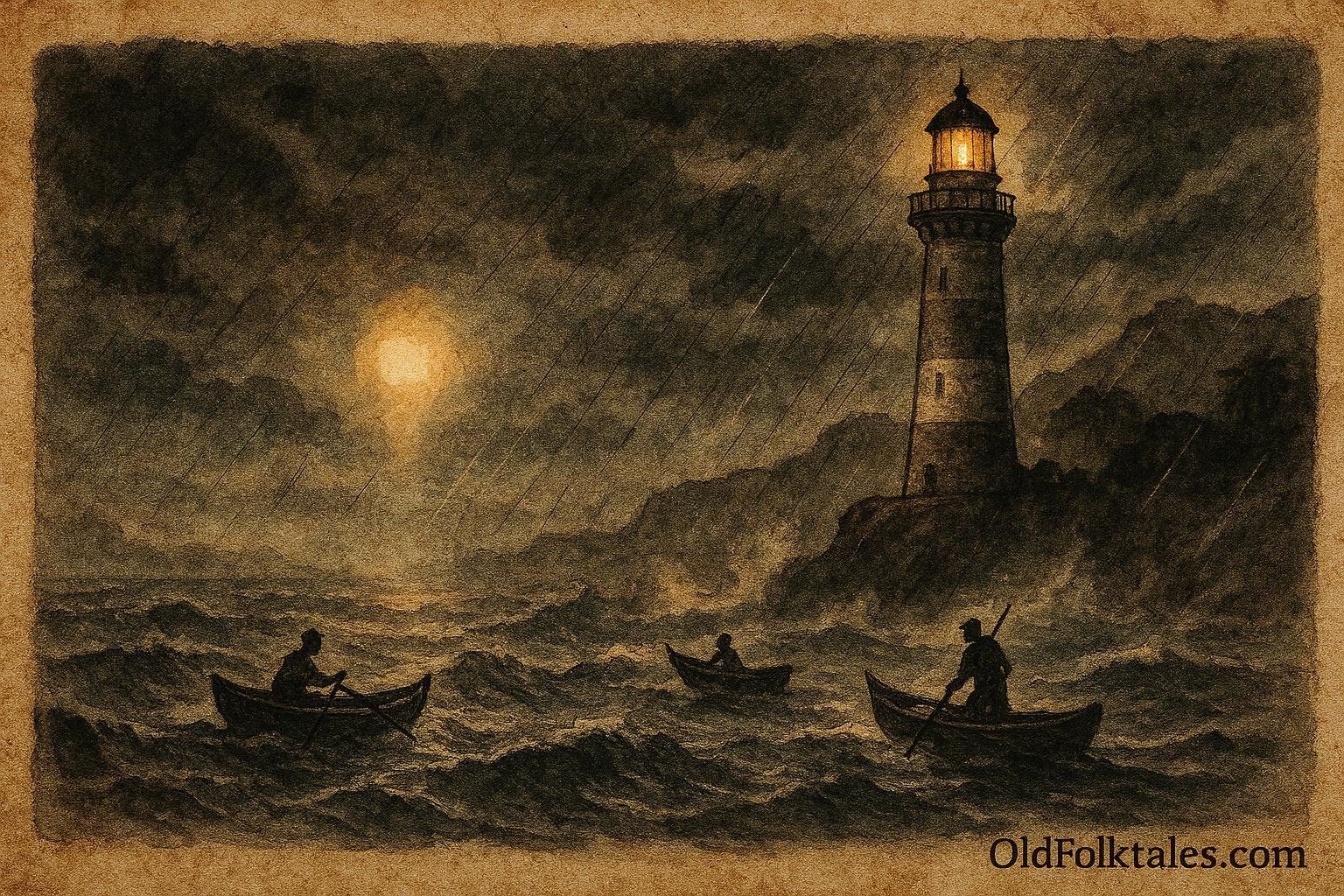
Along the rugged coastline of Albion in Mauritius, where waves strike the rocks with restless rhythm and the wind carries the scent of salt and old wood, there stands an aged lighthouse. Weather-worn and solemn, it watches over the sea like a silent guardian. For generations, fishermen have known it not only as a guide for ships but also as the center of one of the most enduring mysteries in Mauritian coastal folklore, the haunted light that appears on stormy nights.
The people of Albion do not speak of this light lightly. It is not something they mention in passing conversation, nor is it a tale told without respect. It belongs to the sea, to memory, and to the unseen world that many believe exists just beyond the reach of human understanding.
Click here to discover more legendary tales from West Africa
On calm nights, the lighthouse behaves as expected. Its steady beam sweeps across the water in a predictable rhythm, reassuring fishermen as they navigate back to shore. But when storms gather, when the sky turns heavy and the sea becomes dark and uncertain, the ordinary light is said to change.
Fishermen describe it in hushed tones. They say that sometimes, far beyond the reach of the lighthouse’s usual beam, another light appears. It is faint at first, like a distant flicker struggling against the wind. Then, slowly, it grows brighter, hovering above the waves in places where no vessel should be able to stand.
Some who have seen it swear it moves with intention, drifting just ahead of boats caught in the storm. Others insist it remains still, pulsing gently like a heartbeat in the night. But all agree on one thing: it is not natural.
The origin of this light has long divided the fishing community of Albion.
One belief holds that it is the spirit of a sailor who once drowned near those waters. According to this version of the tale, the sailor was lost during a violent storm many years ago, when the sea swallowed his boat and left no trace behind. Yet his presence never left. Instead, it remained bound to the coastline, returning in moments of danger to guide others away from the fate he suffered.
In this telling, the light is not something to fear. It is a form of protection, a lingering act of kindness from a soul who understands the sea’s cruelty too well.
But there is another belief, quieter but more unsettling.
Some fishermen say the light is not a guide but a lure. It appears when visibility is poor, when fear is already rising in the hearts of those at sea. It drifts just close enough to be followed, tempting boats away from safe waters. According to this version, those who chase it too far risk being pulled into deeper, more violent currents where survival becomes uncertain.
Between these two interpretations, guardian or deceiver, the truth remains unproven, held somewhere between fear and faith.
What makes the legend endure is not only the light itself, but the way it appears only under specific conditions. It is never seen on peaceful nights. It never follows a pattern that can be studied or predicted. It belongs entirely to storms, to uncertainty, to the moments when the sea feels most alive and most unpredictable.
Older fishermen often recall their first encounter with it. They describe nights when the wind howled so loudly it drowned out all thought, when rain blurred the horizon and even familiar landmarks disappeared into darkness. In those moments, the sudden appearance of a distant glow would feel almost unreal, like a promise or a warning made visible.
Some would steer toward it, believing it to be an extension of the lighthouse, a safer route home. Others would resist the urge, trusting instead in instinct and experience. Those who returned safely would speak of the light differently depending on their outcome. For some, it had seemed protective. For others, it had felt dangerous, almost alive.
Over time, the story became woven into the identity of Albion’s fishing community. It was passed from elder to apprentice, from father to child, often not as a tale of fear but as a reminder of respect, for the sea, for its unpredictability, and for the limits of human certainty.
The lighthouse itself became more than a structure. It became a symbol of dual meaning: safety and mystery coexisting in the same place. Its stone base, hardened by decades of salt and wind, stood as a reminder that even human guidance has limits when faced with the ocean’s vastness.
During storms, when fishermen gather near the shore waiting for the weather to calm, the conversation often turns to the light. Voices lower, and stories resurface. Each retelling adds a layer of interpretation, but none resolve the contradiction. Instead, the mystery deepens with time.
Some elders suggest that the sea itself is responsible. They speak of water as something that remembers, that reflects emotion and loss. In this understanding, the light is not a spirit or a trick, but a manifestation of memory, of lives lost, journeys ended, and warnings embedded in nature itself.
Others dismiss such explanations and attribute the phenomenon to optical illusion, reflections, or distant fishing boats caught in unusual atmospheric conditions. But even those who speak in practical terms tend to pause when storms arrive, as though acknowledging that not everything can be easily explained.
What remains consistent across all versions of the story is the emotional weight it carries. The light represents uncertainty, something both familiar and unknowable. It reflects the reality of life at sea, where control is always partial and survival depends as much on judgment as it does on luck.
For younger fishermen, the story serves as a lesson passed down indirectly. It teaches caution without instruction, respect without fear, awareness without certainty. No one is told exactly what the light is. Instead, they are taught how to respond to mystery itself.
And so, the legend of the Haunted Light of Albion Lighthouse continues. Not because it has been proven, but because it has been experienced in one form or another by those who have spent their lives near the water. Each generation inherits not just the story, but the uncertainty that comes with it.
Even today, when storms roll in over Albion and the sea turns dark and restless, some fishermen still glance toward the horizon, half-expecting to see a faint glow where no light should be. And in those moments, the boundary between belief and reality becomes as fluid as the ocean itself.
Don’t stop yet! See our complete East African folktales collection
Moral Lesson
The story reminds us that nature holds mysteries beyond human understanding, and true wisdom lies in respecting what we cannot fully explain. Whether seen as warning or protection, the sea demands humility, caution, and reverence.
Knowledge Check
- What is the Haunted Light of Albion Lighthouse believed to be?
It is believed to be either the spirit of a drowned sailor or a mysterious light that appears during storms at sea. - Where does this folktale originate from?
It originates from Albion, Mauritius, within coastal Creole fishing communities. - When does the mysterious light usually appear?
It is said to appear only during stormy nights when the sea is rough and visibility is low. - What are the two main interpretations of the light?
One interpretation sees it as a guiding spirit, while the other views it as a dangerous lure. - What role does the lighthouse play in the story?
The lighthouse is both a physical guide for ships and a symbolic center of the mystery. - What is the main lesson of the folktale?
It teaches respect for the sea and acceptance of natural mysteries beyond human control.
Source: Mauritian coastal Creole folklore influenced by European maritime ghost stories and African spirit traditions. Recorded in oral fishing-community traditions and referenced in 20th-century Mauritian maritime ethnographic studies.
Cultural Origin: Mauritius (Albion coastal folklore) documented mid–20th century.