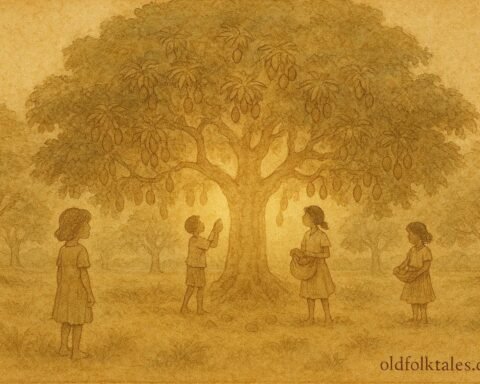
Along the soft, curving shoreline of Mahé, where the Indian Ocean meets the land in endless rhythm, there once lived a young woman known only to her village as a daughter of the coast. Her life was closely tied to the sea, as it was for everyone in her community. The ocean was not just water to them; it was presence, memory, provider, and mystery.
The village itself rested between coconut palms and rocky tide edges, where fishermen rose before dawn and returned only when the sky softened into evening gold. Nets were woven with patience, boats were carved with care, and every tide was watched as if it carried messages from something greater than human understanding.
Click here to discover more legendary tales from West Africa
The young woman grew up in this world of salt wind and drifting foam. She was often seen near the shore, where she would sit quietly as waves curled toward her feet. Some said she listened to the sea the way others listened to songs. She understood its moods, when it was gentle, when it was restless, and when it seemed to speak in a language no one else could hear.
As she grew older, her connection with the ocean deepened. She would walk farther along the coast than others dared, sometimes disappearing behind rocky bends where the water struck harder against stone. The villagers noticed this but did not interfere. In coastal life, the sea was respected too much to question how it called to a person.
But the ocean, though beautiful, was never without danger.
One season, the winds changed. The waters grew unpredictable. Fishermen returned with torn nets and uneasy faces. The elders spoke in low voices, warning that the sea was unsettled. They prayed in their own ways, offering respect to the forces they believed lived beneath the waves.
It was during one of these storms that the story changed forever.
The sky darkened without warning, heavy clouds rolling in like a moving wall. The sea responded quickly, rising and breaking against the shore with a force the village had not seen in years. Boats were pulled tighter to land, and families gathered indoors as wind screamed through palm trees.
The young woman had gone to the shore that day.
Some villagers said they saw her walking toward the water as the storm approached, her figure small against the growing chaos of wind and wave. Others believed she was already near the edge when the first great surge came. What is certain in the telling is that she did not return when the storm passed.
The sea had taken her.
In the days that followed, the village was quiet in a way that felt heavier than grief. Fishermen stopped speaking loudly near the shore. Women gathered in small groups, watching the horizon longer than before. The ocean remained restless, as if carrying something it would not release.
Time moved forward, as it always does, but the memory of the young woman did not fade.
Then came the first sighting.
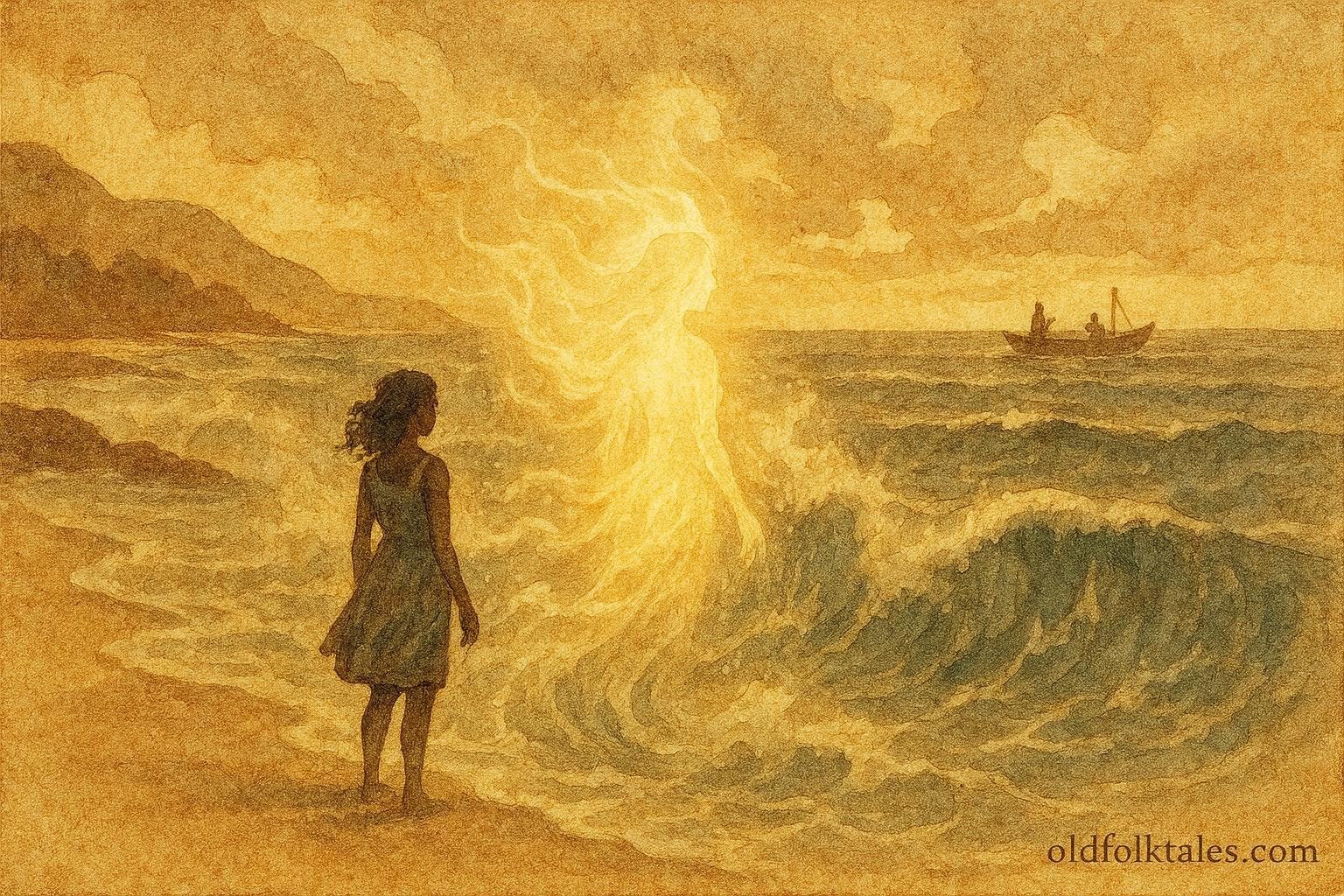
A fisherman returning late one evening claimed he saw a figure standing where the waves broke gently against the reef. At first, he thought it was a trick of light, perhaps mist rising from the water. But as he drew closer, he said the figure resembled a woman, still, luminous, and strangely calm amid the shifting tide.
He did not approach further. Something about the presence made him lower his gaze and steer his boat away.
Others began to share similar accounts. A calm would settle over rough waters, they said, especially when the sea threatened to turn dangerous. Fishermen who respected the ocean, who took only what they needed and offered silent gratitude before casting nets, spoke of safer journeys and gentle winds guiding them home.
But those who were careless, who took more than necessary or disrespected the waters, spoke of sudden storms rising without warning, forcing them back to shore.
And always, in these stories, there was a presence, seen at the edge of vision, standing where sea and sky seemed to meet.
The villagers began to believe what they had once only whispered.
The young woman had not simply been lost to the sea. She had become part of it.
Not as a creature of fear, but as something bound to balance. A spirit of the ocean, neither fully gone nor fully human, watching over the waters that had taken her.
As years passed, her story became woven into the life of the village. Children grew up hearing that the sea remembers kindness. Fishermen learned to begin their journeys with quiet respect. Even those who doubted the legend found themselves pausing longer at the shore, as if unsure whether to challenge something they could not see but could feel.
The ocean remained unpredictable, as it always had been. But there were moments, brief and unexplainable, when it softened, as if acknowledging something unseen between land and water.
Elders would say then, “She is near.”
Not with fear, but with understanding.
The woman who once belonged to the village had become something larger than memory. She was no longer just a daughter of Mahé. She was part of the sea itself, its warning, its mercy, its silence, and its protection.
And so, the village continued to live by the shore, as it always had, with respect renewed in every tide.
For the sea, they now understood, never forgets how it is treated.
Don’t stop yet! See our complete East African folktales collection
Moral Lesson
This folktale teaches that nature must be respected, not controlled. The sea, like all natural forces, carries both life and danger, and harmony comes only through humility, balance, and reverence.
Knowledge Check
- Who is the main figure in The Woman Who Married the Sea?
A young unnamed woman from a coastal Mahé village who becomes spiritually connected to the sea. - What happens to the woman in the folktale?
She disappears into the ocean during a violent storm and is later believed to have become a sea spirit. - What does the sea spirit represent in this Seychellois legend?
It represents nature’s power, protection, and the consequences of respecting or disrespecting the ocean. - Where does the story originate from?
It comes from Seychelles, specifically Mahé island coastal oral traditions. - What is the central theme of this folktale?
The story explores respect for nature, transformation, and spiritual connection to the ocean. - How do fishermen respond to the legend of the sea spirit?
They become more respectful toward the sea, believing it rewards care and punishes greed or disrespect.
Source: Seychellois coastal oral narratives collected from fishing communities and elder storytellers, documented through a fishermen oral history project (2002).
Cultural Origin: Seychelles (Mahé island coastal folklore), shaped by Creole maritime traditions with influences from African coastal spirit beliefs and Indian Ocean seafaring cultures.