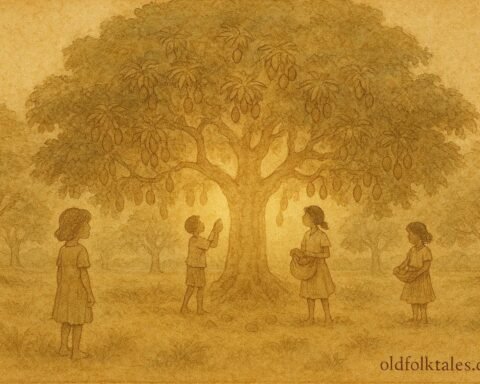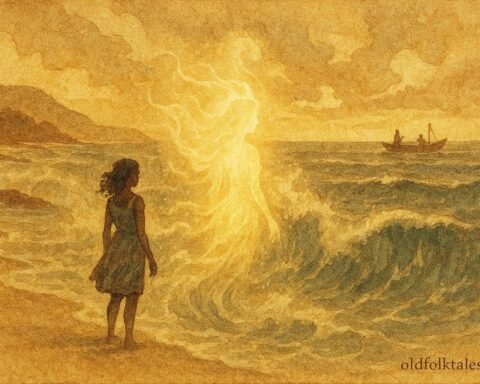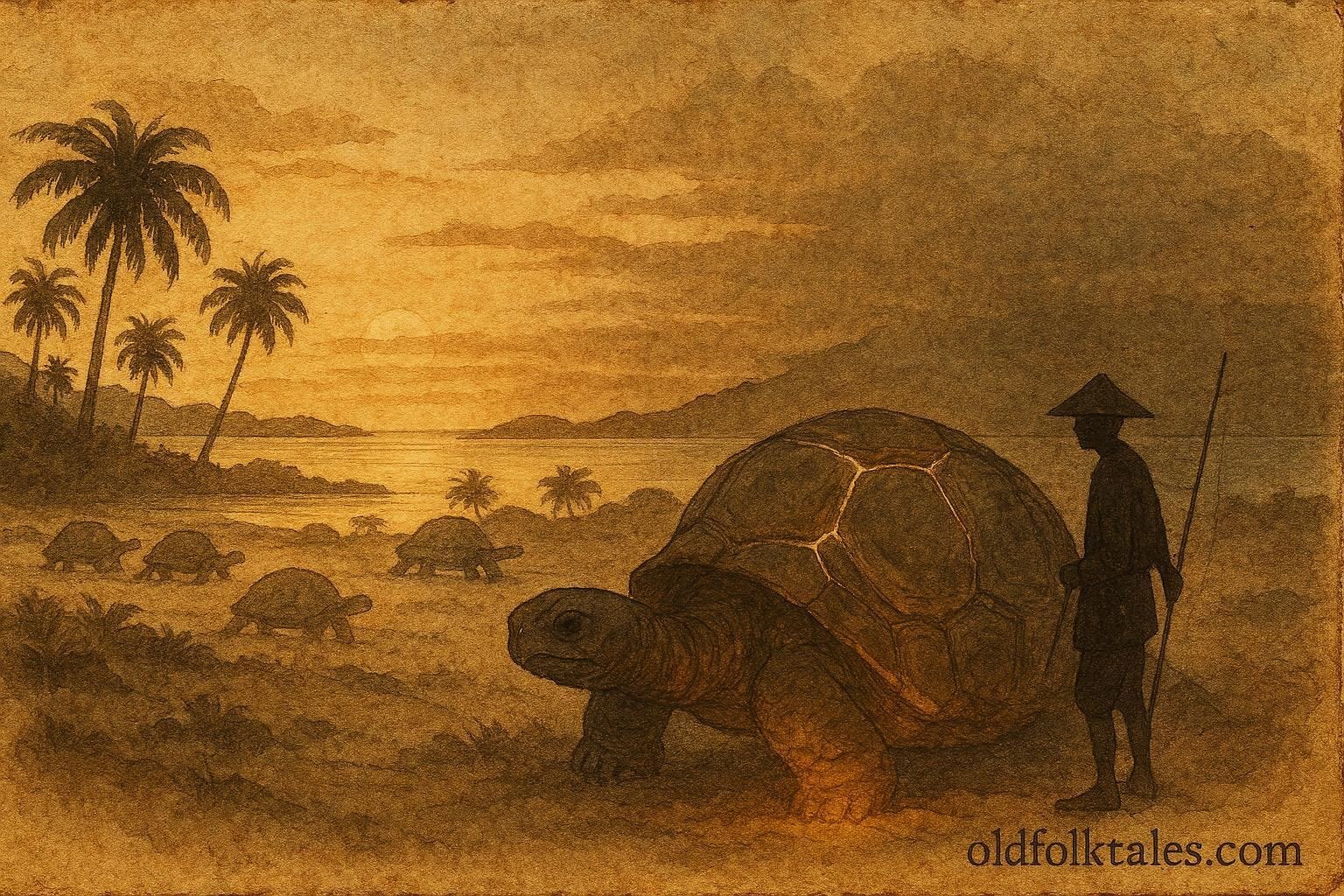
Far from the busy shores of the main islands, beyond the usual paths of fishermen and traders, lies Aldabra Atoll, vast, quiet, and ancient. It is a place where land, sea, and life exist in delicate balance. The air carries the scent of salt and sun-warmed earth, and the ground itself seems to hold stories older than memory.
Among the most remarkable inhabitants of Aldabra are the giant tortoises. Slow-moving and enduring, they wander the atoll with a calm presence, their heavy shells carrying the weight of time itself. To those who understand the land, these creatures are not simply animals. They are part of the island’s spirit, living reminders of patience, resilience, and the quiet rhythm of nature.
Click here to discover more legendary tales from West Africa
The people who knew Aldabra best spoke carefully about the tortoises. They warned that harming them was not just wrong, but dangerous in ways that could not always be seen. There was a belief, passed down through voices and years, that the tortoises were protected, that to injure one was to disturb something far greater than the creature itself.
Still, not everyone listened.
There was once a fisherman who traveled to Aldabra in search of opportunity. He had heard stories of the atoll’s richness, its untouched land, its abundance of life, and the possibility of gaining something valuable where others had not yet taken.
When he first arrived, the island seemed peaceful, almost welcoming. The silence of the place felt different from the noise of coastal villages. Here, time moved slowly, and everything seemed to exist with quiet purpose.
He noticed the tortoises almost immediately.
They moved across the land without hurry, grazing and resting under the sun. Their shells were thick, patterned, and strong, unlike anything he had seen so closely before. To many, they would have been a sign to pause, to observe, and to respect.
But to him, they became something else.
An idea.
He had heard that tortoise shells could be valuable. That they could be taken, used, and sold. The thought began as a passing curiosity, but slowly it grew into intention. He began to look at the tortoises not as part of the island, but as something he could take from it.
At first, he ignored the warnings he had heard before arriving. The quiet voice of caution, in stories of the island, felt distant compared to the immediate promise of gain.
One day, he acted.
He approached one of the giant tortoises, choosing one that moved slowly, unaware of his intention. The act itself was deliberate, driven not by need, but by the belief that he could take something valuable without consequence.
When he broke the shell, something shifted.
Not in a way that could be seen clearly, but in a way that could be felt.
The island, which had once seemed calm and welcoming, became heavy with silence. The wind felt different. The stillness no longer carried peace, it carried something else. Something watchful.
At first, nothing happened.
The fisherman returned to his work, carrying what he had taken with a sense of satisfaction. He believed the act was done, that the moment had passed without consequence. But Aldabra was not a place where actions ended so quickly.
The changes began slowly.
His fishing, once steady, became uncertain. Nets returned lighter than before. Waters that had seemed predictable shifted without reason. Days that should have been productive ended in frustration.
He dismissed it at first.
The sea, after all, was never entirely predictable. There were always days of less catch, always moments when luck seemed to turn. But as time passed, the pattern grew clearer.
It was not just his fishing.
Things he owned began to fail. Tools broke without explanation. Small losses turned into larger ones. What he tried to build began to fall apart, piece by piece, as if something unseen was undoing his efforts.
The island no longer felt neutral.
It felt resistant.
The fisherman began to notice how others moved differently on the land. Those who treated the atoll with care seemed untouched by the misfortune that followed him. They worked, gathered, and lived without the same constant setbacks.
The difference was quiet, but undeniable.
Still, it took time for him to face the connection.
The memory of what he had done returned often, uninvited. The image of the tortoise, the act of breaking the shell, the moment when the island’s silence changed—these thoughts stayed with him, growing heavier with each passing loss.
Eventually, he could no longer ignore it.
The stories he had once dismissed came back to him, not as distant warnings, but as explanations. The belief that harming the tortoises brought misfortune no longer seemed like superstition. It felt like truth.
The island, in its own way, had responded.
Not with sudden punishment, but with steady consequence.
The fisherman’s life became smaller. What he once had began to disappear, not all at once, but in a slow unraveling. Each loss reminded him of the act that had begun it all.
In time, he understood.
The tortoise had not simply been an animal. It had been part of something larger, something that held balance within the island. By breaking the shell, he had broken more than a physical form. He had disrupted that balance.
And the island remembered.
The lesson did not come through words, but through experience. Through loss. Through the quiet, persistent return of consequence.
Those who later told his story did not speak of it with anger, but with clarity. They said that Aldabra teaches in its own way. That the land, the animals, and the sea are not separate from human action. They respond, each in their own time.
The fisherman’s story became part of the island’s memory, shared among those who lived near or traveled to its shores. Not as a tale of fear, but as a reminder.
A reminder that some things are not meant to be taken.
That not all value is meant to be owned.
And that respect for the natural world is not optional, it is necessary.
The giant tortoises continued to move across Aldabra, as they always had, carrying their quiet presence through the land. And those who saw them understood, even without words, that they were more than creatures of the earth.
They were part of its balance.
And that balance, once broken, always finds a way to respond.
Don’t stop yet! See our complete East African folktales collection
Moral Lesson
This folktale teaches that greed disrupts natural balance and brings lasting consequences. Respect for wildlife and the environment is essential, as nature responds to human actions in ways that cannot always be reversed.
Knowledge Check
- What is the main story of The Curse of the Broken Tortoise Shell?
It tells of a fisherman who harms a giant tortoise on Aldabra and suffers ongoing misfortune. - Why are the giant tortoises important in the folktale?
They are seen as sacred beings connected to the island’s natural balance and spirit. - What happens after the fisherman breaks the tortoise shell?
He begins to lose his success, possessions, and stability through unexplained misfortune. - What does the curse symbolize in the story?
It represents the consequences of greed and disrespect toward nature and wildlife. - Where does this folktale originate from?
It comes from Seychelles, specifically Aldabra Atoll ecological folklore traditions. - What lesson does the story teach about nature?
That nature must be respected, as harmful actions will eventually bring consequences.
Source: Seychellois Aldabra Atoll ecological folklore, preserved through conservation-era oral narratives and documented in the Aldabra Conservation Oral Heritage Records (2005).
Cultural Origin: Seychelles (Aldabra Atoll Creole ecological mythology), shaped by strong conservation values, island biodiversity awareness, and African traditions that regard animals, especially long-living creatures like giant tortoises, as sacred beings deserving protection and respect.