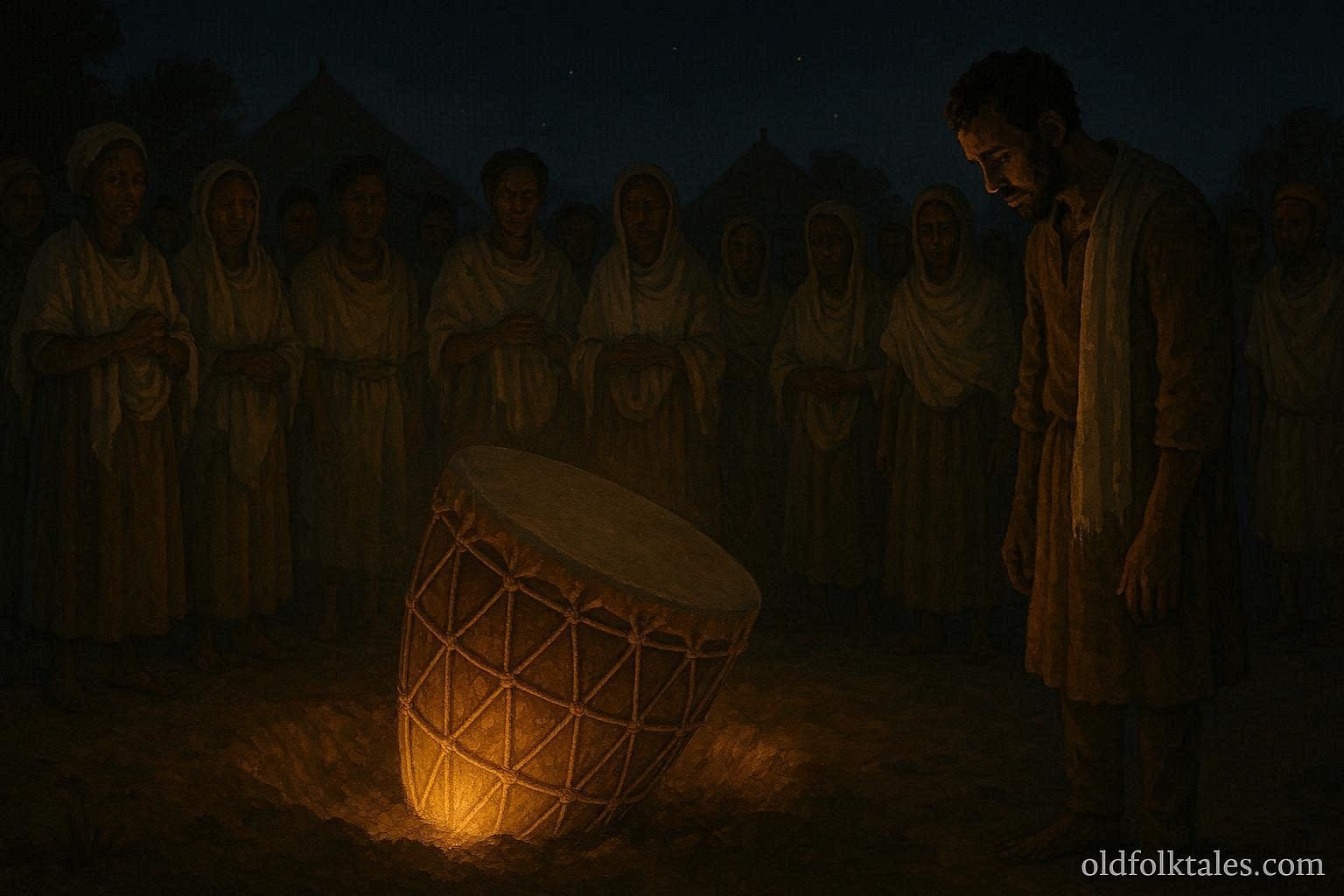
In a highland village of Ethiopia, where stone houses stood close together and the sound of prayer often rose with the morning light, there lived a priest who cared for a small but deeply respected church.
The church was not grand in size, but it was rich in meaning. Its walls held the prayers of generations, and within it rested objects that the people believed were touched by something greater than themselves.
Want more? Read more West African folktales now
Among these objects was a drum.
It was not like the others used in festivals or daily gatherings. This drum was sacred. It was brought out only on special occasions, times of prayer, of judgment, or when truth was called upon to settle disputes.
The people believed something about it.
They believed the drum could not remain silent in the presence of falsehood.
“If truth is hidden,” the elders would say, “the drum will speak.”
For many years, it had remained quiet, sounding only when struck by the priest during ceremony. And so, while its power was respected, it was rarely tested.
Until one night.
In the quiet hours before dawn, when the village lay still and the air held only the faint sounds of night, a man moved carefully through the shadows.
He was known among the people, though not closely trusted. He lived on the edge of the village, keeping mostly to himself. His needs were many, and his patience was little.
That night, his eyes were set on the church.
He had heard of the drum, of its beauty, of its value, and of the attention it drew. Whether he believed in its power or not did not matter.
To him, it was something worth taking.
He waited until the last light had faded, then slipped quietly inside. The church was dark, but he knew where to go. His hands found the drum, resting where it always had.
For a moment, he hesitated.
Not out of fear, but out of the weight of what he was touching.
Then he lifted it.
The drum made no sound.
Encouraged, the thief carried it out into the night and disappeared into the darkness beyond the village.
By morning, the absence was discovered.
The priest entered the church as he always did, but something felt wrong even before he saw it.
The place where the drum rested was empty.
Word spread quickly.
“The drum is gone,” people said.
“Who would take such a thing?” others asked.
The priest stood before the gathered villagers, his face calm but serious.
“This is not an ordinary loss,” he said. “What has been taken is not only an object, but a symbol of truth.”
The villagers murmured among themselves.
“We will find it,” one said.
“We must,” another added.
But the priest raised his hand gently.
“If it has been taken,” he said, “then truth will follow it.”
Meanwhile, the thief had hidden the drum in his home.
At first, he felt a sense of success.
“No one saw me,” he told himself. “No one knows.”
He placed the drum in a corner, covering it carefully, as though hiding it from sight would erase what he had done.
For a time, all was quiet.
But that night, as he lay down to rest, something broke the silence.
A sound.
Low, steady.
A beat.
The thief sat up quickly.
The sound came again.
It was unmistakable.
The drum.
He rushed to the corner and uncovered it.
It was still.
Silent.
He stared at it, his breath uneven.
“I imagined it,” he said.
But when he returned to his bed, the sound came again.
This time, louder.
More certain.
The drum was speaking.
The thief could not sleep.
Each time he closed his eyes, the sound returned, steady, rhythmic, impossible to ignore.
By morning, his confidence had begun to crack.
“This cannot continue,” he muttered.
He decided to move it.
“If it is not here, it will not trouble me,” he reasoned.
He carried the drum out before sunrise and hid it in a nearby field, beneath thick grass and earth.
“There,” he said. “No one will find it.”
That night, he returned home and lay down once more.
For a moment, there was silence.
Then,
The sound came again.
Not from his home this time, but from outside.
From the direction of the field.
The drum beat, steady and clear, carrying through the air, reaching beyond his hearing.
Reaching the village.
People began to stir.
“What is that sound?” they asked.
“It is the drum,” one said.
“But the drum is gone,” another replied.
The sound continued.
The villagers followed it, moving toward the field.
The thief felt his heart race.
“No,” he whispered.
He ran ahead of them, digging quickly to retrieve the drum before they arrived.
When he uncovered it, the sound stopped.
The villagers reached the field moments later.
“What is happening?” they asked.
The thief forced a calm expression.
“I heard the sound too,” he said. “It came from here.”
They looked around, confused.
But with the drum hidden once more, there was nothing to see.
The crowd dispersed slowly, uncertain.
The thief returned home, shaken.
“It cannot stay with me,” he said.
The next day, he took it farther away, beyond the village, beyond the fields, to a place where few people passed.
He buried it deep.
“This will end it,” he said.
But night came again.
And with it,
The sound.
Stronger now.
Not hidden. Not distant.
The drum beat through the land, echoing across the village, through the trees, across the hills.
People rose from their homes.
“It calls again,” they said.
This time, they did not hesitate.
They followed the sound together, their steps guided by the steady rhythm.
The thief stood among them, his face pale, his mind racing.
He knew what they would find.
And still, he walked.
When they reached the place, the sound was clear.
Direct.
The villagers began to dig.
The earth gave way, revealing the drum.
The moment it was uncovered, the sound stopped.
Silence fell.
All eyes turned to the thief.
He stood still, the weight of everything pressing upon him.
No one had accused him.
No one had spoken his name.
But the truth stood there, undeniable.
The priest stepped forward.
“The drum does not lie,” he said.
The thief lowered his head.
“I took it,” he said quietly.
The words came without force, without resistance.
“I thought I could keep it,” he continued. “I thought no one would know.”
The villagers listened.
“But it would not let me hide,” he said. “It followed me. It spoke wherever I placed it.”
The priest nodded.
“Truth does not remain buried,” he said. “It rises, no matter how deeply it is hidden.”
The thief said nothing more.
He did not argue. He did not excuse himself.
He had been revealed, not by accusation, but by truth itself.
The drum was returned to the church.
And from that day on, it was regarded with even greater respect, not only as a symbol, but as a reminder.
That what is done in secret does not remain so.
And that the weight of truth is not something one can carry alone.
Continue your journey: Read more East African folktales
Moral Lesson
Truth cannot be hidden. No matter how deeply we try to bury it, it will reveal itself, often through the weight of our own guilt.
Knowledge Check
- Why was the drum important in the Ethiopian folktale?
The drum was a sacred object believed to reveal truth and expose dishonesty. - What did the thief do with the drum?
He stole it from the church and tried to hide it in different places. - How did the drum expose the thief?
It mysteriously sounded wherever it was hidden, drawing attention and leading villagers to it. - Why couldn’t the thief keep the drum hidden?
Because the drum symbolized truth, it revealed itself and his guilt no matter where he hid it. - What lesson did the thief learn?
He learned that guilt and truth cannot be concealed and will eventually come to light. - What is the main theme of “The Priest, the Thief, and the Drum”?
The story emphasizes honesty, accountability, and the inevitability of truth.
Source: Inspired by Ethiopian moral tales recorded in “Ethiopian Folktales” by Richard Pankhurst (1999).
Cultural Origin: Amhara and Ethiopian Orthodox Christian storytelling traditions