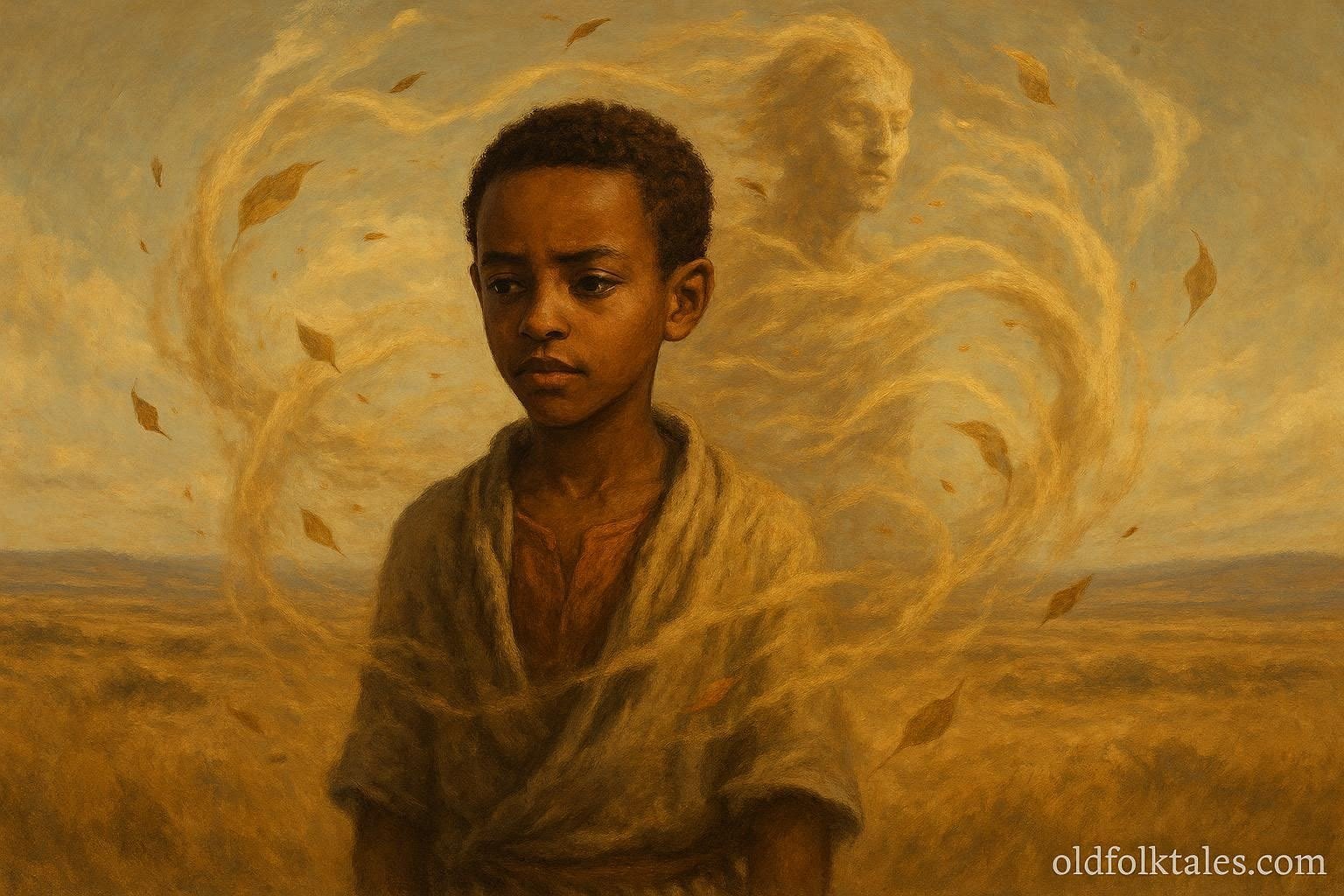
In the wide, sunlit plains and drylands of eastern Ethiopia, where the wind moved freely across open ground and carried whispers from one place to another, there lived a boy who often felt alone.
He was not without people.
Fascinated by this tale? Discover more North African folktales
There was a village, with its routines and its voices, its laughter and its labor. But the boy stood slightly apart from it all. While others gathered in groups, he wandered. While others spoke easily, he listened.
It was not that he wished to be alone.
It was simply how things had come to be.
He found comfort in quiet places, along the edges of the fields, beneath the shade of scattered trees, and on the open paths where the wind passed without obstruction.
It was there, one afternoon, that something changed.
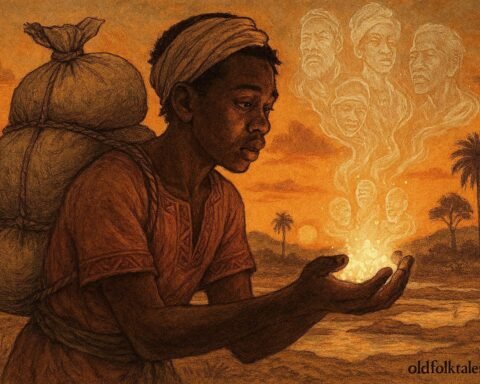
The boy sat on a low rise of ground, watching the grasses bend and sway as the wind moved through them. He had watched this many times before, but on this day, he spoke aloud.
“If you could hear me,” he said softly, “I would speak to you.”
The wind moved as it always did, steady, unseen, shaping the world without being seen itself.
But then,
Something shifted.
A change, slight but clear.
“I hear you.”
The boy’s breath caught.
He looked around, searching for the source of the voice. But there was no one.
“Do not look for me as you would another person,” the voice continued. “I am where I have always been.”
The boy stood slowly.
“The wind?” he asked.
“Yes.”
The answer came as a gentle movement through the air, brushing against his face.
For a moment, the boy did not speak.
He had felt the wind before, had watched it, had known its presence. But to hear it, to be answered, was something entirely different.
“You can speak?” he asked.
“I can be heard,” the wind replied.
The boy smiled slightly, a feeling of something new rising within him, not fear, but wonder.
“And you can hear me?” he asked.
“When you speak with attention,” the wind said, “I listen.”
From that day forward, the boy returned often to that place.
He spoke.
And the wind answered.
At first, their conversations were simple.
The boy spoke of his days, of what he saw, what he felt, what he wondered. The wind responded in ways that were not always direct, but always present, through movement, through sound, through words that seemed to rise and fall with the air itself.
In time, the bond between them grew.
“You move everywhere,” the boy said one day. “You see things beyond this place.”
“I pass through many lands,” the wind replied.
“Then you can carry messages,” the boy said.
“I can carry what is given to me,” the wind answered.
The boy thought carefully.
“There are people in the village who need to send words to those far away,” he said. “If I speak them to you, will you carry them?”
The wind moved around him, thoughtful.
“If the words are true and needed,” it said, “I will carry them.”
The boy nodded.
And so, he began.
He listened to the villagers, their concerns, their needs, their messages meant for others beyond their reach. He carried those words to the wind, speaking them clearly, carefully.
The wind carried them.
And in time, answers returned.
The village began to notice.
“How do these messages travel so quickly?” they asked.
The boy did not speak of the wind at first. But the results spoke for him.
Soon, he was trusted.
“Take this message,” one would say.
“Send word to them,” another would ask.
The boy accepted these tasks with care.
And the wind remained steady, carrying what was given, returning what was needed.
But the wind did more.
When food was scarce, it guided the boy toward places where it could be found, bending grasses, shifting dust, revealing what might otherwise remain hidden.
When danger approached, it moved differently, faster, sharper, warning the boy before others could see.
“You are not alone,” the wind said. “You are part of what moves.”
The boy felt it.
The loneliness that once followed him began to fade. He was no longer separate. He was connected, to something greater, something constant.
But as time passed, something else began to grow.
Not in the wind.
In the boy.
Confidence.
At first, it was quiet, a sense that he could help, that he could make a difference.
But slowly, it changed.
“If the wind listens to me,” he thought, “then I have power others do not.”
The thought settled.
And with it came a shift.
One day, instead of carrying a message that was needed, he spoke a message that served only himself.
“Tell them I am important,” he said to the wind. “Tell them they must listen to me.”
The wind moved, but more slowly.
“That is not a message of need,” it said.
“It is a message,” the boy replied.
The wind carried it.
The boy felt a brief satisfaction.
He began to do more.
He asked the wind to bring him food—not when it was needed, but when he simply wanted it.
He asked it to move things in ways that drew attention to himself.
“Let them see what I can do,” he said.
The wind responded, but each time, something felt different.
Less certain.
Less present.
“You use what is given for yourself,” the wind said one day.
“I use what I have,” the boy replied.
“There is a difference,” the wind answered.
But the boy did not listen as he once had.
He had grown used to being heard.
He had grown used to being followed.
And so, he continued.
Until one day—
The wind did not answer.
The boy stood in the open field, speaking as he always had.
“Carry this message,” he said.
Silence.
He waited.
Nothing.
He spoke again.
Still, nothing.
The air was still, not empty, but unchanged.
“The wind?” he called.
There was no reply.
The boy felt something shift within him, not sudden, but deep.
“The wind,” he said again, quieter now.
But the voice did not return.
The movement he had come to know so well felt distant, unreachable.
Days passed.
The boy returned again and again to the place where they had spoken.
But the wind remained silent.
Without it, the messages stopped.
The guidance faded.
The small signs he had once followed no longer appeared.
The villagers noticed.
“What has changed?” they asked.
The boy had no answer.
At last, he sat where he had first spoken to the wind.
Not with confidence.
But with reflection.
“I did not listen,” he said quietly.
The words were not directed outward.
They were spoken with understanding.
“I used what was given for myself,” he added.
The air remained still.
But something within the boy had changed.
He was no longer asking for power.
He was recognizing responsibility.
“I would do differently,” he said.
The moment passed.
And then,
A movement.
Light.
Gentle.
The wind returned, not as before, but as something careful.
“You have learned,” it said.
The boy looked up.
“I did not understand,” he replied.
“Understanding comes with experience,” the wind said.
The boy nodded.
“I will listen,” he said.
“And I will carry what is needed,” the wind answered.
From that day forward, their bond was different.
Not driven by desire, but by balance.
The boy spoke when it mattered.
The wind carried what was true.
And the village, though it did not always see the source, felt the change.
For the boy had learned what the wind had always known,
That power is not in being heard.
It is in knowing when and why to speak.
Don’t stop yet! See our complete East African folktales collection
Moral Lesson
Power must be used with responsibility and restraint. When we misuse what is given to us, we risk losing it, but through reflection, balance can be restored.
Knowledge Check
- How did the boy communicate with the wind in the folktale?
He spoke with focus and intention, and the wind responded when he listened carefully. - What benefits did the boy gain from his friendship with the wind?
He could send messages, find food, and receive warnings about danger. - Why did the wind stop responding to the boy?
Because he began to misuse its power for selfish purposes instead of helping others. - What lesson did the boy learn after losing the wind’s help?
He learned that power must be used responsibly and not for personal gain. - How did the wind return to the boy?
It returned after the boy reflected on his actions and showed understanding and restraint. - What is the main theme of “The Boy Who Befriended the Wind”?
The story teaches that power and connection require responsibility, respect, and balance.
Source: Drawn from Ethiopian oral traditions involving elemental forces, referenced in “Oral Literature of Ethiopia” (1970 approximate compilation period).
Cultural Origin: Oromo and Afar traditions