In a village set among the rolling highlands of Ethiopia, where the air carried the scent of roasted grain and earth warmed by the sun, there was a woman known for her grace in hosting.
Her home was often open.
Click here to discover more legendary tales from West Africa
People came not only for conversation, but for something deeper, for the gathering that brought hearts into one space.
They came for the coffee ceremony.
The bunna ceremony was more than the preparation of coffee. It was a rhythm, a process, a sacred unfolding. From the washing of the green beans to their roasting over open flame, from the careful grinding to the slow brewing in the jebena, each step carried meaning.
It was a time when words mattered.
When silence mattered.
When what was spoken settled into the air and into memory.
The woman understood this.
Or at least, she believed she did.
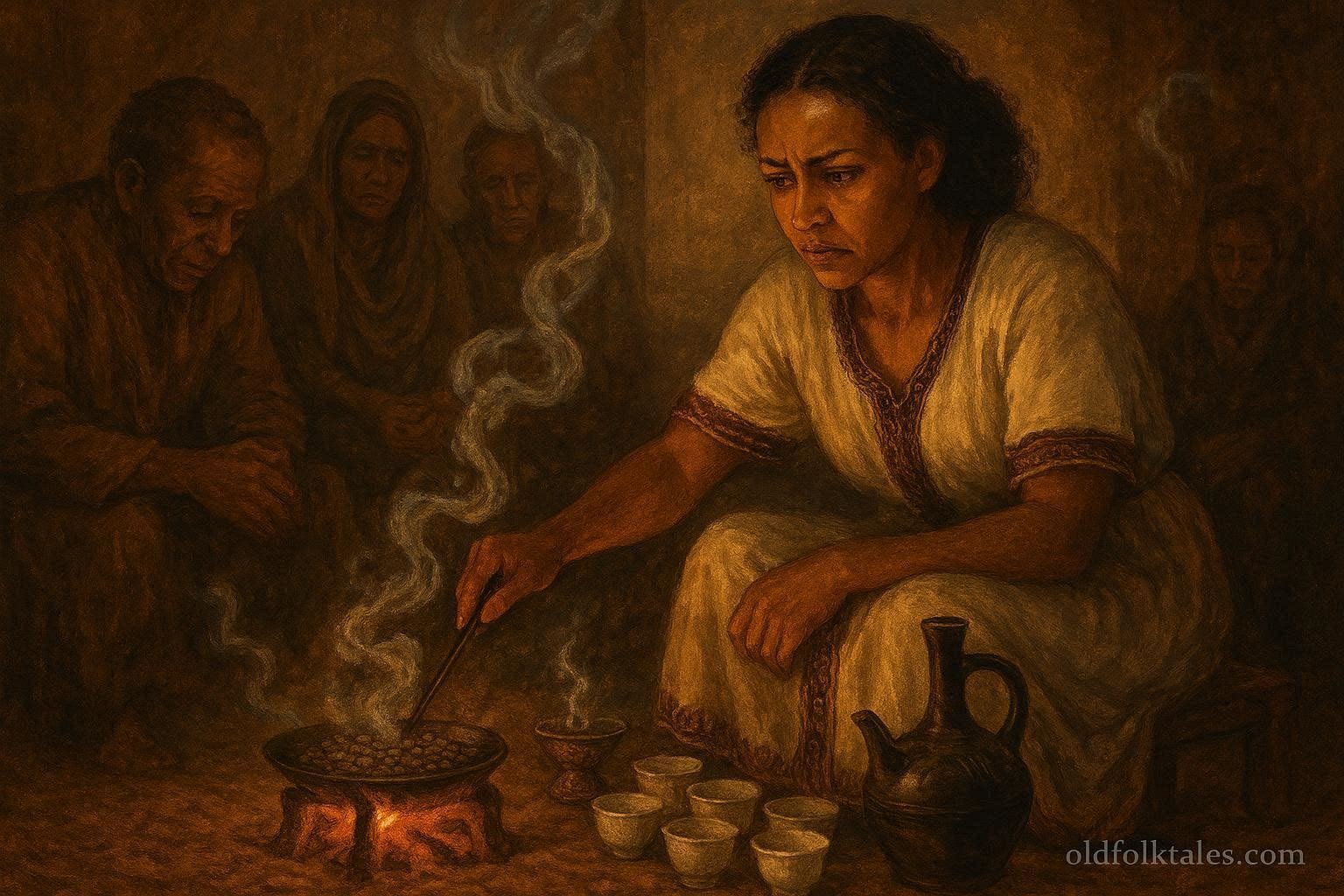
One afternoon, as the sun softened and the day began to slow, she prepared to host a gathering. Mats were laid. Incense was lit, its smoke rising in thin, curling lines. The green coffee beans were washed and set ready.
Neighbors arrived, greeting one another with warmth, taking their places as the ceremony began.
Among them was a close friend.
The two had known each other for many seasons. They had shared work, laughter, and quiet moments. But recently, something had shifted.
The friend had come with a request some days before.
“I need your help,” she had said. “When the time comes, will you stand with me?”
The woman had hesitated.
The request was not small. It would require effort, time, and commitment, things she was not certain she wanted to give.
But faced with her friend’s expectation, she had answered quickly.
“Yes,” she said. “You can trust me.”
The words had come easily.
Too easily.
Now, as the ceremony began, the memory of that promise lingered quietly in her mind.
She pushed it aside.
“This is not the time,” she thought.
The roasting began.
She placed the green beans in a flat pan over the fire, turning them carefully as their color changed. The sharp scent softened into something rich and familiar. Smoke rose, filling the space with the deep, unmistakable aroma of coffee.
The guests leaned in slightly, breathing it in.
“It smells strong today,” one said.
The woman smiled faintly.
“Yes,” she replied.
But as the beans cracked and darkened, something stirred within her.
A thought.
Unsettled.
“What you have spoken is not yet settled,” a quiet voice seemed to echo, not from outside, but from within.
She paused for a brief moment, then continued roasting.
The ceremony moved forward.
The beans were ground slowly, the rhythmic motion steady and deliberate. The sound filled the space, blending with low conversation.
The friend sat nearby, watching, her expression calm.
“You remember,” she said softly.
The woman looked up.
“Of course,” she replied quickly.
But her voice lacked the steadiness she intended.
The grinding continued.
Each turn of the stone seemed heavier than the last.
“You have said yes,” the voice within her returned. “But your heart has not followed.”
She tightened her grip slightly, pushing the thought away.
The brewing began.
Water was poured into the jebena, the ground coffee added with care. The pot was set over the fire, and the liquid within began to heat, to rise, to gather strength.
The ceremony had reached its most attentive stage.
This was the moment when silence often settled, when the presence of those gathered deepened.
The woman watched the jebena closely.
And then,
It rose too quickly.
The foam surged upward, spilling slightly before she could adjust.
A small thing.
But unusual.
“It is restless,” one guest observed.
The woman said nothing.
She lowered the heat, steadying the pot.
But her thoughts were no longer steady.
“What you hold within you does not align with what you have spoken,” the quiet voice returned.
She felt it now, not as a passing thought, but as something that would not be ignored.
The first round of coffee was poured.
Abol.
The cups were filled one by one, passed carefully to each guest.
This was the strongest cup, the beginning.
The woman handed a cup to her friend.
Their eyes met briefly.
“You will be there?” the friend asked.
The question was simple.
But it carried weight.
The woman hesitated, only for a moment.
“Yes,” she said again.
The word left her mouth.
But this time, it did not feel the same.
As the guests lifted their cups, a sudden bitterness cut through the aroma.
One person paused.
“It tastes… off,” they said.
Others nodded slightly.
The woman felt it too.
The coffee, though prepared with care, carried something different.
She said nothing, but her hands grew still.
The ceremony continued.
The second round was prepared.
Tona.
Lighter, gentler.
But as the process repeated, the same unease followed.
The roasting seemed uneven.
The grinding felt strained.
The brewing required more attention than usual.
“You are divided,” the quiet voice said.
She closed her eyes briefly.
“This is nothing,” she told herself.
But it was not nothing.
The second round was poured.
The guests drank.
Again, the taste was not as it should be.
The conversations grew quieter.
Not out of discomfort, but out of awareness.
Something was not aligned.
The friend set her cup down.
“You are not with me,” she said softly.
The woman looked at her.
The words settled between them.
The ceremony moved to its final stage.
Baraka.
The blessing.
This was the round that carried completion, the moment where what had been shared became something more.
The woman prepared it carefully.
But now, she could no longer ignore what had followed her through each stage.
The promise.
The words she had spoken without intention.
The weight they carried in this space.
As she poured the final cups, her hands slowed.
The room was quiet.
All eyes were not on her, but she felt seen.
Not by judgment.
But by truth.
She set the jebena down.
“I spoke without truth,” she said.
The words came plainly.
No decoration.
No defense.
“I said I would stand with you,” she continued, looking at her friend. “But I did not intend to.”
The silence held.
Then softened.
“I did not want to disappoint you,” she said. “But in trying to avoid that, I spoke what I could not carry.”
Her friend listened.
“You could have said no,” she replied gently.
“I know,” the woman said.
The weight in the room began to lift, not because the moment was easy, but because it was now clear.
“What will you do?” the friend asked.
The woman took a breath.
“I will speak truth,” she said. “Even when it is difficult.”
The final cups were taken.
This time, when the guests drank, the taste had changed.
It was not stronger.
Not sweeter.
But balanced.
As it should be.
The ceremony ended, not with perfection, but with alignment.
From that day forward, the woman hosted as she always had.
But she spoke differently.
She did not promise lightly.
She did not agree without intention.
For she had learned what the ceremony had shown her,
That words spoken in such spaces do not remain empty.
They take shape.
They reveal themselves.
And they return, until they are made true.
Looking for more? Explore the magic of East African folktales here
Moral Lesson
Promises made without intention carry consequences. Integrity requires that our words and actions align, especially in sacred and communal spaces.
Knowledge Check
- What is the significance of the coffee ceremony in the Ethiopian folktale?
It represents a sacred communal space where words, actions, and intentions carry deep meaning. - What mistake did the woman make during the story?
She made a promise she did not intend to keep, showing a lack of honesty. - How did the ceremony reflect her dishonesty?
Each stage of the ceremony became unsettled, and the coffee tasted off, symbolizing imbalance. - What role did the friend play in the story?
She reminded the woman of her promise and helped reveal the truth. - What changed after the woman confessed?
The atmosphere and the coffee became balanced again, reflecting restored honesty. - What is the main theme of “The Coffee Ceremony Promise”?
The story emphasizes integrity, truthfulness, and the importance of honoring one’s word.
Source: Inspired by cultural practices and storytelling motifs referenced in “Bunna: Ethiopian Coffee Ceremony Traditions” (2005).
Cultural Origin: Pan-Ethiopian, especially within Amhara and Oromo communities