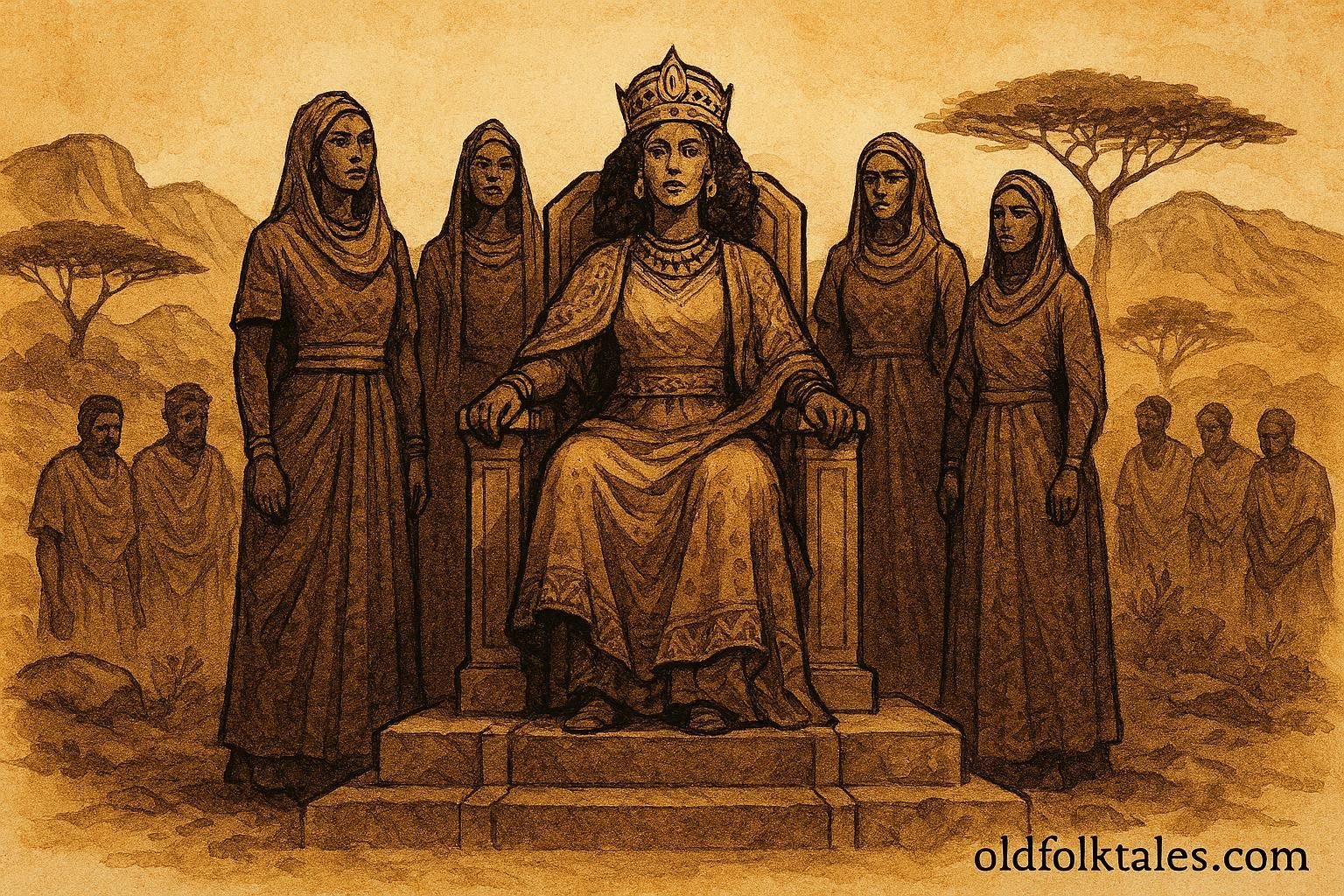
In the northern stretches of the Somali lands, where rocky hills rise from the earth and the wind carries stories across wide horizons, there once lived a woman whose name still echoes through generations, Araweelo.
Her story is not told in whispers like that of a monster in the bush. It is told with reflection, sometimes with pride, sometimes with caution. For Araweelo was not born feared, she became powerful.
Love this story? Discover our full Southern African folktales collection
And with power, she changed the world around her.
A Woman Who Saw Injustice
In those days, society was shaped by the strength and authority of men. They led, they decided, and they controlled the rhythms of daily life. Women labored, cared, and endured.
Araweelo was among these women.
She worked hard, as many did, but what set her apart was not just her strength, it was her awareness. She saw what others had grown used to. She noticed the imbalance in how decisions were made, how respect was given, and how voices were heard.
Where others accepted, she questioned.
Where others endured, she remembered.
The injustice she witnessed did not fade with time. It gathered within her, slowly shaping her thoughts, her resolve, and eventually, her actions.
The Rise of Araweelo
Araweelo began to speak.
At first, it was quietly, among other women, in shared moments of work and rest. She spoke of fairness, of dignity, of a world where women were not merely followers but equals.
Her words spread.
Women listened. Some hesitated, uncertain. Others felt something stir within them, a recognition of truth long unspoken.
Over time, Araweelo’s voice grew stronger, and so did her influence.
She did not remain a voice among many. She became a leader.
With determination and clarity, Araweelo organized the women. She united them not only through shared struggle but through a vision of change. A new order began to take shape, one where women would no longer live beneath the authority of men.
Eventually, Araweelo rose to power.
She became queen.
A New Order
Under Araweelo’s rule, the balance of society shifted.
Where once men had led, now women held authority. Decisions were made by women. Rules were enforced by women. The structure of daily life changed in visible and undeniable ways.
But Araweelo did not stop at equality.
Her rule became strict.
She imposed laws that limited the roles of men, placing them under the control of women. What had once been imbalance began to tilt in the opposite direction.
The reasoning, to her, was clear.
She had seen injustice. She had lived it. And now, she sought to ensure it would never happen again.
But in doing so, her rule began to mirror what it once opposed.
Power, when held without restraint, rarely stays balanced.
The Weight of Authority
At first, many women supported Araweelo fully. They saw her as a symbol of strength, a correction to generations of inequality.
And indeed, change had come.
But as time passed, the strictness of her rule began to weigh heavily, not only on men, but on the harmony of society itself.
Men, once dominant, now found themselves restricted, their voices diminished. Some accepted it in silence. Others grew restless.
Among the people, something subtle began to shift.
The question was no longer about justice, it became about balance.
Even among women, quiet concerns emerged. Was this the fairness they had hoped for? Or had justice transformed into something else?
Araweelo, however, remained firm.
She believed that strength was necessary to maintain the new order. To loosen her grip, she feared, would mean losing everything she had built.
The Rise of Resistance
Where there is pressure, resistance follows.
The men, once silent, began to find ways to challenge the system. Their resistance was not loud at first. It grew slowly, like embers beneath ash.
They observed. They waited. They looked for moments of weakness.
And as Araweelo’s rule grew more rigid, those moments began to appear.
The balance of society had been disrupted for too long. What had been built on correction had turned into control, and control rarely holds without opposition.
The tension became unavoidable.
The Fall of Araweelo
The exact moment of Araweelo’s fall is told in different ways across storytellers, but all agree on one truth, her rule did not last forever.
Resistance reached its peak.
The authority she had built began to crumble under the weight of opposition and imbalance. The system she created could not sustain itself against growing unrest.
Araweelo, once unchallenged, was confronted.
And in that confrontation, her reign came to an end.
What replaced it was not a return to the past, but something shaped by the lessons of both extremes.
A new balance.
After the Reign
In the years that followed, Araweelo’s story remained.
Not as a simple tale of right or wrong, but as a complex reflection of power, justice, and human nature.
She was remembered as strong, as visionary, as someone who refused to accept injustice.
But she was also remembered as a ruler whose response to imbalance created another.
Her story became a lesson carried across generations, not only about leadership, but about restraint.
Because power alone does not create fairness.
Balance does.
Don’t stop yet! See our complete East African folktales collection
Moral Lesson
Justice must be guided by balance, not driven by revenge. When power shifts without fairness, it risks repeating the very injustice it sought to correct.
Knowledge Check
- Who was Araweelo in Somali folklore?
Araweelo was a powerful queen who led a society where women ruled over men after experiencing injustice. - What motivated Araweelo to rise to power?
She was driven by the inequality and unfair treatment women faced in her society. - What was unique about Araweelo’s rule?
Her leadership reversed traditional gender roles, placing women in authority and limiting men’s roles. - Why did Araweelo’s reign face resistance?
Her strict and unbalanced rule created tension, leading to opposition from men and concerns within society. - What led to the fall of Araweelo?
Growing resistance and imbalance in society caused her authority to collapse. - What lesson does Araweelo’s story teach?
It teaches that justice must be balanced and that absolute power can lead to new forms of injustice.
Source: African folktale, Somalia.
Adapted from Somali Sultanate oral traditions (2002).
Cultural Origin: Northern Somali regions (Somaliland oral tradition)