Long ago in the central highlands of Madagascar, before modern cities and roads spread across the island, the Merina kingdoms were ruled by powerful nobles, respected elders, and warrior families whose histories lived through oral tradition. Villages stood among green hills and rice terraces while storytellers gathered beside evening fires to preserve the memory of kings, battles, spirits, and legendary heroes.
Among all the tales passed from generation to generation, few were as famous as the story of Ibonia.
His name traveled across the highlands for centuries because people believed he was no ordinary man.
According to ancient prophecy, Ibonia’s destiny was announced before his birth.
At that time, a respected noblewoman named Rasoa struggled with sorrow because she remained unable to bear a child. In the royal courts of the Merina people, children represented continuity, inheritance, and the future strength of noble families. Without an heir, uncertainty surrounded the household.
Rasoa sought guidance from healers, diviners, and spiritual elders throughout the kingdom.
One elderly diviner eventually delivered an astonishing prophecy.
“You will bear a son unlike any other,” the old woman declared. “His strength will challenge warriors, spirits, and even the forces of stone itself.”
Don’t miss out: Read more Southern African folktales
The prophecy spread quickly across neighboring communities.
Months later, Rasoa gave birth to a child under mysterious circumstances said to be accompanied by thunder and unusual winds across the hills. The boy received the name Ibonia.
From early childhood, people recognized something extraordinary about him.
Stories claimed he spoke boldly while still very young and displayed unusual intelligence and physical strength beyond his age. As he grew older, Ibonia trained constantly with spears, wrestling, horseback riding, and the traditions expected of future warriors.
But alongside admiration came fear.
Some elders worried the prophecy surrounding him would attract dangerous enemies.
Others believed supernatural forces already watched his destiny carefully.
As Ibonia reached adulthood, news of his abilities spread far beyond the Merina highlands. Rival rulers heard stories about the fearless young warrior whose strength seemed almost unnatural. Travelers described him defeating experienced fighters in public contests and surviving challenges that would have destroyed ordinary men.
Yet the greatest threat still waited ahead.
In a distant region beyond the hills ruled a terrifying supernatural being known as the Stone Man.
No one agreed completely about the creature’s origin.
Some believed he had once been human before dark spiritual forces transformed him. Others claimed he emerged directly from the mountains themselves. According to legend, his body possessed the hardness of stone, making weapons nearly useless against him.
The Stone Man ruled through fear.
Villages abandoned fertile lands to escape him, and travelers disappeared along roads crossing his territory. Chiefs who challenged him reportedly vanished without trace.
Worst of all, the Stone Man became obsessed with claiming power over noble families connected to ancient prophecy.
One season, during a period of regional unrest, the Stone Man attacked allies connected to Ibonia’s family and seized sacred possessions belonging to the household. The insult spread humiliation across the Merina court.
Many feared open confrontation would only bring destruction.
But Ibonia refused to remain silent.
“If fear rules the people,” he declared before the elders, “then no kingdom can stand with honor.”
Despite warnings from advisors and relatives, Ibonia prepared to confront the supernatural enemy himself.
Before leaving, his mother Rasoa spoke privately with him.
“Strength alone does not defeat darkness,” she warned. “You must also understand wisdom, patience, and the spirits that guide destiny.”
Ibonia listened carefully.
Then armed with spear, shield, and ceremonial charms, he began his journey beyond the highlands toward the territory of the Stone Man.
The journey itself tested him severely.
He crossed dense forests filled with dangerous animals and traveled through isolated villages abandoned after attacks by supernatural forces. Along the way, he encountered wandering elders, hunters, and spiritual guardians who offered guidance about the enemy he sought.
One old traveler delivered an important warning.
“The Stone Man cannot be defeated by anger alone,” he explained. “His strength grows stronger against those ruled by pride.”
The words remained in Ibonia’s mind as he continued traveling.
Finally, after many days, he reached the dark rocky hills where the Stone Man ruled.
The land itself seemed lifeless.
Trees stood twisted and broken while silence covered the valleys unnaturally. At the center of the territory rose a massive stone fortress built into the side of a mountain.
There, Ibonia finally encountered his enemy.
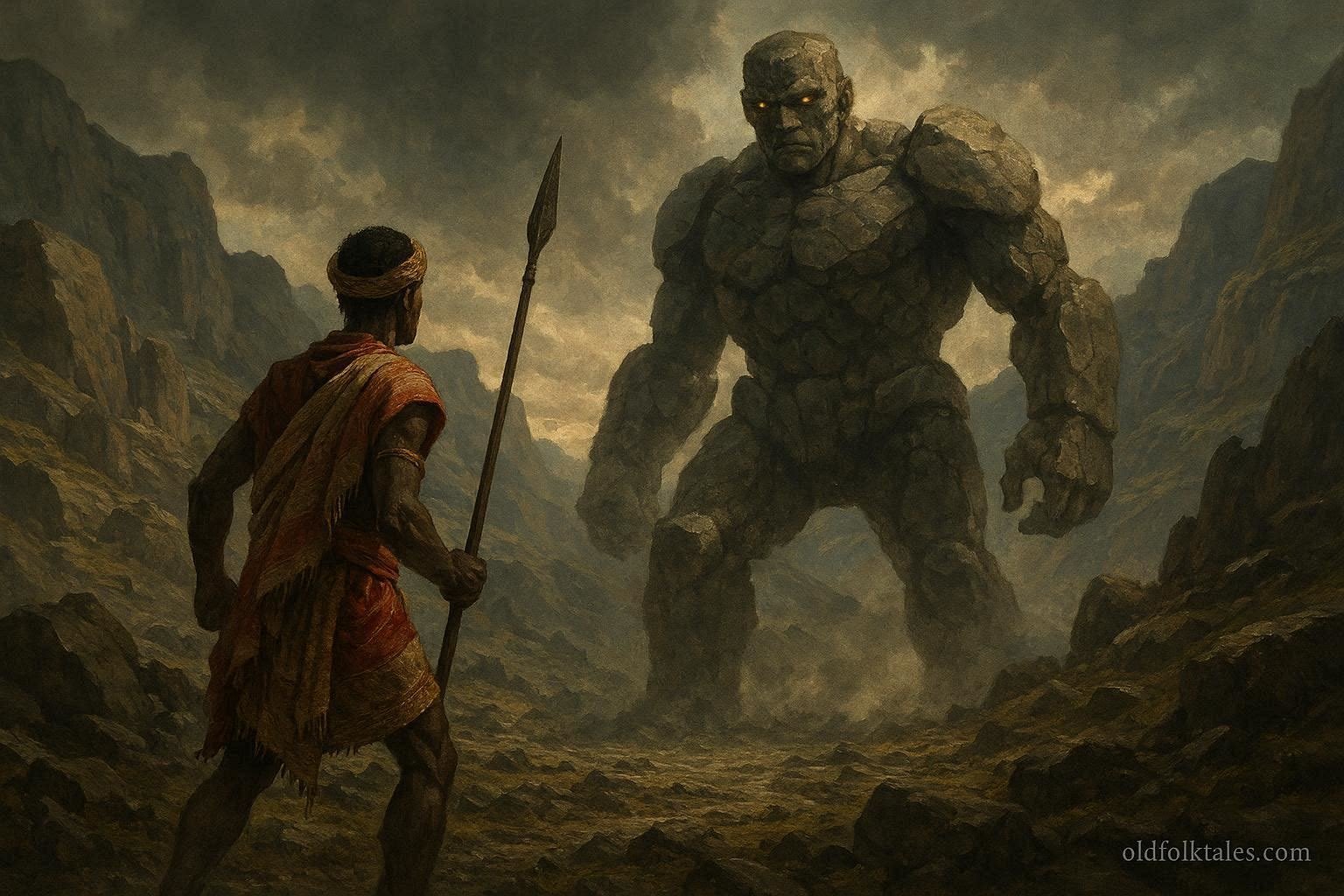
The Stone Man appeared enormous, with skin resembling cracked rock and eyes burning like fire beneath heavy shadows. His voice echoed across the cliffs when he laughed at the young warrior approaching alone.
“So this is the child of prophecy,” the creature mocked.
Ibonia stood fearlessly before him.
“I came to reclaim my family’s honor,” he answered.
The battle that followed became legendary throughout Madagascar.
Spears shattered against stone-like skin while the ground trembled beneath the force of their struggle. The Stone Man struck with terrifying strength, breaking rocks and trees during the fight.
At first, Ibonia’s attacks seemed useless.
But gradually, he remembered the warnings given during his journey.
Instead of relying only on physical force, he began studying the creature carefully. He noticed the Stone Man became reckless whenever anger controlled him.
So Ibonia changed his strategy.
He moved patiently, avoiding direct attacks while forcing the creature into frustration and exhaustion. The longer the battle continued, the more unstable the Stone Man became.
Finally, during a moment of uncontrolled rage, the creature exposed a hidden weakness beneath his chest where the stone covering appeared cracked.
Ibonia seized the opportunity immediately.
With a final powerful strike, he pierced the vulnerable place and defeated the supernatural enemy at last.
The Stone Man collapsed across the rocky hills, and silence returned to the valley.
News of Ibonia’s victory spread rapidly across the kingdoms.
Villages once trapped by fear reopened their roads. Families returned to abandoned lands. The sacred possessions taken from Ibonia’s household were restored, and his family’s honor returned stronger than before.
But beyond the victory itself, the people remembered something more important.
Ibonia had not succeeded through strength alone.
He triumphed because he combined courage with patience, wisdom, and discipline.
For generations afterward, storytellers across Madagascar continued repeating the epic of Ibonia and the Stone Man beside evening fires. His legend became a symbol of heroic perseverance and the belief that destiny favors those who balance power with wisdom.
And according to old tradition, the hills of Madagascar still remember the footsteps of the warrior child born through prophecy.
Don’t stop yet! See our complete East African folktales collection
Moral Lesson
True strength comes not only from power, but from wisdom, patience, and courage during adversity.
Knowledge Check
- Who was Ibonia?
Ibonia was a legendary hero from Madagascan oral tradition. - Why was Ibonia considered special?
A prophecy announced his greatness before his birth. - Who was the Stone Man?
He was a supernatural enemy feared across many regions. - Why did Ibonia confront the Stone Man?
He wanted to reclaim honor and protect his family and people. - How did Ibonia defeat the Stone Man?
He used patience, strategy, and courage instead of strength alone. - What lesson did people learn from Ibonia’s story?
Wisdom and perseverance are more powerful than anger and pride.
Source
Madagascan epic folklore. Adapted from Ibonia: Epic of Madagascar translated by Lee Haring (1994).