In a close-knit village nestled within the living landscapes of Madagascar, where the rhythm of daily life moved in harmony with the earth, the people shared more than space, they shared responsibility.
Each person’s actions mattered.
Click here to discover more legendary tales from West Africa
What one did could strengthen the whole or quietly weaken it. Trust was not written or enforced; it was lived. It moved through conversations, through shared labor, through the unspoken understanding that the community stood or fell together.
But like all human places, not everything was as it seemed.
There were truths that remained unspoken.
Small ones, buried in daily life. Larger ones, carried in silence. Some were harmless, others heavy. Yet the village continued, held together by a fragile but steady balance.
Until the drum arrived.
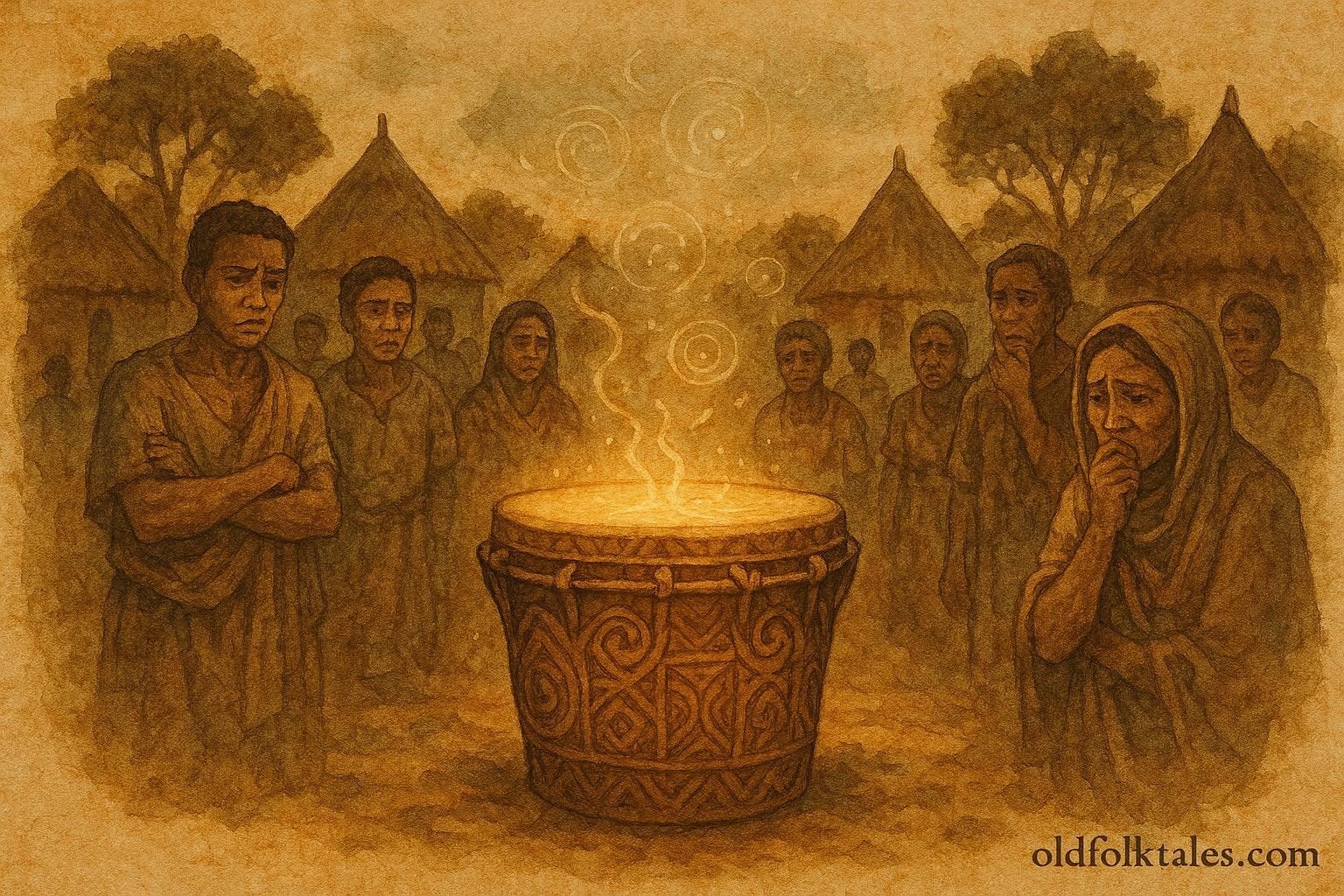
It came without noise, without warning, and without explanation. One day, it was simply there, a carved drum, resting at the center of the village, as though it had always belonged.
Its surface bore markings that seemed to shift depending on how one looked at them. Its presence felt… aware.
No one claimed it.
No one could explain it.
But the people, guided by curiosity and the deep cultural instinct to seek meaning, gathered around it.
At first, they approached with caution.
Then, someone struck it.
The sound that followed was unlike any drum they had ever heard. It did not simply echo, it spoke.
Not in riddles. Not in symbols.
In truth.
A truth so clear, so direct, that it left no space for denial.
The villagers fell silent.
At first, they tested it carefully. Questions were asked, simple ones, safe ones. And each time, the drum answered with unwavering honesty.
There was no hesitation.
No distortion.
No mercy.
Word spread quickly.
The drum did not lie.
And soon, its purpose began to take shape.
Where disputes once lingered unresolved, the drum brought clarity. When disagreements arose, people gathered and let the drum speak. It revealed what was hidden, corrected what was false, and settled matters with certainty.
Justice, which had once depended on memory and testimony, now felt immediate and undeniable.
The village changed.
There was relief at first.
No more guessing. No more uncertainty. The burden of proving truth was lifted. The drum carried it instead.
People began to rely on it.
Why struggle through conflict when the drum could decide? Why wrestle with doubt when the answer could be revealed instantly?
And so, the drum was struck more often.
Not just for disputes, but for questions.
Not just for justice, but for curiosity.
What had begun as a tool became something else.
A source of exposure.
Because truth does not limit itself.
It does not stop at what is convenient. It does not soften itself for comfort. It does not consider timing, or readiness, or consequence.
It simply is.
And soon, the drum began to reveal more than the village had expected.
Secrets, once buried, surfaced.
Quiet tensions, once ignored, were laid bare. Words spoken in private became known. Thoughts unshared found voice.
At first, people laughed nervously, brushing aside the discomfort.
But the laughter did not last.
Because truth, when revealed without care, does not always heal.
Sometimes, it wounds.
The village, once held together by balance, began to strain.
Trust, which had quietly supported their way of life, started to fracture. Not because truth is harmful, but because of how it was being used.
People began to fear the drum.
Conversations grew cautious. Silence replaced openness. The same tool that had once brought clarity now brought unease.
Where there had been community, there was now tension.
Because the drum did not know when to speak.
It did not know when truth needed time. It did not know when understanding should come before revelation. It did not know the difference between justice and harm.
It simply revealed.
And the people, in their reliance, had forgotten something important:
Truth is not just about what is said.
It is about how, when, and why it is revealed.
The realization came slowly, but it came.
The village began to see that while the drum was powerful, it was not wise. It could uncover truth, but it could not guide what to do with it.
And without that guidance, truth alone was not enough.
In fact, it could destroy the very thing it was meant to protect.
So, the people changed.
They did not reject the drum.
They did not silence it.
Instead, they stepped back.
They became more thoughtful.
They began to understand that not every truth needed to be exposed immediately. That some truths required care. That justice was not only about correctness, but about restoration.
The drum remained.
But it was no longer struck without intention.
When it was used, it was used with purpose, not curiosity. Not impulse. Not fear.
But wisdom.
The village, though changed, began to heal.
Trust returned, not because truth disappeared, but because it was handled differently. With patience. With understanding. With respect for both the facts and the people they affected.
And the drum?
It still spoke.
But now, it was part of something greater.
Not just truth.
But balance.
Continue your journey: Read more East African folktales
Moral Lesson
Truth alone is not enough. Without wisdom, timing, and compassion, even honesty can cause harm. True justice requires not just revealing the truth, but knowing how to use it to restore, not destroy.
Knowledge Check
- What is the main lesson in “The Drum That Spoke Only Truth”?
The story teaches that truth must be guided by wisdom, as honesty alone can cause harm if used carelessly. - What made the drum special in the Malagasy folktale?
The drum revealed absolute truth whenever it was beaten, without distortion or bias. - How did the drum initially help the village?
It brought clarity to disputes and ensured justice by revealing hidden truths. - Why did the drum begin to cause problems in the community?
It exposed secrets without consideration for timing or consequences, creating tension and mistrust. - What does the drum symbolize in the story?
The drum represents truth, powerful, neutral, and potentially harmful without wisdom. - How did the village restore balance?
They learned to use the drum thoughtfully, understanding that truth must be handled with care and intention.
Source: Inspired by justice-centered oral narratives in “Oral Literature in Africa” by Ruth Finnegan (1970)
Cultural Origin: Malagasy folklore, Madagascar