Across the open Somali plains, where dry winds sweep through thorn bushes and animals depend on sharp instincts to survive, stories are told to remind both children and adults that strength alone does not guarantee survival.
Among these stories is one about a greedy hyena and a small hare.
Fascinated by this tale? Discover more North African folktales
It is not a story of size or power.
It is a story of thinking.
The Hyena’s Hunger
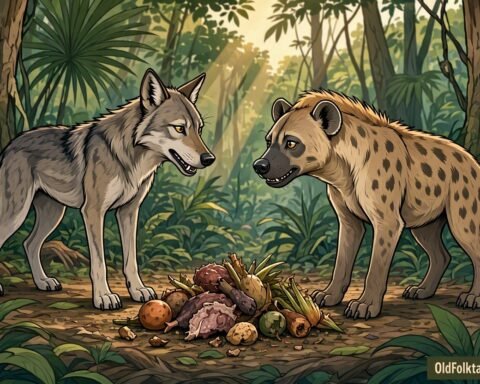
In the vast wilderness, a hyena wandered alone.
It was always hungry.
Not because food was absent, but because nothing ever seemed enough. Whatever it found, it wanted more. Whatever it had, it believed it could take better.
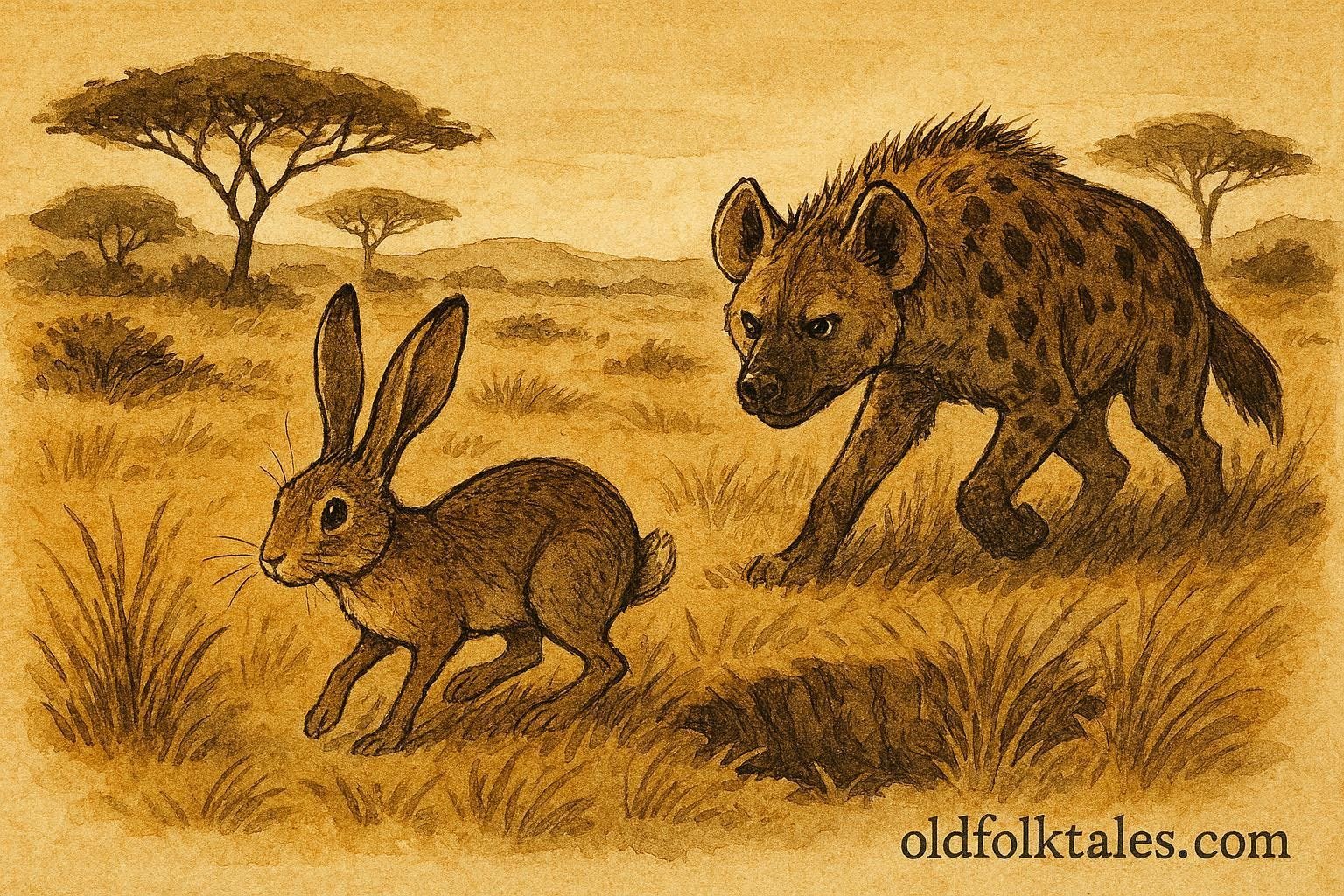
One day, while roaming near a patch of scrubland, the hyena spotted something small moving among the grass.
A hare.
Tiny. Quick. Alert.
The hyena licked its lips.
“This will be easy,” it thought.
But the hare had already seen it.
The First Encounter
The hyena approached slowly.
“Little one,” it called, trying to sound calm, “why are you alone?”
The hare paused.
It knew this voice. It had heard stories about it, voices that sounded friendly but meant harm.
“I am not alone,” the hare replied.
The hyena looked around.
There was no one.
It smirked.
“Where are your friends?” it asked.
The hare tilted its head slightly.
“They are nearby,” it said. “Very nearby.”
The hyena hesitated.
It did not like uncertainty.
“So many?” it asked.
“Yes,” said the hare calmly. “And they are very hungry too.”
The hyena looked around again.
The grass rustled in the wind. Shadows moved.
Its confidence weakened.
“I will return later,” it muttered.
And it left.
The Hyena Learns Nothing
But greed does not learn easily.
The next day, the hyena returned.
This time, it was more careful.
It found the hare again near the same area.
“Now,” the hyena said, “there will be no tricks.”
The hare was sitting quietly.
It looked up.
“You came back quickly,” it said.
The hyena frowned.
“I did not leave,” it lied.
The hare nodded as if it believed this.
“Then you must be very hungry,” it said gently.
The hyena stepped forward.
“I am always hungry,” it replied.
The hare sighed.
“That is unfortunate,” it said.
The hyena blinked.
“What do you mean?”
The hare pointed behind the hyena.
“Because you are standing on something that belongs to my people.”
The hyena turned quickly.
Nothing was there.
When it looked back, the hare had already moved closer to a bush.
It was gone.
The Third Trick
Now the hyena was angry.
It searched harder.
It watched more carefully.
And eventually, it found the hare again.
This time, it did not speak politely.
“I will not be fooled again,” the hyena growled.
The hare looked up from the grass.
“I hope not,” it said.
The hyena stepped closer.
“I will eat you today,” it declared.
The hare nodded slowly.
“That is what the last one said,” it replied.
The hyena froze.
“What last one?” it asked sharply.
The hare gestured vaguely toward the distance.
“The one who tried yesterday.”
The hyena narrowed its eyes.
“There was no one yesterday.”
The hare sighed.
“That is what you think,” it said.
Then it began to hop away slowly, as if uninterested.
The hyena followed.
It could not resist.
The Trap of Greed
The hare led the hyena through uneven ground, small dips, narrow paths, patches of thick grass.
The hyena became frustrated.
“Stop running!” it snapped.
“I am not running,” the hare called back. “I am simply going where I need to go.”
The hyena sped up.
But the more it rushed, the more it lost control of its steps.
The hare stayed just far enough ahead to remain visible.
Always just out of reach.
Until the terrain changed.
The ground became soft and uneven.
The hare stopped suddenly at the edge of a wide, shallow pit hidden beneath grass.
It turned.
“You are very fast,” it said to the hyena.
The hyena, breathing heavily, smiled.
“I will catch you now.”
The hare shook its head.
“No,” it said calmly.
“You will not.”
The Final Trick
The hyena lunged forward.
But the ground beneath it gave way.
It stumbled into the shallow pit, rolling awkwardly, surprised and embarrassed.
The hare stood at the edge, watching.
“You were hungry,” it said softly.
The hyena struggled to climb out.
“This is not over!” it growled.
The hare tilted its head.
“It is for today,” it replied.
Then it hopped away without rushing, without fear.
Just calm.
Just certain.
After the Encounter
The hyena eventually escaped the pit.
But it did not find the hare again.
Not that day.
Not the next.
Each time it returned to the area, it found nothing but empty grass and silence.
And slowly, something began to change in its mind.
Not wisdom.
But frustration.
Because the hare had not beaten it with strength.
It had beaten it with thinking.
Don’t stop yet! See our complete East African folktales collection
Moral Lesson
Greed blinds judgment, while intelligence and patience create survival. Strength alone cannot win against careful thinking and strategy.
Knowledge Check
- What is “The Foolish Hyena and the Clever Hare” about?
It is a Somali folktale about a greedy hyena repeatedly tricked by a clever hare. - How does the hare escape the hyena?
The hare uses wit, deception, and careful planning to stay ahead and avoid capture. - What does the hyena represent in the story?
The hyena represents greed, impatience, and overconfidence. - What key theme is shown through the hare’s actions?
Intelligence, patience, and strategy are stronger than physical power. - Why does the hyena keep failing?
Because its greed clouds its judgment, making it easy to manipulate. - What lesson does this Somali folktale teach?
It teaches that wit and patience are essential tools for survival against stronger opponents.
Source: African folktale, Somalia.
Adapted from Somali nomadic oral storytelling tradition (1993).
Cultural Origin: Somali nomadic oral storytelling tradition